

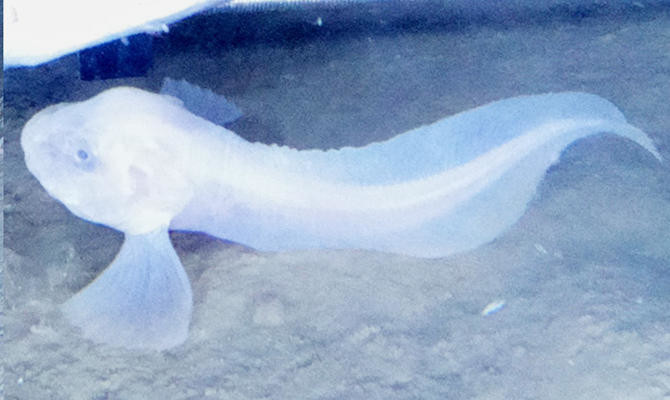

PARIS: Scientists have discovered three new species of “hardcore” fish living in one of the deepest parts of the ocean, the see-through, scale-free creatures perfectly adapted to conditions that would instantly kill most life on Earth.
An international team of researchers used state-of-the-art underwater cameras to find the new fish at the bottom of the Atacama Trench in the eastern Pacific Ocean at a depth of 7,500 meters (24,600 feet) — and were surprised at their abundance in such an inhospitable environment.
“These things are right on the limit of what all fish can take so you might expect at that depth you’d maybe be lucky to see one or two eking out an existence,” Alan Jamieson, senior lecturer in marine ecology at Newcastle University told AFP on Friday.
“But there’s a whole heap of them sitting there.”
Temporarily named the pink, blue and purple Atacama snailfish, the previously unknown creatures are 20-25 centimeters (8-10 inches) long, translucent and have no scales.
They appear to be uniquely adapted to conditions four-and-a-half miles beneath the ocean surface, where the days are permanently pitch black and water temperatures barely top two degrees Celsius (36 Farenheit).
At such depths, the pressure is so great that larger animals would be crushed under their own mass.
“It’s the equivalent of having an 800-kilogramme weight placed on your little finger,” Jamieson said.
Researchers believe the fish may have evolved to live on the sea floor to avoid larger prey.
“The hardest structures in their bodies are the bones in their inner ear, which give them balance, and their teeth,” said Thomas Linley, a Newcastle research associate who went on the expedition.
In fact, being made almost entirely of a gel-like substance, the fish would die without the crushing pressure holding them together.
“Their bodies are extremely fragile and melt rapidly when brought to the surface,” Linley said.
The Atacama Trench runs almost 6,000 kilometers along the west coast of South America and bottoms out at 8,000 meters.
Jamieson said the team’s discovery should give hope to researchers working to uncover new species in some of the least-explored corners of our planet.
“The finding of new species is not limited to small stuff in the mud or tiny jellyfish, here there are three species of fish about 20-25 cm long,” he said.
“The Atacama Trench is the same size as the Andes mountain range. If we can put a camera down and pick out three new species within a matter of days... these things are not rare — they are just out of reach.”
With over 300 known varieties of snailfish, Jamieson said it has adapted to a wide variety of conditions, some extremely tough to survive in.
“Most of them live at shallow levels — we even get them up the Tyne River in Newcastle. They’re an amazing family that has sort of evolved to fit every niche, every corner of the planet,” he said.
He nevertheless admitted to being impressed with the newly discovered varieties and their ability to thrive in some of the harshest environments on Earth.
“The water temperatures in these trenches are always less than 2C — that in itself is pretty hardcore, let alone slamming 800-bar pressure on it and hardly any food,” he said.


