


BEIJING: Any chemical weapons attack on Syria’s last opposition stronghold would lead to “consequences” for the regime in Damascus, French Foreign Minister Jean-Yves Le Drian warned in Beijing on Thursday.
Russia-backed regime forces have massed around Idlib in recent weeks, sparking fears of an imminent air and ground attack to retake the last major opposition bastion.
Speaking at a joint press conference with his Chinese counterpart Wang Yi, Le Drian said the use of chemical weapons in the assault would prompt a response from Paris.
 “France warns against the use of chemical weapons,” he said, calling it a “red line.”
The Assad regime has twice been targeted by US air and missile strikes after previous alleged chemical attacks, and US officials have in recent days said additional action would follow if Assad uses the banned weapons in opposition-held Idlib.
The US launched a missile strike on a Syrian air base in April 2017 after an alleged chemical attack in Idlib, while a second US-led strike, supported by the British and French militaries, took place in April this year.
Le Drian said any regime chemical attack in Idlib would “have the same consequences as we knew in April.”
UN chief Antonio Guterres on Wednesday warned Syria and its backers against a full-scale offensive in Idlib, saying it “must not be transformed into a bloodbath.”
Nerve gas
Throughout the seven-year war, Syrian regime forces have repeatedly been accused of targeting opposition-held areas with chemical attacks — mostly with chlorine but also with deadly sarin nerve gas.
The regime and Russia have consistently denied the accusations.
But international investigators have found that on at least three occasions the regime unleashed chemical weapons on civilians, while Daesh was also blamed for using mustard gas.
More than 360,000 people have been killed across Syria in seven years, a monitoring group said on Thursday.
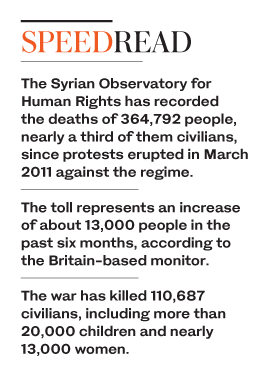
The Syrian Observatory for Human Rights said it had recorded the deaths of 364,792 people, nearly a third of them civilians, since protests erupted in March 2011 against Assad.
The toll represents an increase of about 13,000 people in the past six months, according to the Britain-based monitor, which uses a vast network of sources including fighters, officials and medical staff.
The war has killed 110,687 civilians, including more than 20,000 children and nearly 13,000 women.
More than 124,000 pro-regime fighters have died, about half of them pro-Assad troops and the rest an assortment of Syrian and foreign militiamen loyal to Assad.
Among them are 1,665 from Lebanon’s Hezbollah movement.
The Observatory recorded the deaths of 64,000 hard-line radicals and terrorists, including from Daesh and former Al-Qaeda affiliate factions.
Another 64,800 fighters from other forces, including non-extremist fighters, soldiers who defected and Kurdish factions, were also killed since 2011.
The Observatory said it had confirmed the deaths of another 250 people but could not specify their identities.


