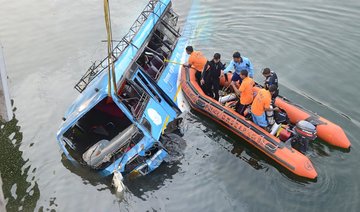
DUBAI: Poor maintenance has been blamed for a bridge collapse that has killed at least five people in south Calcutta, in the state of West Bengal in eastern India.
Images of the Majerhat road bridge show a broken section of the 40-year old highway that appears to be roughly 30 meters long.
Speaking to the Arab News, a Calcutta resident who did not wish to be identified said: “There is total pandemonium in the area with distraught bystanders present and rescue teams trying to manage the situation. This is hampering rescue operations.”
He added that the death toll was expected to rise, as rescue workers struggled to rescue any survivors.
“There is speculation that the maintenance work on many bridges in the city of Calcutta has not been regular,” he added. “The onus falls on the authorities. The Majerhat bridge is a case in point. The volume of heavy and light traffic over the bridge has increased over the years since it connects two parts of the city. This traffic has not been regulated or controlled. The number of cars plying over it has obviously increased and thousands commute daily over the bridge.”
Chief Minister Mamata Banerjee said the first priority was to rescue the injured and those who were trapped, according to a Press Trust of India report.
The bridge, that collapsed at around midday on Tuesday, was built in the late 70s, according to Calcutta resident Jason Pote.
“At that time, the area was not developed since the city had not witnessed the construction and residential boom then. This bridge was built for low-volume traffic. The gradual increase in traffic occurred with the construction of a free port area nearby. Port containers and other heavy cargo then began to move across this bridge at nights to be offloaded at other parts of the city. The lack of maintenance therefore made it an accident waiting to happen.”
Pote added that the crash “would affect a lot of people. The Majerhat bridge and a parallel bridge, the Durgapur Bridge, carry people from the developed areas to the central business districts of Calcutta.
“People will now find it tough to reach their destinations. There are very little options. The local police will be under pressure to regulate alternative traffic routes in a city which is renowned for traffic jams.
“There are six schools on the main road itself. So, from 8 a.m. - 8.30 a.m. there will be mayhem since it is school times. Each school has probably around 2,000 students and this is a conservative number. This means 10,000 passengers travelling daily in over 2,500-3,000 vehicles looking for alternative routes which will be affected.”
Arab News tried to contact Derek O’Brien, a member of Parliament and spokesman for the All-India Trinamool Congress, the ruling party in West Bengal, but was unable to get a comment.

Poor maintenance blamed for deadly Calcutta bridge collapse
- Dramatic footage captured on a security camera shows how a busy Calcutta street turned into carnage
- Chief Minister Mamata Banerjee said the first priority was to rescue the injured and those who were trapped
AI reshaping the battle over the narrative of Maduro’s US capture
- Since the US captured Venezuelan leader Nicolas Maduro in early January, pictures and videos chronicling the events have been crowded out by those generated with artificial intelligence
CARACAS: Since the US captured Venezuelan leader Nicolas Maduro in early January, pictures and videos chronicling the events have been crowded out by those generated with artificial intelligence, blurring the lines between fiction and reality.
The endless stream of content ranges from comedic memes to dramatic retellings.
In one, a courtroom illustration of Maduro in a New York courthouse springs to life and announces: “I consider myself a prisoner of war.”
In another, an AI-generated Maduro attempts to escape a US prison through an air duct, only to find himself in a courtroom with US President Donald Trump, where they dance with a judge and an FBI agent to a song by American rapper Ice Spice.
Maduro was captured alongside his wife Cilia Flores during US strikes in the Venezuelan capital of Caracas on January 3.
They have since been taken to a prison in New York where they are being held on drug trafficking charges.
While some have celebrated Maduro’s ouster, the “Chavismo” movement he leads — named after his predecessor Hugo Chavez — has worked to reframe what his fall means for Venezuela’s future.
- ‘ Confuse, combat, and silence’ -
Leon Hernandez, a researcher at Andres Bello Catholic University, told AFP that with AI’s rapid creation of content, we see development of “disinformation labs” that flood social media platforms.
“There were things that circulated that were not real during the capture (of Maduro), and things that circulated which were real that generated doubt,” Hernandez said.
“That was the idea: to create confusion and generate skepticism at the base level by distorting certain elements of real things.”
The goal, he added, is for the content to overwhelm audiences so they cannot follow it.
Even legacy media such as the Venezuelan VTV television channel are in on it, with the broadcaster playing an AI-animated video narrated by a child recounting Maduro’s capture.
“AI has become the new instrument of power for autocrats to confuse, combat, and silence dissent,” said Elena Block, a professor of political communication and strategy at the University of Queensland in Australia.
- ‘Greatest threat to democracy’ -
Block pointed out the use of cartoons, specifically, had been a medium of propaganda used in both authoritarian and democratic states.
Long before his arrest, Maduro was depicted as the illustrated superhero “Super Bigote” or “Super Mustache,” donning a Superman-like suit and fighting monsters like “extremists” and the “North American empire.”
The cartoon’s popularity spawned toys that have been carried by Maduro’s supporters during rallies advocating for his return.
And much like his predecessor, Maduro continued a practice of “media domination” to stave off traditional media outlets from airing criticism of Chavismo.
“With censorship and the disappearance or weakening of news media, social media has emerged as one of the only spaces for information,” Block said.
Maduro is not the only leader to use AI propaganda — Trump has frequently posted AI-generated pictures and videos of himself with “antagonistic, aggressive, and divisive language.”
“These digital and AI tools end up trivializing politics: you don’t explain it, you diminish it,” Block said. “AI today is the greatest threat to democracy.”
The endless stream of content ranges from comedic memes to dramatic retellings.
In one, a courtroom illustration of Maduro in a New York courthouse springs to life and announces: “I consider myself a prisoner of war.”
In another, an AI-generated Maduro attempts to escape a US prison through an air duct, only to find himself in a courtroom with US President Donald Trump, where they dance with a judge and an FBI agent to a song by American rapper Ice Spice.
Maduro was captured alongside his wife Cilia Flores during US strikes in the Venezuelan capital of Caracas on January 3.
They have since been taken to a prison in New York where they are being held on drug trafficking charges.
While some have celebrated Maduro’s ouster, the “Chavismo” movement he leads — named after his predecessor Hugo Chavez — has worked to reframe what his fall means for Venezuela’s future.
- ‘ Confuse, combat, and silence’ -
Leon Hernandez, a researcher at Andres Bello Catholic University, told AFP that with AI’s rapid creation of content, we see development of “disinformation labs” that flood social media platforms.
“There were things that circulated that were not real during the capture (of Maduro), and things that circulated which were real that generated doubt,” Hernandez said.
“That was the idea: to create confusion and generate skepticism at the base level by distorting certain elements of real things.”
The goal, he added, is for the content to overwhelm audiences so they cannot follow it.
Even legacy media such as the Venezuelan VTV television channel are in on it, with the broadcaster playing an AI-animated video narrated by a child recounting Maduro’s capture.
“AI has become the new instrument of power for autocrats to confuse, combat, and silence dissent,” said Elena Block, a professor of political communication and strategy at the University of Queensland in Australia.
- ‘Greatest threat to democracy’ -
Block pointed out the use of cartoons, specifically, had been a medium of propaganda used in both authoritarian and democratic states.
Long before his arrest, Maduro was depicted as the illustrated superhero “Super Bigote” or “Super Mustache,” donning a Superman-like suit and fighting monsters like “extremists” and the “North American empire.”
The cartoon’s popularity spawned toys that have been carried by Maduro’s supporters during rallies advocating for his return.
And much like his predecessor, Maduro continued a practice of “media domination” to stave off traditional media outlets from airing criticism of Chavismo.
“With censorship and the disappearance or weakening of news media, social media has emerged as one of the only spaces for information,” Block said.
Maduro is not the only leader to use AI propaganda — Trump has frequently posted AI-generated pictures and videos of himself with “antagonistic, aggressive, and divisive language.”
“These digital and AI tools end up trivializing politics: you don’t explain it, you diminish it,” Block said. “AI today is the greatest threat to democracy.”
© 2026 SAUDI RESEARCH & PUBLISHING COMPANY, All Rights Reserved And subject to Terms of Use Agreement.