JEDDAH: This city is famous for the Red Sea. Scuba diving is popular among Jeddawis and residents as the sea offers so much to explore, and divers in the city participate in the preservation of the sea’s marine environment.
The Vice President of the Environmental Affairs at the General Authority of Meteorology and Environmental Protection (GAMEP), Dr. Ahmed Al-Ansari, explained that the authority is working on a marine-friendly initiative under the Saudi Vision 2030, specifically the National Transformation Plan 2020.
“One of GAMEP’s initiatives for the National Transformation Plan is titled the Protection of Marine & Coastal Environment Initiative. We will have some sub-projects in this initiative that will take care of many things, including surveying of marine waste to determine its amounts and the best ways to deal with it,” he told Arab News.
The initiative will also aim to improve other things, such as our capabilities in continuous monitoring of our coastal and marine environments to prevent any possible pollution that may occur in the water bodies in Saudi Arabia, whether from point or non-point sources,” he added.
A diving center called Jeddah Pro Divers cooperates with many divers in the Red Sea area. Ehab Al-Jawi, the 45-year-old diving instructor and owner of the center, continuously coordinates with the diving community to ensure the preservation of the marine environment.
Jeddah Pro Divers is certified by the Professional Association of Diving Instructors (PADI), of which Al-Jawi is a member.
“In order to preserve the environment, we sometimes create many programs or activities to clean the Red Sea, whether it is on the beach or the corniche, and we have created many events, such as Earth Day 2010. There were specific activities for the groups,” Al-Jawi told Arab News.
He explained that Project AWARE created a program called Dive Against Debris, in which “we teach divers from the beginning how to collect garbage when they are diving and how to take it out of the water.”
PADI is affiliated with the nonprofit organization Project AWARE. Jeddah Pro Divers sends the collected ocean data to the nonprofit organization’s website, www.projectaware.org.
PADI member Nouf Al-Osaimi, the 30-year-old diving instructor at the Bay La Sun Marina Yacht Club at King Abdullah Economic City, also constantly participates in marine environment preservation.
Her heavy interest in the ocean began the first time she experienced diving in Sharm El-Sheikh, Egypt.
“I tried diving for the first time in Sharm El-Sheikh in 2008, and I fell in love with it. I began taking courses in 2009, and I have been diving for about nine years now,” Al-Osaimi told Arab News.
Al-Osaimi has been nominated by PADI as an AmbassaDiver.
As explained in PADI’s website, “PADI AmbassaDivers are selected representatives who have excelled within their field, inspiring others to start diving, keep diving or teach diving. They represent PADI values and help to inspire divers, ocean advocates and explorers across the globe.”
“I frequently participate in environmental awareness events, such as this year’s Earth Day. I explained the negative impact plastic has on the environment to people from a marine life creature’s standpoint,” Al-Osaimi told Arab News.
The AmbassaDiver cares deeply about marine life. “I participated in many shark awareness events,” she said. “Sharks are top of the food chain in the ocean. They are actually the creatures that clean the marine environment and preserve the environmental balance.
“Their existence is an indicator that the area is a healthy environment. You will know it is a healthy reef and sea. If an area does not have sharks, it is a very unhealthy marine environment. Just like humans: If there is a land without humans, it is not a healthy environment to live in.”
She explained that sharks are misunderstood creatures. “People fear them because of what is displayed in the media. It is my calling to educate people about sharks for people to know the significance of their presence in the ocean, and that they are not the monstrous creatures that we were brought up to believe they are.”
Al-Osaimi warns people that whatever is thrown in the ocean will come back to them.
“The plastic they throw in the ocean is ingested by marine creatures, which are our source of seafood.


![]()
![]()
![]()

Saudi divers to the rescue of the Red Sea environment

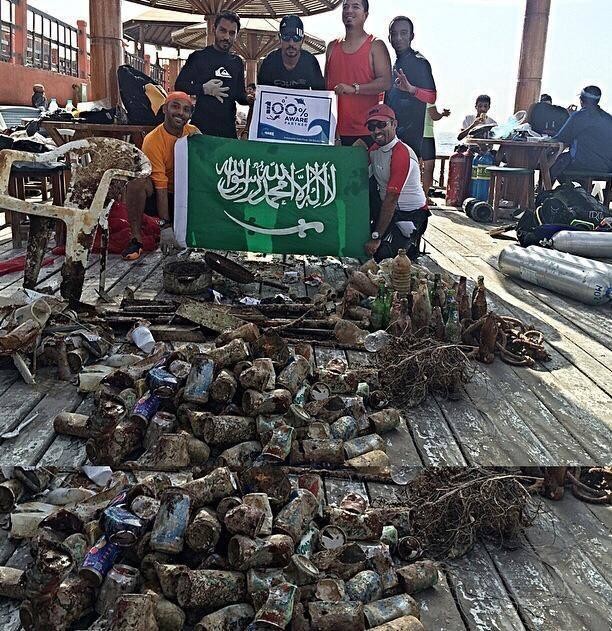
Saudi divers to the rescue of the Red Sea environment


Latest updates


© 2026 SAUDI RESEARCH & PUBLISHING COMPANY, All Rights Reserved And subject to Terms of Use Agreement.