

Sheep remains buyers’ top pick in KP for Eidul Adha

1 / 7
A man with his herd of sheep in Gulberg area of Peshawar Saddar. (AN photos)
2 / 7
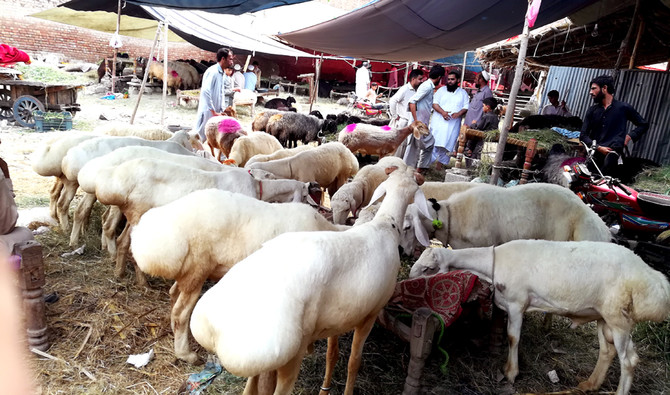
A sheep market near Bacha Khan Chowk in Peshawar. (AN photos)
3 / 7
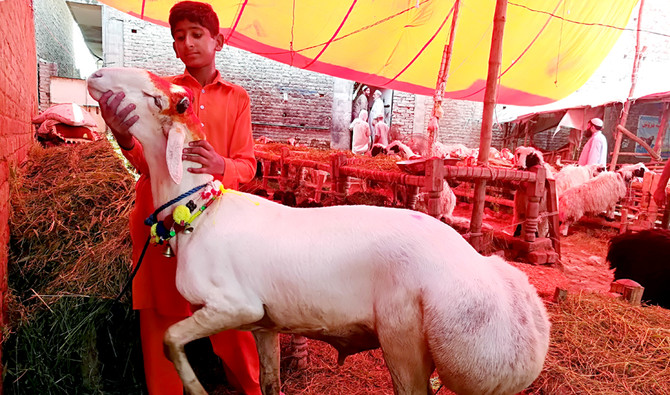
Aman Ullah, a trader, cleaning sheep to sell in a Peshawar market. (AN photos)
4 / 7
Buyer Aslam Khan (right) negotiating the price of a sheep with the owner (left) at a market in Peshawar. (AN photos)
5 / 7
A sheep on sale at Pajjagai Road market for 150,000 rupees. (AN photos)
6 / 7
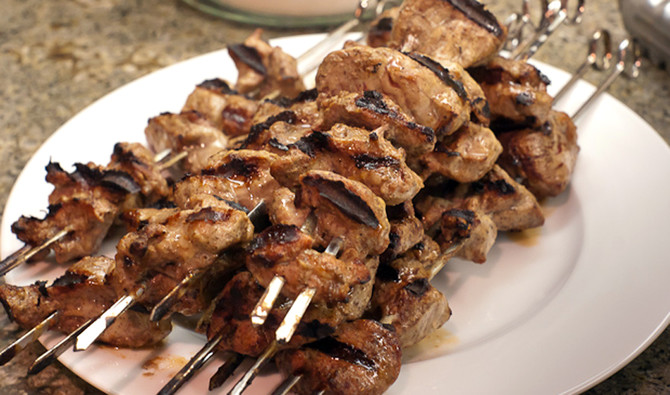
Tikkas, the popular Pashtun go-to dish (Internet images)
7 / 7
Tikkas, the popular Pashtun go-to dish (Internet images)
Updated 22 August 2018
Follow

Sheep remains buyers’ top pick in KP for Eidul Adha

  • A sheep can sell for as much as 150,000 rupees — around $1,200 — depending on the health and weight of the animal
  • Pashtuns, generally known as meat-lovers, have a distinct preference for lamb and sheep over goat

PESHAWAR: It is during the month leading up to Eidul Adha that the hustle-bustle of sales at sacrificial markets begins. Nearly 10 million animals are sacrificed in Pakistan every year on Eidul Adha, according to estimates.

While all of Pakistan is busy haggling over the prices of goats, cows, camels and sheep, in Khyber Pakhtunkhwa (KP), the buyer’s favorite is still sheep.
Aman Ullah, a sheep trader in KP’s capital city of Peshawar, told Arab News that the average price he gets for a sheep is about 25,000 rupees, although it can reach a staggering 150,000 rupees (app. $1200). The variation depends on the size and weight of the animal, he explained.
He said 70 percent of all animals sold in the market were sheep. Aman Ullah added: “Its meat is preferred for its distinct taste and the variety of cuisines it is used in, especially in the Pashtun society,” he added, explaining the reason behind the animal being the buyers’ top pick for Eid.
Aslam Khan, a buyer negotiating the price of a sheep at the cattle market, said he buys sheep for sacrifice every year. “There is a big difference in the quality of sheep meat and mutton. The meat is tender and more full of flavor,” he added.
Last-minute sales surge about 10 days before the first day of Eid up until the third day of the festival with an average of 10 sheep being sold a day, said Abdul Rehman, a trader at a sheep market near Shama Cinema in Peshawar.
“Most people buy large animals just a day or two before Eid in the city whereas smaller households cannot accommodate big animals like cows, buffaloes or camels, so the sale of sheep begins a month before Eidul Adha,” said Rehman.
“Sheep are smaller and can be accommodated easily. Parents prefer their children to acquaint themselves with the docile animal, to develop a bond to better understand the concept behind the sacrifice,” he added.
The markets in KP have two major kinds of sheep — ones imported from Afghan and locally raised breeds. Discussing both kinds, trader Ahmed Khan said that he had bought 30 sheep from Talagang area of Punjab to sell for Eid sacrifice.
“The sheep coming from Afghanistan are available for sale but at a lower price because customers prefer the local breed,” he said.
KP cuisine most closely resembles that of neighboring Afghanistan. Typically dishes include very few spices and are cooked with basic ingredients. Meat is generally cooked in its own juices and fat, with tomatoes and green chillies added for flavor. Celebrated dishes include the infamous chapli kabab, dumba karahi and namkeen tikka.
Waris Khan, proprietor of the Lala Azam Shinwari Tikka Karahi in Peshawar’s famous food street Namak Mandi, told Arab News that lamb can be cooked in a variety of ways. People, in KP and elsewhere, all enjoy lamb over mutton and beef — it is more tender and does not require many spices.
People in KP celebrate their culture and cuisine, said Khan, whether by preparing slow-cooked mutton over low flame with the meat and vegetables sealed in a clay pot covered with dough, or cooking a whole lamb with rice and vegetables stuffed inside its body.


Pakistan says defense pact with Saudi Arabia elevated brotherly ties to ‘new heights’

Updated 25 February 2026
Follow

Pakistan says defense pact with Saudi Arabia elevated brotherly ties to ‘new heights’

  • Pakistan, Saudi Arabia signed strategic defense pact last year pledging aggression against one will be treated as attack on both
  • Deputy PM Ishaq Dar says enduring bonds with Islamic and Arab nations form vital pillar of Pakistan’s foreign policy 

ISLAMABAD: Deputy Prime Minister Ishaq Dar said on Wednesday that Pakistan’s defense pact with Saudi Arabia elevated its brotherly ties with the Kingdom to “new heights,” stressing that close ties with Arab and Islamic nations form a key pillar of Islamabad’s foreign policy. 

Pakistan and Saudi Arabia signed a Strategic Mutual Defense Agreement on Sept. 17 last year, pledging that aggression against one country would be treated as an attack on both, enhancing joint deterrence and formalizing decades of military and security cooperation.

Both nations agreed in October 2025 to launch an economic cooperation framework to strengthen trade and investment ties. 

“In the Middle East, our landmark Strategic Mutual Defense Agreement with Saudi Arabia has elevated our brotherly ties to new heights,” Dar said while speaking at the Pakistan Governance Forum 2026 event in Islamabad. 

The Pakistani deputy prime minister was speaking on the topic “Navigating International Relations Amidst Changing Geo-Politics.”

Dar noted that Pakistan has reinforced partnerships with other Middle Eastern nations such as the UAE, Qatar, Jordan, Oman, Egypt and Bahrain. He said these partnerships have yielded “concrete agreements” in investment, agriculture, infrastructure, and energy sectors. 

“Our enduring bonds with Islamic and Arab nations form a vital pillar of our foreign policy, and we will continue to expand our partnerships across Asia, Latin America, and Africa,” he said. 

Dar pointed out that the presidents of Kazakhstan, Uzbekistan and Kyrgyzstan have undertaken visits to Pakistan in recent months, reflecting Central Asian nations’ desire to boost cooperation with Islamabad.

On South Asia, the Pakistani deputy PM said Pakistan has successfully transformed its fraternal ties with Bangladesh into “a substantive partnership.”

“Similarly, the trilateral mechanism involving China, Pakistan, and Bangladesh has been launched with a view to expanding and deepening regional cooperation and synergy,” the Pakistani minister said. 

He said Islamabad has strengthened its “all-weather” partnership with China via the second phase of the multi-billion-dollar China-Pakistan Economic Corridor agreement and “unwavering support” from both sides for each other’s core interests. 

Dar said Pakistan had also reinvigorated its partnership with the US, advancing cooperation in trade, technology, investment, and regional stability. 

“This calibrated approach has enhanced our ability to navigate complexity with skill and confidence, ensuring that our national interests are served without compromising our core foreign policy principles,” he said.