



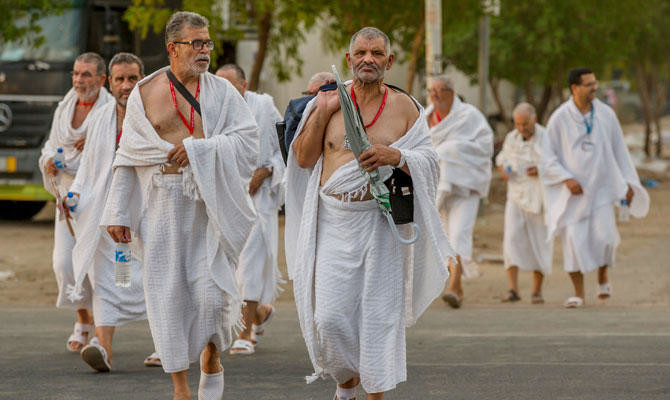


JEDDAH: More than two million Muslims from around the globe started the Hajj pilgrimage on Sunday in Makkah.
After spending the night in the massive valley of Mina, the pilgrims headed to Mount Arafat, some 20 kilometers (12 miles) east of Makkah, for the pinnacle of the pilgrimage. Around sunset, they will leave for Muzdalifa, nine kilometers west of Arafat.
In a cable to King Salman, Prince Abdul Aziz bin Saud bin Naif, minister of interior, who is also chairman of Hajj Higher Committee, congratulated the monarch on the safe, comfortable and easy arrival of pilgrims at the holy sites via the Kingdom’s air, land and sea inlets.
In his cable, he said the pilgrims benefited from the host of services and facilities made available as per Vision 2030.
The report said the number of pilgrims coming from outside amounted to 1,756,039: 930,030 are males, representing 53 percent, and 826,009 females, representing 47 percent.
Hajj Ministry
The operation to transport pilgrims from the holy city of Makkah to Mina went successfully, the Hajj Ministry said.
Abdulfattah Mashat, deputy minister of Hajj and Umrah, said: “17,000 busses were used to transport pilgrims from Makkah.”
Most pilgrims will leave the tented city in the morning on Monday for an emotional day on and around Jabal Rahmah, on Arafat’s great plain.
The ministry has also urged the pilgrims to follow the scheduled provided to them to avoid the dangers caused by overcrowding.
Public Prosecution
The Saudi Public Prosecution has recruited 174 of its employees to serve pilgrims at five supervisory offices and 33 other offices, said the attorney general, Sheikh Saud bin Abdullah Al-Muajab.
He added that the employees are to begin investigating in the holy places the cases referred to them by the concerned authorities, bring cases before the competent courts, manage detention units in the holy places, and oversee the implementation of court orders there.
Al-Muajab pointed out that the Saudi leadership gives great attention and care to the pilgrims to ensure their safety and comfort and provide them with advanced services that are in line with Vision 2030.
He referred to the role of security men in serving the pilgrims, stressing the importance of respecting and appreciating their roles as they ensure the safety of pilgrims.
“Assaulting security men, whether verbally or in any other form, is considered a breach of regulations and instructions, and the Public Prosecution will strictly take all necessary legal measures in such cases,” he said.
The attorney general warned that the Public Prosecution will not be lenient in cases against security, explaining that when an offender is arrested, the Public Prosecution will interrogate him and immediately take all necessary measures.
“If the case requires detaining a suspect, he will be detained immediately,” he added.
Hajj metro
The opening of the Al-Mashaaer Al-Mugaddassah Metro Project (MMMP) in 2010 introduced a new means of transport for pilgrims in the Kingdom.
The MMMP (South Line) links the southeast of Arafat and southwest of Mina through Muzdalifah. The trains pass through three stations in each of Arafat, Muzdalifah and Mina. The track stretches over roughly 20 kilometers and the driverless trains run at speeds between 80-120 kph.
The project includes nine overground stations, each with a 300-meter long platform that can be accessed by pilgrims via specific routes to the waiting areas under the stations, each of which can accommodate more than 3,000 people.
During this year’s pilgrimage season, the service is expected to transport 350,000 pilgrims over the course of seven days, running a total of over 1,000 journeys on its 17 air-conditioned trains, in which each carriage accommodates 300 pilgrims.
Facilities
The Department of Mobility Services at the Grand Mosque in Makkah has allocated 10,000 regular vehicles and 700 electric cars for the use of elderly and infirm pilgrims, or those with special needs, to help them perform their rites more easily.
The department oversees the electric vehicle operation at the Grand Mosque and has a number of staff available to answer pilgrims’ queries.
Hajj cleanup
Malaysia’s Pilgrim Fund Board, Tabung Hajji, will lead a large-scale cleanup operation in Makkah during Hajj, in collaboration with Saudi’s pilgrim-management body, the Southeast Asia Muassasah Tawafa.
Syed Saleh Syed Abdul Rahman, the head of this year’s Malaysian Hajj Delegation Mission, told Arab News that this is the first time Tabung Hajji has collaborated with the Southeast Asia Muassasah Tawafa to implement a cleanliness campaign on such an “organized and large scale.”
He said the campaign would “be executed on Dul Hijjah 11, 12 and 13 in Mina at around 8 o’clock in the morning,” adding that the cleanup operation will involve all Malaysian Hajj pilgrims, Malaysian Hajj Delegation Mission personnel and representatives from the Southeast Asia Muassasah Tawafa.


