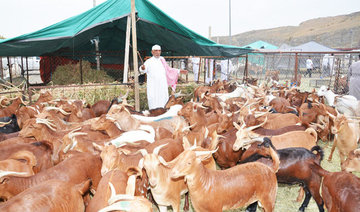
PESHAWAR: The provincial government in Khyber Pakhtunkhwa has launched a crackdown on the illegal transport of cattle to Afghanistan, in an attempt to control the rising price of livestock in local markets in the run-up to Eid Al-Adha.
Teams have been sent to the Takhta Beg checkpoint in the Jamrud subdivision of the tribal district to prevent the smuggling of animals, said Syed Masoom Ali Shah, director of the KP Directorate of Livestock and Diary Development.
“The ban on cattle transportation is not new; it had been enforced by the federal government since September 2013,” he added. “But some people still managed to smuggle cattle to Afghanistan through less-frequented routes in the Tirah and Shalman valleys in KP tribal district.”
Dost Muhammad Khan, the chief Minister of KP, on Monday ordered a ban on export of cattle and foodstuffs to Afghanistan from KP, because it was causing shortages and price increases for people in the province, given the high demand during Eid Al-Adha.
The livestock directorate has also set up nine teams to regularly spray animals at cattle markets to prevent the spread of Congo virus.
“In Peshawar alone there are about seven cattle markets and our mobile teams regularly visit and spray the animals at all the markets,” said Shah.
Afghanistan exports sheep to Pakistan but KP supplies buffaloes and cows to Afghanistan, he added.
“For the sheep transported to Pakistan from Afghanistan, we have our experts who check the animals’ health and then allow their transportation into Pakistan,” he explained.
Arbab Saadullah Khan, the owner of Kala Mandi, a major cattle market in Peshawar, welcomed the government crackdown.
“It will definitely lower cattle prices in Peshawar and other parts of KP,” said Khan, a former member of the National Assembly. Most of the cattle in his market come from Multan, Bahawalpur, Gujranwala and other locations in Punjab. “Most of the cattle markets in KP, including Peshawar, receive livestock from Punjab,” he added.
Niaz Muhammad, assistant commissioner of the Landikotal subdivision of Khyber tribal district, said that cattle smuggling had been curbed at the border with fencing.
“Border routes in Shalman and Tirah, through which the cattle used to be smuggled to Afghanistan, have been fenced,” he said. “In the wake of a recent directive by the KP chief minister, the surveillance of these routes has been further strengthened through the paramilitary FC (Frontier Corps) personnel deployed there now.”
Cattle that are seized are often sold at auction because smugglers are usually unable to afford the fines that are imposed, said Muhammad.
Behramand Khan, a spokesman for the KP chief minister, said that the provincial government has directed all divisional commissioners and tribal district deputy commissioners to closely monitor the borders with Afghanistan to prevent smuggling of cattle.
“The KP chief minister himself is monitoring the issue and has asked the deputy commissioners, particularly of those of the tribal districts bordering Afghanistan, to update him on daily basis,” he added.

KP government bans transport of cattle to Afghanistan ahead of Eid Al-Adha
- In a crackdown on the smuggling of cattle to Afghanistan, authorities in Khyber Pakhtunkhwa have dispatched teams to monitor less-frequented routes in the Shalman and Tirah areas
- The provincial government ordered a ban on the transport of cattle and and food to Afghanistan, which has caused scarcity and price increases for local people
Chinese group plans up to $1.3 billion investment in Pakistan’s industrial complex, says official
- Shandong Xinxu eyes $800 million for shipbuilding and $540 million for broader maritime complex
- The project aims to turn Pakistan’s Port Qasim into regional hub for heavy industry and logistics
KARACHI: China’s Shandong Xinxu Group is planning to invest as much as $1.34 billion to build an integrated maritime industrial complex (IMIC) at Pakistan’s second-largest port in southern commercial capital Karachi, a senior official familiar with the project told Arab News on Tuesday.
IMIC is the government’s flagship initiative to modernize industrial operations through upgrading port infrastructure, establishing shipbuilding and recycling facilities as well as an integrated steel mill at Port Qasim, which houses the Qasim International Container Terminal of DP World.
“They have shown interest in investing an estimated $1.34 billion overall in the IMIC project,” said a maritime affairs ministry official on condition of anonymity since the project’s modalities are still being discussed.
The planned investment, if materialized soon would augur well for Pakistan’s economy which has stabilized with the help of a $7 billion International Monetary Fund’s loan but desperately awaits dollar inflows especially on account of foreign direct investment (FDI) and exports, which according to official data, dropped 43 percent to $808 million in July-Dec.FY26 and 7 percent to $18.2 billion in July-Jan. FY26 period, respectively.
Shandong Xinxu Group Corporation Ltd. is a global manufacturer specializing in green battery manufacturing, nuclear power equipment, environmental protection products and other industrial solutions.
“The Chinese plan to invest about $800 million in shipbuilding and $540 million in the rest of the IMIC or sea-to-steel project,” said the official, referring to the government’s initiative to integrate ship recycling with domestic steel production, adding that the amount of investment was contingent upon the establishment of a 300,000-ton furnace oil plant at Port Qasim.
In Nov. 2025, Prime Minister Shehbaz Sharif’s government announced new initiatives including Pakistan’s first green ship repair and recycling yard to be established under the sea-to-steel IMIC project. IMIC will also support the revival of Pakistan Steel Mills (PSM).
Pakistan’s government has long been in talks with Russia for the revival of PSM that has been dormant since June 2015 due to financial losses and technical issues.
Muhammad Arshad, public relations officer at the maritime affairs ministry, said the Chinese were keen to invest in Pakistan’s port infrastructure, though he said the exact amount was not clear at the moment.
Shandong Xinxu Group, in a previous meeting with Pakistan’s maritime authorities, had estimated the project cost between €1 billion ($1.18 billion) and €2 billion ($2.37 billion), according to a ministry statement on Dec. 18.
“The Chinese group has been asked to submit a detailed proposal as soon as possible,” Arshad told Arab News when contacted.
The Chinese, once all the modalities are finalized, will build a shipbuilding and ship maintenance facility at Port Qasim and use the leftover steel from shipbuilding and recycling at PSM.
“They are expected to submit a comprehensive unsolicited feasibility study that would include financial impact assessments, structural and hydrographic analyzes and quantitative risk evaluations,” he said.
Pakistan plans to build a $100 billion blue economy by 2047, develop three new deep-sea ports and AI-enabled maritime industrial complexes, expand shipping fleet, manufacture vessels and achieve 100 percent green digital ports with multimodal connectivity under its Maritime Century (2047-2147) initiative.
Explaining the project, Arshad said one of IMIC’s core components was the revival and upgradation of Port Qasim’s iron ore and coal berth jetty, which has been abandoned for many years.
“The jetty once revived would be used for the recycling and repair of vessels, with the resulting scrap used to revive the Steel Mills,” the official said.
The IMIC project is envisaged to connect ship recycling with domestic steel production to cut the cash-strapped nation’s reliance on imported raw materials and leverage recyclable scrap.
Once approved, IMIC would rank among Pakistan’s largest recent maritime and industrial investments, turning Port Qasim into a regional hub for heavy industry and logistics.