

Pakistan defends its economic partnership with China

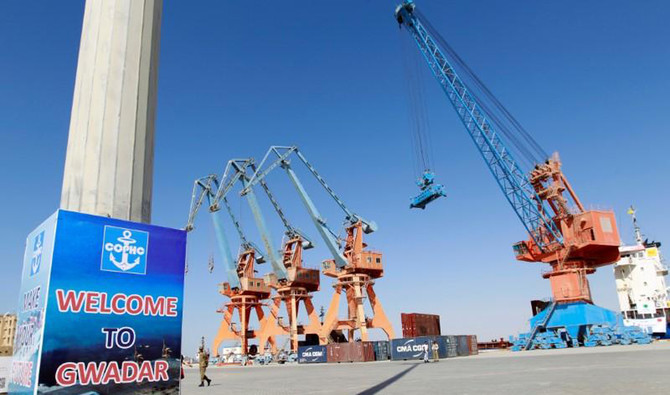
A general view of China Pakistan Economic Corridor (CPEC) port in Gwadar, Pakistan. (REUTERS/file)
Updated 08 August 2018
Follow

Pakistan defends its economic partnership with China

  • CPEC is an ambitious plan by Beijing to build infrastructure in Pakistan, mainly energy and transport
  • China's financial largesse, in the form of the Belt and Road project, has raised concerns over the vulnerability of poorer nations to such massive debt

ISLAMABAD: Pakistan Wednesday defended its economic partnership with China, amid fears that the terms of opaque multi-billion dollar investments by Beijing could be exacerbating Islamabad's economic woes as it considers a fresh IMF bailout.

"We have noted recent media reports questioning the viability of China Pakistan Economic Corridor (CPEC), claiming that it would create an unbearable debt burden for Pakistan," the government said in a statement issued to the media.

"Such media reports are often one-sided, distort facts, and are based on irresponsible statements by individuals who either have no understanding of CPEC or are driven by ulterior motives," the statement continued.

CPEC is an ambitious plan by Beijing to build infrastructure in Pakistan, mainly energy and transport, connecting the western Chinese region of Xinjiang with the Arabian Sea.

It is part of China's massive "Belt and Road" initiative seeking to revive ancient trade routes through a massive rail and maritime network via $1 trillion in investments across Asia and Europe.

But the opaqueness of the CPEC terms has led to concerns as Pakistan faces a looming balance-of-payments crisis, with analysts saying it will need to take urgent action, potentially seeking a bailout from the International Monetary Fund (IMF).

"It is because of the favourable financing arrangements that Pakistan opted for Chinese investment under CPEC," said the statement, issued under the caretaker administration currently running the country pending the formation of a new coalition government by election winner Imran Khan.

"China stepped forward to support Pakistan's development at a time when foreign investment had dried up, and economic activity was being crippled by energy shortages and infrastructure gaps," it said, calling CPEC a "win-win".

Chinese energy companies have "raised funds from Chinese banks and investors", and these do not constitute any debt obligation on Pakistan, the statement said.

"CPEC projects are financed through a composite financing package comprising long-term government-to-government concessional and preferential loans, as well as grants from the government of China. Repayments on these loans would not commence in the immediate future," it added.

The details come after US Secretary of State Mike Pompeo voiced concerns in July over any IMF bailout being used to repay Islamabad's debts to China, with whom Washington is engaged in a trade war.

On Tuesday Pakistan's likely future finance minister Asad Umar announced that the decision on a possible IMF loan would be taken by "the end of September".

"There is a general perception that we have picked up very expensive loans from the Chinese. I personally don't think so," he told reporters in Islamabad.

"They are like most commercial loans," he said, denouncing the "lack of transparency" by the previous government on the subject.

China's financial largesse, in the form of the Belt and Road project, has raised concerns over the vulnerability of poorer nations to such massive debt.

Last year Sri Lanka was forced to hand over majority control of its Hambantota port to China after being unable to repay its loans.


Pakistan highlights economic reforms at Davos, eyes cooperation in AI, IT and minerals

Updated 21 January 2026
Follow

Pakistan highlights economic reforms at Davos, eyes cooperation in AI, IT and minerals

  • Prime Minister Shehbaz Sharif speaks at breakfast event in Davos at sidelines of World Economic Forum summit
  • Pakistan, rich in gold, copper reserves, has sought cooperation with China, US, Gulf countries in its mineral sector

ISLAMABAD: Prime Minister Shehbaz Sharif highlighted Pakistan’s recent economic reforms during the sidelines of the ongoing World Economic Forum (WEF) summit in Davos on Wednesday, saying that his country was eyeing greater cooperation in mines and minerals, information technology, cryptocurrency and artificial intelligence with other states. 

The Pakistani prime minister was speaking at the Pakistan Pavilion in Davos on the sidelines of the WEF summit at a breakfast event. Sharif arrived in Switzerland on Tuesday to attend the 56th annual meeting of the WEF, which brings together global business leaders, policymakers and politicians to speak on social, economic and political challenges. 

Pakistan has recently undertaken several economic reforms, which include removing subsidies on energy and food, privatization of loss-making state-owned enterprises and expanding its tax base. Islamabad took the measures as part of reforms it agreed with the International Monetary Fund (IMF) in exchange for a financial bailout package. 

“We are now into mines and minerals business in a big way,” Sharif said at the event. “We have signed agreements with American companies and Chinese companies.”

Islamabad has sought to attract foreign investment in its critical minerals sector in recent months. In April 2025, Pakistan hosted an international minerals summit where top companies and government officials from the US, Saudi Arabia, China, Türkiye, the UK, Azerbaijan, and other nations attended.

Pakistan is rich in gold, copper and lithium reserves as well as other minerals, yet its mineral sector contributes only 3.2 percent to the countrys GDP and 0.1 percent to global exports, according to official figures.

Sharif said Pakistan has been blessed with infinite natural resources which are buried in its mountains in the northern Gilgit-Baltistan, Khyber Pakhtunkhwa, Azad Kashmir and southwestern Balochistan regions. 

“But we have now decided to go forward at lightning speed,” he said. “And we are also moving speedily in the field of crypto, AI, IT.”

He said the government’s fiscal and economic measures have reduced inflation from nearly 30 percent a few years ago to single-digit figures, adding that its tax-to-GDP ratio had also increased from 9 to 10.5 percent. 

The prime minister admitted Pakistan’s exports face different kinds of challenges collectively, saying the country’s social indicators needed to improve. 

“But the way forward is very clear: that Pakistan has to have an export-led growth,” he said. 

SHARIF MEETS IMF MANAGING DIRECTOR

Separately, Sharif met IMF Managing Director Kristalina Georgieva on improvements in Pakistan’s macroeconomic indicators, efforts toward stability and progress on institutional reforms, a statement from Sharif’s office said.

He emphasized Pakistan’s commitment to fiscal discipline, revenue mobilization and sustainable development, it added. 

The IMF managing director acknowledged and appreciated Pakistan’s reform efforts, the Prime Minister’s Office (PMO) said.

“Both sides exchanged views on the global economic outlook, challenges facing emerging economies, and the importance of multilateral cooperation in safeguarding economic stability,” the PMO said.