



BUDAPEST, Hungary: While Europeans are experiencing a rare but increasingly typical heatwave this summer, for Arabs it is business as usual. Every year, Middle Easterners complain about the weather, but then brush it off as they fan themselves while reaching for a plate of freshly cut fruit.
As temperatures in Europe soar, the continent is feeling the heat in places as far north as the Arctic Circle, with temperatures at least 10 degrees Celsius above average, and as far south as the Amalfi Coast and Iberian Peninsula, with record-breaking temperatures exceeding 35 degrees.
This week, a supermarket in Helsinki opened its doors for one night and had 100 shoppers sleeping in its aisles as temperatures hit 30 degrees.
Temperatures were expected to peak on Tuesday in France, Portugal, Spain, Germany, the Netherlands, the UK and eastern Europe. More than a million children returned to school on Monday in three German states, but some were allowed to go home earlier than planned due to the heatwave as temperatures are expected to spike midweek to about 39 degrees.
People are heading to beaches and pools to cool down, but to no avail. With the long summer days and short nights, the heat lingers throughout the evening. 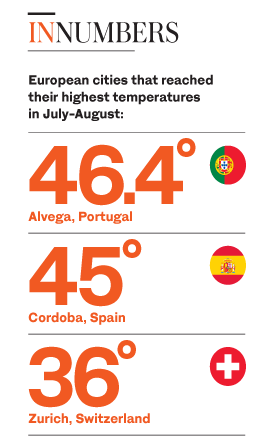
The summer of 2018 looks set to be one of the hottest on record. In the first week of August, areas in southeast Portugal and southwest Spain has temperatures of 47 degrees, higher than most Middle Eastern cities.
While heatwaves have forced many countries around the world to issue states of emergency, residents of the Middle East are no strangers to scorching summers.
Saudi Arabia, Kuwait and the other Gulf states have grown accustomed to the heat. As Manar Saud, a head administrator based in Riyadh, put it (one might say coolly): “There’s no real advice that could be given to our European neighbors. We’ve just become immune and no one is complaining.”
Many Gulf residents prefer to stay indoors or cool off in air-conditioned malls, cafes and homes, a luxury not found in many European cities, where homes are designed to conserve heat in the long winter months and air-conditioning units are rare.
Hala Radwan, a marketing consultant in Riyadh and Jeddah, has experienced a few hot summers while studying at Grenoble University in France. “The best advice I’d give would be to hydrate, hydrate, hydrate. Starting off with a cold shower in the morning, a glass of cold water and snacking on water-based fruits and vegetables like watermelon and cucumbers throughout the day will regulate your internal temperature,” Radwan said.
“Sleeping with an ice pack under the pillow and with a light bed sheet or a light throw helps as well. Europeans don’t use ACs, but with a fan and light sheets, nights are tolerable.”
“Carrying light bags or purses and wearing light materials help with feeling airy and light,” said Maha Nasef, a life coach based in Jeddah and the US. “Having a water spray or misting fan while drinking cool beverages throughout the day helps with relieving the heat. We’re used to having air-conditioning units on everywhere in Saudi. It’s different in the US.”
Moudhi Sameer, a 30-year-old Kuwaiti ESL instructor, said that eating a breakfast infused with hot green chili helps to cool her down. The evaporation of sweat cools the body, a trick she learned during a trip to India.
Saudi beauty blogger Heyam Omar has seen her fair share of heatwaves while in Chicago. “I never leave home without my fan or a high-SPF sun screen,” she said. The blogger also offers tips on how to stay fresh-faced and cool this summer.
“I drink cool drinks and fan myself all through my outing. We walk everywhere just as Europeans do, ride the buses and trains to move around. But as soon as I feel the heat getting to me, I stop whatever I’m doing and head to the nearest building away from the sun to cool down.”
Arabs for years have designed their homes to deal with the heat of the region. Long before air-conditioning units were developed, residents of the Western Region built homes several floors high to accommodate several rooms with the family sleeping quarters at the top. Windows covered with wooden lattices, known as “rawasheen” or “shanasheel,” helped the air flow throughout the house and keep it cool.
My late aunt once explained how our family home in Makkah was designed long before there were any electrical appliances and the typical household units we have now. The family slept in Al-mabeet, or sleeping quarters, with an adjoining Al-kharja, or open balcony, where a mosquito net tied to the walls created a canopy around the mattresses.
“My mother, siblings and I wet the mosquito nets every night in summer,” Um Mohammed told me. “Mosquitoes were common in Makkah during summer. The net wasn’t only to protect us, but also cooled us down as the breeze passed through Al-mabeet.”
If there is one lesson Arabs can teach about enduring heatwaves, it’s that it can be done. But one thing is certain: It’s going to be a long, hot summer.
Anyone up for a gelato?




