Dozens of wildfires rage in Sweden amid Nordic heat wave

1 / 4
Fire burns in Karbole, Sweden, on July 15, 2018. (AFP)
2 / 4
Smoke rises after a wildfire swept through the large forest area in Pyh'ranta, Finland, Wednesday July 18, 2018. (AP)
3 / 4
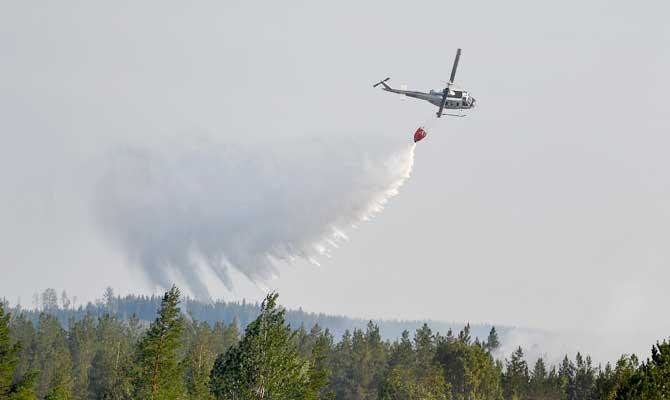
An aircraft helps to stop the advancing wildfire near to homes, outside Ljusdal, Sweden, Tuesday July 17, 2018. (AP)
4 / 4
An aerial view of the wildfire outside Ljusdal, Sweden, July 18, 2018. (REUTERS)
Updated 19 July 2018
Follow

Dozens of wildfires rage in Sweden amid Nordic heat wave

  • Thousands of people have been warned to remain inside with the windows shut to avoid breathing smoky air

HELSINKI: Sweden says it has mobilized all available resources to put out dozens of wildfires raging across the country.
The Swedish Civil Contingencies Agency said Wednesday that two Canadair CL-415 water-bombing planes on loan from Italy joined the firefighting efforts that included helicopters from Norway.
Swedish public broadcaster SVT says an estimated 40 wildfires are burning mostly in Sweden, mostly in the central and western parts of the country, but also in the Arctic north.
Thousands of people have been warned to remain inside with the windows shut to avoid breathing smoky air.
The Nordic region of Europe has experienced an intense heat wave in the past week. Temperatures reached over 32 degrees Celsius (90 F) throughout Finland, Norway and Sweden. The weather also has been dry.


NATO wants ‘automated’ defenses along borders with Russia: German general

Updated 24 January 2026
Follow

NATO wants ‘automated’ defenses along borders with Russia: German general

  • That zone would act as a defensive buffer before any enemy forces advanced into “a sort of hot zone,” said Lowin
  • The AI-guided system would reinforce existing NATO weapons and deployed forces, the general said

FRANKFURT: NATO is moving to boost its defenses along European borders with Russia by creating an AI-assisted “automated zone” not reliant on human ground forces, a German general said in comments published Saturday.
That zone would act as a defensive buffer before any enemy forces advanced into “a sort of hot zone” where traditional combat could happen, said General Thomas Lowin, NATO’s deputy chief of staff for operations.
He was speaking to the German Sunday newspaper Welt am Sonntag.
The automated area would have sensors to detect enemy forces and activate defenses such as drones, semi-autonomous combat vehicles, land-based robots, as well as automatic air defenses and anti-missile systems, Lowin said.
He added, however, that any decision to use lethal weapons would “always be under human responsibility.”
The sensors — located “on the ground, in space, in cyberspace and in the air” — would cover an area of several thousand kilometers (miles) and detect enemy movements or deployment of weapons, and inform “all NATO countries in real time,” he said.
The AI-guided system would reinforce existing NATO weapons and deployed forces, the general said.
The German newspaper reported that there were test programs in Poland and Romania trying out the proposed capabilities, and all of NATO should be working to make the system operational by the end of 2027.
NATO’s European members are stepping up preparedness out of concern that Russia — whose economy is on a war footing because of its conflict in Ukraine — could seek to further expand, into EU territory.
Poland is about to sign a contract for “the biggest anti-drone system in Europe,” its defense minister, Wladyslaw Kosiniak-Kamysz, told the Gazeta Wyborcza daily.
Kosiniak-Kamysz did not say how much the deal, involving “different types of weaponry,” would cost, nor which consortium would ink the contract at the end of January.
He said it was being made to respond to “an urgent operational demand.”