SYDNEY: Australia Thursday vowed to “vehemently” oppose a new push by Japan to undermine a global moratorium on commercial whaling, and urged like-minded nations to stand firm against Tokyo.
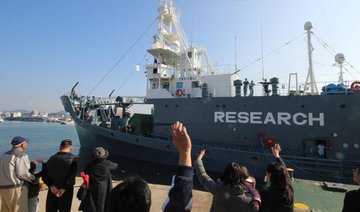
Japan has regularly sought an easing of the International Whaling Commission’s (IWC) prohibition on commercial whaling and continues to kill the animals under what it calls a “scientific research” program despite international criticism.
At September’s IWC meeting in Brazil, Tokyo has said it plans to “propose setting a catch quota for species whose stocks are recognized as healthy by the IWC scientific committee.”
Australian Foreign Minister Julie Bishop said she was concerned by the proposal.
“We strongly support the 30-year global moratorium on commercial whaling and will vehemently oppose any attempts to undermine the processes that support it,” she said.
This included “through changed voting regimes or the establishment of catch-limits for commercial whaling.”
“At the commission meeting in September, Australia will be calling on like-minded nations to reject Japan’s proposal,” she added.
Hideki Moronuki, an official in charge of whaling at Japan’s fisheries agency, said in June the proposal would not specify which whale species and how many mammals Japan wants to hunt.
But he said the IWC classifies several species as no longer depleted.
Japan also plans measures to change the body’s decision-making process, lowering the threshold for proposals to pass from three quarters of members to half.
Tokyo claims its “scientific research” is necessary to prove whale populations are large enough to sustain a return to commercial hunting, but Bishop said this was not correct.
“The science is clear, you do not need to kill whales in order to study them,” she said.
Japan makes no secret of the fact that meat from the expeditions ends up on dinner tables, despite a significant decline in the popularity of whale meat.
During its most recent annual whale hunt, Japan reported it caught 333 minkes, 122 of which were pregnant, sparking outrage among conservationists.
Japanese officials said the high rate of pregnant whales showed the strength of the minke population.

Australia to ‘vehemently’ oppose Japan push to ease whaling ban
- Japan has regularly sought an easing of the International Whaling Commission’s prohibition on commercial whaling and continues to kill the animals
- ‘The science is clear, you do not need to kill whales in order to study them’
UN’s top court opens Myanmar Rohingya genocide case
- The Gambia filed a case against Myanmar at the UN’s top court in 2019
- Verdict expected to impact Israel’s genocide case over war on Gaza
DHAKA: The International Court of Justice on Monday opened a landmark case accusing Myanmar of genocide against its mostly Muslim Rohingya minority.
The Gambia filed a case against Myanmar at the UN’s top court in 2019, two years after a military offensive forced hundreds of thousands of Rohingya from their homes into neighboring Bangladesh.
The hearings will last three weeks and conclude on Jan. 29.
“The ICJ must secure justice for the persecuted Rohingya. This process should not take much longer, as we all know that justice delayed is justice denied,” said Asma Begum, who has been living in the Kutupalong refugee camp in Bangladesh’s Cox’s Bazar district since 2017.
A mostly Muslim ethnic minority, the Rohingya have lived for centuries in Myanmar’s western Rakhine state but were stripped of their citizenship in the 1980s and have faced systemic persecution ever since.
In 2017 alone, some 750,000 of them fled military atrocities and crossed to Bangladesh, in what the UN has called a textbook case of ethnic cleansing by Myanmar.
Today, about 1.3 million Rohingya shelter in 33 camps in Cox’s Bazar, turning the coastal district into the world’s largest refugee settlement.
“We experienced horrific acts such as arson, killings and rape in 2017, and fled to Bangladesh,” Begum told Arab News.
“I believe the ICJ verdict will pave the way for our repatriation to our homeland. The world should not forget us.”
A UN fact-finding mission has concluded that the Myanmar 2017 offensive included “genocidal acts” — an accusation rejected by Myanmar, which said it was a “clearance operation” against militants.
Now, there is hope for justice and a new future for those who have been displaced for years.
“We also have the right to live with dignity. I want to return to my homeland and live the rest of my life in my ancestral land. My children will reconnect with their roots and be able to build their own future,” said Syed Ahmed, who fled Myanmar in 2017 and has since been raising his four children in the Kutupalong camp.
“Despite the delay, I am optimistic that the perpetrators will be held accountable through the ICJ verdict. It will set a strong precedent for the world.”
The Myanmar trial is the first genocide case in more than a decade to be taken up by the ICJ. The outcome will also impact the genocide case that Israel is facing over its war on Gaza.
“The momentum of this case at the ICJ will send a strong message to all those (places) around the world where crimes against humanity have been committed,” Nur Khan, a Bangladeshi lawyer and human rights activist, told Arab News.
“The ICJ will play a significant role in ensuring justice regarding accusations of genocide in other parts of the world, such as the genocide and crimes against humanity committed by Israel against the people of Gaza.”