HONOLULU: In an emotional and solemn ceremony, the remains of dozens of presumed casualties from the Korean War were we escorted by military honor guards onto US soil on Wednesday, 65 years after an armistice ended the conflict and weeks after President Donald Trump received a commitment from North Korean leader Kim Jong Un for their return.
The US military believes the bones are those of US servicemen and potentially servicemen from other United Nations member countries who fought alongside the US on behalf of South Korea during the war. What is expected to be an exhaustive analysis and identification process will soon begin.
“Some have called the Korean War the ‘forgotten war.’ But today, we prove these heroes were never forgotten,” Vice President Mike Pence said at a ceremony welcoming the remains, which were flown from South Korea earlier in the day. “Today, our boys are coming home.”
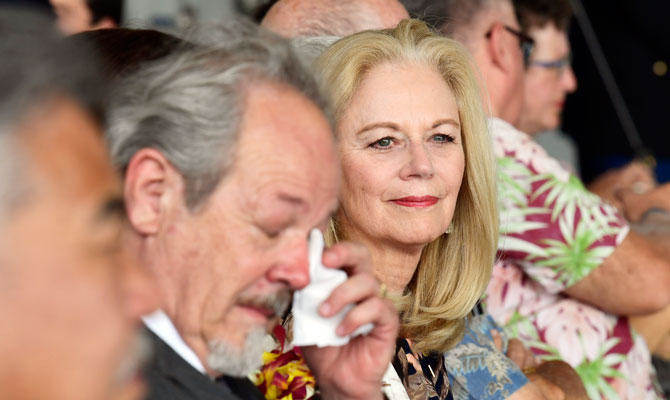
Each container was accompanied by one Marine, one sailor, one soldier and one airman. They set them gently on risers lined up inside the hangar as Pence stood watching with his hand over his heart. Adm. Phil Davidson, commander of the US Indo-Pacific Command, saluted. Some of the invited guests wiped tears from their eyes during the procession of the containers off the planes.
Sixteen other United Nations member countries fought alongside US service members on behalf of South Korea. Some of them, including Australia, Belgium, France and the Philippines, have yet to recover some of their war dead from North Korea.
Defense Secretary Jim Mattis has said some remains could turn out to be those of missing from other nations. He said last week that the return was a positive step but not a guarantee that the bones are American.
“Whosoever emerges from these aircraft today begins a new season of hope for the families of our missing fallen,” Pence said. “Hope that those who are lost will yet be found. Hope that after so many years of questions, they will have closure.”
North Korea handed over the remains last week. A US military plane made a rare trip into North Korea to retrieve the 55 cases.
Hanwell Kaakimaka’s uncle, John Kaakimaka, is among those who never came home.
“We’ve been watching the news, and we’ve been hopeful that my uncle is among the remains,” he said, adding that it could bring his family some closure.
His uncle, who was from Honolulu, was a corporal in the 31st Infantry Regiment of the Army’s 7th Infantry Division. He went missing on or about Dec. 2, 1950.
Hanwell Kaakimaka said the story he heard from his dad was that his uncle was injured and was being brought back from the front when Chinese troops overran the area and attacked the convoy.
The Kaakimaka family provided DNA samples to the US military’s Defense POW/MIA Accounting Agency over a decade ago, hoping officials would be able to make a match.
The agency identifies remains of servicemen killed in past conflicts. It typically uses bones, teeth and DNA to identify remains along with any items that may have been found with remains like uniforms, dog tags and wedding rings. But North Korea only provided one dog tag with the 55 boxes it handed over last week.
Before the remains were put on military planes bound for Hawaii, hundreds of US and South Korean troops gathered at a hanger at the Osan base in South Korean for the repatriation ceremony.
The repatriation is a breakthrough in a long-stalled US effort to obtain war remains from North Korea.
There are 7,699 US service members listed as unaccounted for from the 1950-53 Korean War, of which about 5,300 are believed to have died on North Korean soil. The remainder are those who died in South Korea but have not been recovered; those who died in air crashes at sea or on ships at sea, as well as a number who are believed to have been taken to China.
The bones’ return was part of an agreement reached during a June summit between US President Donald Trump and North Korean leader Kim Jong Un. Trump thanked Kim for the return.
During the summit, Kim also agreed to “work toward complete denuclearization of the Korean Peninsula” in return for Trump’s promise of security guarantees. Trump later suspended annual military drills with South Korea which North Korea had long called an invasion rehearsal.
But Trump now faces criticism at home and elsewhere that North Korea hasn’t taken any serious steps toward disarmament and may be trying to buy time to weaken international sanctions against it.
North Korea halted nuclear and missile tests, shut down its nuclear testing site and began dismantling facilities at its rocket launch site. But many experts say those are neither irrevocable nor serious steps that could show the country is sincere about denuclearization.
North Korea may want to use the remains’ return to keep diplomacy with the United States alive and win a reciprocal US concession. Experts say the North likely wants a declaration of the end of the Korean War as part of US security assurances.
An armistice that ended the Korean War has yet to be replaced with a peace treaty, leaving the peninsula in a technical state of war. North Korea has steadfastly argued its nuclear weapons are meant to neutralize alleged US plans to attack it.


![]()
![]()
![]()

Pence welcomes return of presumed Korean War dead

Pence welcomes return of presumed Korean War dead
- There are 7,699 US service members listed as unaccounted for from the 1950-53 Korean War, of which about 5,300 are believed to have died on North Korean soil
- Sixteen other United Nations member countries fought alongside US service members on behalf of South Korea


Latest updates


© 2026 SAUDI RESEARCH & PUBLISHING COMPANY, All Rights Reserved And subject to Terms of Use Agreement.