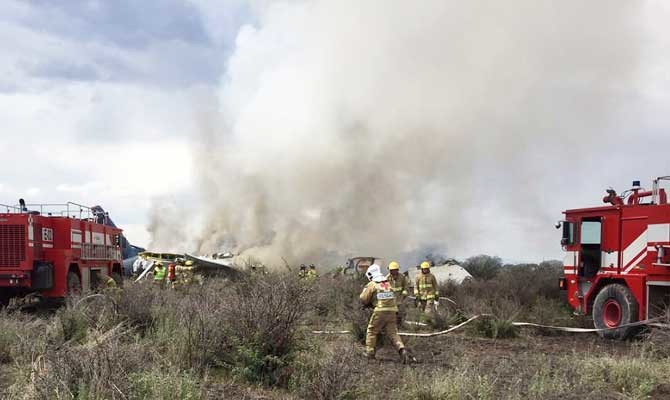
MEXICO CITY: An Aeromexico jetliner crashed while taking off during a severe storm in northern Mexico on Tuesday, smacking down in a field nearly intact then catching fire, but officials said everyone on board escaped alive.
Gov. Jose Aispuro, who had initially reported there were no deaths but later said authorities were searching the charred Embraer 190 to make sure, announced late Tuesday that “no person has died.”
He said the pilot and one other person were in serious but stable condition. Earlier, he said a total of 49 people had been taken to hospitals, and officials said most had minor injuries.
“Fortunately we have now found all 103 — now we know where each one is — this gives us a lot of tranquility,” Aispuro said.
The federal government earlier said 101 people were on the plane, 97 passengers and four crew members. But the governor said two minors had not been included in the first tally.
The state civil defense office published photos of a burning but relatively intact plane lying on its belly in a field. Ambulances lined up at the accident site to ferry the injured to hospitals. The governor said some passengers got out under their power, and some even wandered back to the nearby airport of Durango city to seek out relatives.
Officials and witnesses differed on whether the plane either fell shortly after takeoff or ran off the runway without really gaining altitude. But they agreed the plane was trying to take off during a storm, with some describing marble-sized hail.
The governor said a gust of wind hit the plane shortly after it took off, causing the jet to lose speed and hit the ground with its left wing, knocking both engines loose. He said the plane skidded into a field in a horizontal position, which allowed escape slides to activate so all passengers and crew could escape before the plane caught fire.
Israel Solano Mejia, director of the Durango city civil defense agency, told Foro TV that the plane “made it off the ground, but fell nose-first” just a few hundred yards from the end of the runway.
“The nose took the hit. The most seriously injured is the pilot,” Solano Mejia said. However, he said, “the majority of passengers left (the plane) under their own power.”
The federal Transport Department office said in a press statement that the airplane “suffered an accident moments after takeoff,” but gave no information on the possible cause.
Aeromexico said the flight was AM2431 from Durango to Mexico City.
The web site Planespotters.net said the Brazilian-made medium-range Embraer 190 was about 10 years old and had seen service with two other airlines before joining the Aeromexico fleet.
Operations were suspended at Guadalupe Victoria airport after the crash.


Mexico airliner crashes and burns, but all aboard survive


Mexico airliner crashes and burns, but all aboard survive

- Mexican governor says a gust of wind hit an Aeromexico jetliner shortly after it took off
- The Guadalupe Victoria airport has been closed since the plane went down near the runway during an afternoon storm


Tug of war: how US presidents battle Congress for military powers
- The last official declaration of war by Congress was as far back as World War II
WASHINGTON, United States: Donald Trump’s unleashing of operation “Epic Fury” against Iran has once more underscored the long and bitter struggle between US presidents and Congress over who has the power to decide on foreign military action.
In his video address announcing “major combat” with the Islamic republic, Trump didn’t once mention any authorization or consultation with the US House of Representatives or Senate.
In doing so he sidelined not only Democrats, who called for an urgent war powers vote, but also his own Republican party as he asserts his dominance over a largely cowed legislature.
A US official said Secretary of State Marco Rubio had called top congressional leaders known as the “Gang of Eight” to give them a heads up on the Iran attack — adding that one was unreachable.
Rubio also “laid out the situation” and consulted with the same leaders on Tuesday in an hour-long briefing, the US official said.
According to the US Constitution, only Congress can declare war.
But at the same time the founding document of the United States first signed in 1787 says that the president is the “commander in chief” of the military, a definition that US leaders have in recent years taken very broadly.
The last official declaration of war by Congress was as far back as World War II.
There was no such proclamation during the unpopular Vietnam War, and it was then that Congress sought to reassert its powers.
In 1973 it adopted the War Powers Resolution, passed over Richard Nixon’s veto, to become the only lasting limit on unilateral presidential military action abroad.
The act allows the president to carry out a limited military intervention to respond to an urgent situation created by an attack against the United States.
In his video address on Saturday, Trump evoked an “imminent” threat to justify strikes against Iran.
- Sixty days -
Yet under this law, the president must still inform Congress within 48 hours.
It also says that if the president deploys US troops for a military action for more than 60 days, the head of state must then obtain the authorization of Congress for continued action.
That falls short of an official declaration of war.
The US Congress notably authorized the use of force in such a way after the September 11, 2011 attacks on the United States by Al-Qaeda. Presidents have used it over the past two decades for not only the 2001 invasion of Afghanistan but a series of operations in several countries linked to the “War on Terror.”
Trump is far from the first US president to launch military operations without going through Congress.
Democrat Bill Clinton launched US air strikes against Kosovo in 1999 as part of a NATO campaign, despite the lack of a green light from skeptical lawmakers.
Barack Obama did the same for airstrikes in Libya in 2011.
Trump followed their example in his first term in 2018 when he launched airstrikes in Syria along with Britain and France.
But since his return to power the 79-year-old has sought to push presidential power to its limits, and that includes in the military sphere.
Trump has ordered strikes on alleged drug trafficking boats in Latin America without consulting Congress, and in June 2025 struck Iran’s nuclear facilities.
Perhaps the most controversial act was when he ordered the capture of Venezuelan president Nicolas Maduro in a lightning military raid on January 3.
Republicans however managed to knock down moves by Democrats for a rare war powers resolution that would have curbed his authority over Venezuela operations.
Trump has meanwhile sought to extend his powers over the home front. Democrats have slammed the Republican for deploying the National Guard in several US cities in what he calls a crackdown on crime and immigration.