Imran Khan sent a ‘Twitter prayer’ for hospitalized Nawaz Sharif

1 / 2
Pakistan Tehreek-e-Insaf (PTI) Chairman Imran Khan prayed for Nawaz Sharif’s recovery and directed party workers to stay away from the hospital where he is being treated and not to hold any demonstration against the ousted premier, the PTI said in a tweet. (Pakistan Tehreek Insaf via AFP)
2 / 2
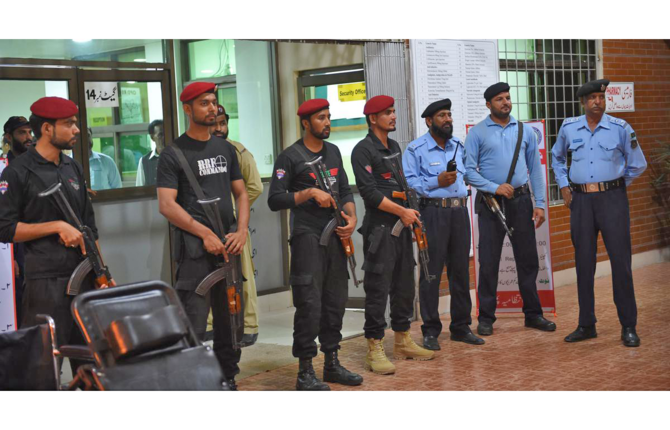
Pakistani security forces stand outside PIMS hospital in Islamabad, where Nawaz Sharif was admitted. (AFP)
Updated 30 July 2018
Follow

Imran Khan sent a ‘Twitter prayer’ for hospitalized Nawaz Sharif

  • PTI directed party workers to stay away from the hospital, and not to hold any demonstration against Sharif
  • Authorities have made extra security arrangements around the medical ward where he is being treated

ISLAMABAD: Pakistan Tehreek-e-Insaf (PTI) Chairman Imran Khan, whose party has emerged as the largest in the July 25 general elections, prayed for Nawaz Sharif’s recovery and directed party workers to stay away from the hospital where he is being treated and not to hold any demonstration against the ousted premier, the PTI said in a tweet.

Sharif was shifted from jail in Rawalpindi to the Pakistan Institute of Medical Sciences (PIMS) in the capital Islamabad, on Sunday, after his health deteriorated. He is suffering from heart problems.
Sharif’s party said that its leader refused earlier to go to the hospital. “After initially refusing to be shifted to PIMS, PML-N Quaid Nawaz Sharif agreed to be treated outside prison after consulting with his personal doctor,” Nawaz Sharif’s party Pakistan Muslim League (PML-N) said in a tweet.

On Sunday at midnight, the Islamabad chief commissioner declared the medical ward where former Prime Minister Sharif was hospitalized as a sub-jail.

Sharif, 68, is serving a 10-year jail term after the national accountability bureau ruled that Sharif and his family laundered money to pay for four luxury apartments in London.
He was put in the Adiala Jail Rawalpindi after July 13, and then shifted to the hospital.
Maryam Nawaz, Sharif’s daughter, and son-in-law Captain (retired) Muhammad Safdar are also serving seven-year and one-year jail terms respectively in the same case.
Pakistan authorities have made extra security arrangements around the medical ward where three-time Pakistan premier Nawaz Sharif is being treated.


Pakistan urges diplomacy on Iran nuclear issue, warns sanctions would hurt civilians

Updated 10 sec ago
Follow

Pakistan urges diplomacy on Iran nuclear issue, warns sanctions would hurt civilians

  • Pakistan warns the situation has become more complex since Israel’s attack on Iran and US bombing of nuclear sites
  • It cautions against invoking the snapback mechanism, saying sanctions will further deepen mistrust, derail diplomacy

ISLAMABAD: Pakistan demanded on Tuesday that diplomacy be given a chance in addressing all issues related to Iran’s nuclear program, warning the United Nations Security Council that sanctions would hurt ordinary Iranians, as tensions remain heightened following this year’s war between Israel and Iran.

Pakistan’s comments came amid renewed debate at the Security Council over Iran’s nuclear program and the future of the Joint Comprehensive Plan of Action (JCPOA), which sought to limit Tehran’s nuclear activities in exchange for sanctions relief.

The conflict in June was dubbed the Twelve-Day War and erupted after Israel carried out a surprise attack on Iranian military and nuclear facilities while international diplomacy was still underway. The strikes derailed negotiations, with the United States later bombing Iranian nuclear sites and declaring that the attacks had substantially degraded Iran’s nuclear capabilities.

Addressing the Security Council, Pakistan’s Acting Permanent Representative Ambassador Usman Jadoon said Islamabad believed that “diplomacy and dialogue should be the guiding principles for the resolution of all outstanding issues concerning Iran’s nuclear program in accordance with the rights, obligations and responsibilities of the parties concerned.”

“Coercive measures would not help in bringing the parties closer and only exacerbate the trust deficit,” he said. “Sanctions directly hurt ordinary people the most, impact trade, affect economic development and diminish the prospects of regional connectivity.”

Jadoon said the council last met on the issue in September following developments related to the JCPOA’s “snapback” mechanism — a provision that allows the automatic re-imposition of UN sanctions on Iran in cases of alleged non-compliance — adding that Pakistan opposed what it viewed as a rushed move and cautioned against hasty action.

He said Pakistan’s stance was grounded in the belief that disputes over Iran’s nuclear program should be resolved through dialogue, with more time allowed for diplomacy to succeed, while preserving the JCPOA framework until a successor arrangement is reached.

The ambassador said divisions within the council had widened in recent months, further complicating efforts to resolve the issue.

While acknowledging that the JCPOA was not implemented as intended, Jadoon said the agreement had nonetheless provided an essential framework rooted in international law and mutual respect, and could still prove useful if there was a shared willingness to move forward in a spirit of compromise.

He stressed the need to revive the agreement’s underlying principles and restore trust in diplomatic engagement that had been damaged in recent months, urging all parties to avoid confrontation and work toward a solution-oriented approach.