

‘Our time to shine’: Saudi piano prodigy plays a song of her own

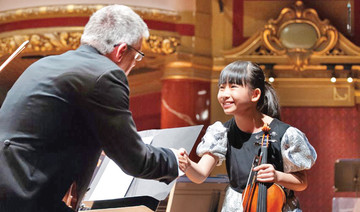
Eman Gusti: The young Saudi pianist, who captivated the audience alongside 11-year-old violinist, Chloe Chua. (Courtesy: Saudi General Cultural Authority)
Short Url
Updated 29 August 2022
Follow

‘Our time to shine’: Saudi piano prodigy plays a song of her own

  • The Kingdom is brimming with musical talents waiting for their moment to shine
  • For Eman Gusti, performing for the sell-out Saudi audiences was unlike anything she had experienced

JEDDAH: Chloe Chua, the 11-year-old Singaporean violinist and winner of the international Menuhin competition, is certainly an impressive performer, as her concerts in Riyadh and Jeddah show. But the Kingdom, too, is brimming with musical talents waiting for their moment to shine.

Among them is 21-year-old pianist Eman Gusti, who opened for Chua with songs of her own after the General Culture Authority offered her the chance to widen her audience and make a name for herself in the music industry.

Gusti developed her passion for music watching her mother play the keyboard when she was a child. Her earliest memories were of lazy afternoons spent listening to her mother playing, and late nights watching performances of classical music.

“My mother bought me my first keyboard when I was 5,” Gusti told Arab News. “She instilled a love of music in me. I was inspired by her. I started practicing on my own, but found myself more into the piano than the keyboard.”

Seeing her growing interest in music, Gusti’s father presented her with her first piano when she was almost 15, just before she began high school.

The young pianist continued to refine her skills and grow as a musical talent, performing at 32 events before her debut alongside Chua.

For Gusti, performing for the sell-out Saudi audiences was unlike anything she had experienced. 

“It was such a wonderful feeling to see people interact with my music and to watch them enjoy it. I was nervous at the beginning, but once the music seeped into my veins, it was strange and beautiful.”

Gusti said that she was left speechless when she saw how enthralled the audience was with the music, especially since she was playing original pieces.

In the future, she hopes to “continue growing as an artist professionally and internationally.” She also wants to learn the harp.

“My belief is that everyone should follow their dreams and work hard to make them a reality. I wish to set an example for girls in my country and show them that this is their time, and that now everything is possible.”

Japanese researchers hope to restore coral from Saudi-made structures

Updated 05 January 2026
Follow

Japanese researchers hope to restore coral from Saudi-made structures

  • Coral skeletons made for Saudi Pavilion at Japan expo last year
  • Results of Japanese study to be revealed at Riyadh Expo 2030

TOKYO: Japanese universities are seeking to restore coral reefs and marine ecosystems after receiving artificial structures that Saudi Arabia made and showcased at last year’s Osaka-Kansai Expo.

The coral skeletons were donated to the University of the Ryukyus in Okinawa and Kansai University in Osaka Prefecture, Kyodo News reported at the weekend.

The structures are made from calcium carbonate, a material on which corals are believed to grow more easily compared to artificial alternatives such as concrete or metal.

The skeletal structures were created using 3-D printers, with one piece produced a day during the expo, and displayed across an entire wall in the Saudi Arabia Pavilion, which had an area focusing on sustainable marine environments.

Coral reefs serve as habitats for much marine life, but over 40 percent of the world’s 892 species face possible extinction, according to the International Union for Conservation of Nature.

The University of the Ryukyus, which received about 150 of the artificial coral skeletons, will place them in waters off the eastern coast of Okinawa’s main island and then examine their impact on the ecosystem.

Kansai University has placed theirs in the sea around Kagoshima Prefecture’s Yoron Island to observe their growth after transplanting coral polyps onto the structures.

The results of the research are expected to be revealed at the Riyadh Expo in 2030.

“I had never imagined that Japan and Saudi Arabia would cooperate on coral research,” said Masato Ueda, a professor specializing in regenerative medicine at Kansai University.

Ueda said he wants to demonstrate to children that “humanity is attempting to restore the environment.”