Man bites dog: North Koreans eat dog meat to beat the heat

1 / 3
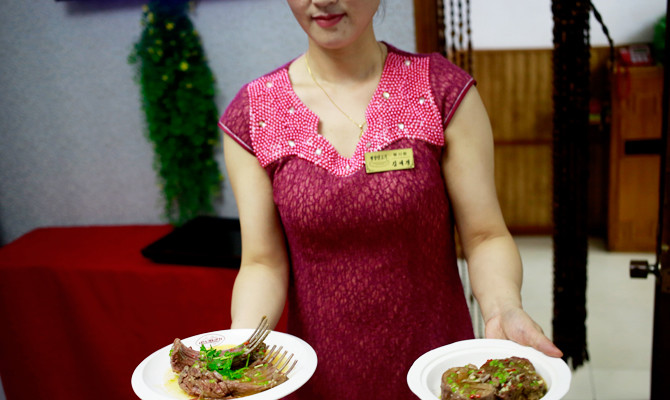
A waitress shows dishes made of dog meat at at Pyongyang House of Sweet Meat, a dog specialty restaurant in Pyongyang, North Korea, Wednesday, July 25, 2018. (AP)
2 / 3
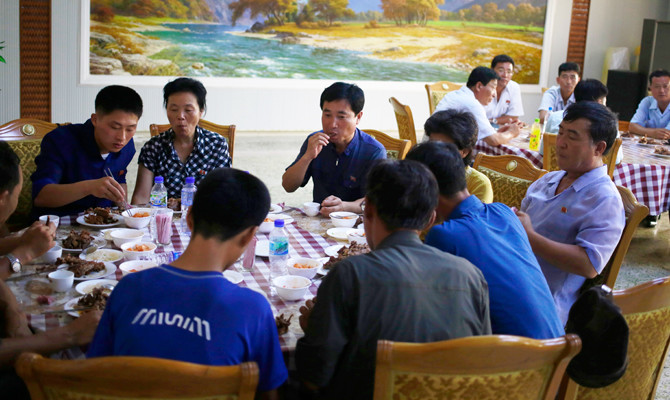
People have their lunch at Pyongyang House of Sweet Meat, a restaurant specialized in dishes made of dog meat, in Pyongyang, North Korea, Wednesday, July 25, 2018. (AP)
3 / 3
A waitress serves dishes made of dog meat at Pyongyang House of Sweet Meat, a dog specialty restaurant in Pyongyang, North Korea, Wednesday, July 25, 2018. (AP)
Updated 26 July 2018
Follow

Man bites dog: North Koreans eat dog meat to beat the heat

  • The restaurant’s menu lists more than a dozen dog dishes, including ribs, hind legs and boiled dog skin
  • It is increasingly common to see people walking their dogs on leashes in Pyongyang and other cities in the North

PYONGYANG, North Korea: In North Korea, summer is not a good time to be a dog.
In the sizzling heat, North Korea’s biggest brewery is pumping out twice as much beer as usual, Pyongyang residents are lining up to get their “bingsu” — a syrupy treat made with shaved ice — and restaurants are serving up bowl after bowl of the season’s biggest culinary attraction: spicy dog meat soup.
Euphemistically known as “dangogi,” or sweet meat, dog has long been believed to be a stamina food in North and South Korea and is traditionally eaten during the hottest time of the year, giving a sad twist to the old saying “dog days of summer.”
The dates are fixed according to the lunar calendar and dog meat consumption centers around the “sambok,” or three hottest days — July 17 and 27, and Aug. 16 this year. Demand appears to be especially high this year because of a heatwave in East Asia. Temperatures in the North have been among the highest ever recorded, hovering near 40 degree Celsius (104 Fahrenheit) in several cities.
As is the case with almost everything, good statistics are not available for how much dog is eaten in the North.
But in South Korea, where even President Moon Jae-in has dogs as pets, at least 2 million canines are slaughtered and eaten each year even though its popularity as food is waning. While many older South Koreans believe dog meat aids virility, younger people generally are either against the practice or indifferent to it and there has been increasing pressure to ban it altogether.
On both sides of the Demilitarized Zone, dogs used for their meat are raised on farms for that express purpose.
“It’s been our national food since olden times,” explained Kim Ae Kyong, a waitress at the Pyongyang House of Sweet Meat, the largest dog specialty restaurant in the North Korean capital. “People believe that heat cures heat, so they eat dog meat and spicy dog soup on the hottest days. It’s healthier than other kinds of meat.”
The restaurant’s menu lists more than a dozen dog dishes, including ribs, hind legs and boiled dog skin.
Like their neighbors to the South, North Korean attitudes toward dogs are changing.
It is increasingly common to see people walking their dogs on leashes in Pyongyang and other cities in the North, a trend that seems to have just begun to catch on over the past few years. Feral dogs are common in the countryside, however, and left to fend for themselves.
How leader Kim Jong Un feels about all this isn’t known.
But in January he made a point of donating 30 pet dogs of seven breeds — including a bulldog — to Pyongyang’s newly renovated Central Zoo, where dogs are put on display much like the wild animals. The canine center at the zoo is, in fact, one of its most popular attractions, and posters near the cages explain how to properly care for and feed — not eat — canine companions.


Ilia Malinin hints at ‘inevitable crash’ amid Olympic pressure and online hate in social media post

Updated 16 February 2026
Follow

Ilia Malinin hints at ‘inevitable crash’ amid Olympic pressure and online hate in social media post

  • He says Olympic pressure and online hate have weighed on him. He described negative thoughts and past trauma flooding in during his skate
  • He later congratulated the surprise champion, Mikhail Shaidorov of Kazakhstan

MILAN: Ilia Malinin posted a video on social media Monday juxtaposing images of his many triumphs with a black-and-white image of the US figure skater with his head buried in his hands, and a caption hinting at an “inevitable crash” amid the pressure of the Olympics while teasing that a “version of the story” is coming on Saturday.
That is when Malinin is expected to skate in the traditional exhibition gala to wrap up the Olympic figure skating program.
Malinin, who helped the US clinch the team gold medal early in the Winter Games, was the heavy favorite to add another gold in the individual event. But he fell twice and struggled throughout his free skate on Friday, ending up in eighth.
He acknowledged afterward that the pressure of the Olympics had worn him down, saying: “I didn’t really know how to handle it.”
Malinin alluded again to the weight he felt while competing in Milan in the caption to his social media video.
“On the world’s biggest stage, those who appear the strongest may still be fighting invisible battles on the inside,” wrote the 21-year-old Malinin. “Even your happiest memories can end up tainted by the noise. Vile online hatred attacks the mind and fear lures it into the darkness, no matter how hard you try to stay sane through the endless insurmountable pressure. It all builds up as these moments flash before your eyes, resulting in an inevitable crash.”
Malinin, who is expected to chase a third consecutive world title next month in Prague, had been unbeaten in 14 events over more than two years. Yet while Malinin always seemed to exude a preternatural calm that belied his age, the son of Olympic skaters Tatiana Malinina and Roman Skorniakov had admitted early in the Winter Games that he was feeling the pressure.
The first time came after an uneven short program in the team event, when he finished behind Yuma Kagiyama of Japan — the eventual individual silver medalist. Malinin referenced the strain of the Olympics again after the Americans had won the team gold medal.
But he seemed to be the loose, confident Malinin that his fans had come to know after winning the individual short program. He even playfully faked that he was about to do a risky backflip on the carpeted runway during his free skate introduction.
The program got off to a good start with a quad lutz, but the problems began when he bailed out of his quad axel. He ended up falling twice later in the program, and the resulting score was his worst since the US International Classic in September 2022.
Malinin was magnanimous afterward, hugging and congratulating surprise gold medalist Mikhail Shaidorov of Kazakhstan. He then answered a barrage of questions from reporters with poise and maturity that few would have had in such a situation.
“The nerves just went, so overwhelming,” he said, “and especially going into that starting pose, I just felt like all the traumatic moments of my life really just started flooding my head. So many negative thoughts that flooded into there and I could not handle it.”
“All I know is that it wasn’t my best skate,” Malinin added later, “and it was definitely something I wasn’t expecting. And it’s done, so I can’t go back and change it, even though I would love to.”