LAHORE: Cricketer-turned-politician Imran Khan is set to emerge victorious from Pakistan’s general elections, as unofficial early results on Wednesday night indicated he had taken the lead in a political contest marred by allegations of rigging by the main political parties.
The vote is proving to be a close fight between Khan’s Pakistan Tehreek-e-Insaf (PTI) party and the Pakistan Muslim League-Nawaz (PML-N), led by jailed former Prime Minister Nawaz Sharif.
“God willing, PTI will emerge as the single largest party in Parliament,” said Shah Mahmood Qureshi, the party’s vice-chairman. “I congratulate Imran Khan.”
But victory in the election, which marks only the second time that power in Pakistan has been transferred from one civilian government to another, will be tempered by unprecedented allegations of voting irregularities. Leaders of all political parties other than PTI said voters were not given the required forms on time and that polling agents, party volunteers who monitor the count, had been forced out of polling stations, leaving security officials free, potentially, to tamper with the vote.
About 800,000 law-enforcement officials, including 371,388 soldiers, were deployed to protect and facilitate the vote.
PML-N President Shehbaz Sharif said that his party will reject the election results over concerns of rigging.
“This is not an election, it is complete selection,” said PML-N Sen. Mushahid Hussain Sayed. “A great disservice has been done to Pakistan. This is the dirtiest election in the history of Pakistan.”
Sherry Rehman, the leader of the opposition in the upper house of Parliament and a senior leader of the Pakistan People’s Party (PPP), said the widespread reports of voting irregularities had the potential to render “the whole election null and void.”
Violence also cast a shadow over election day. At least 31 people were killed in a suicide bombing outside a polling station in the southwestern Baluchistan province. There were also clashes in all four provinces between supporters of the various parties, in which at least two people were killed.
The run-up to the election was also bloody. A suicide bomber killed 151 people, including Balochistan Awami Party candidate Siraj Raisani, at a rally in Baluchistan’s Mastung area this month. Ikramullah Gandapur, a candidate for PTI, and Haroon Bilour, who was standing for the secular Awami National Party, were assassinated in separate attacks in northwestern Pakistan.
In addition, the election has been plagued by widespread allegations that the army was working behind the scenes to skew the contest in Khan’s favor. Sharif, who was jailed on corruption charges this month, has long had tense relations with the military and accuses army chiefs of orchestrating his conviction.
But despite the threat of violence and some public disenchantment over the allegations of rigging, at least half of the country’s 106 million registered voters turned out to cast their ballots for the 272 parliamentary seats.
“A lot has been written dismissing Pakistan’s election as a sham but there are scores of women, grandparents and great grandparents queuing today to cast their vote even in the face of news of violence from Quetta,” said Fahd Humayun, a researcher at Jinnah Institute. “This is the resilience of this country and its people.”
Women in the Dir, Kohistan, and North and South Waziristan regions made history by voting for the first time. Media footage showed disabled people arriving to vote across the country, and one news channel followed the election experiences of a team of wrestlers and two grooms who left their weddings to cast ballots. A teenage girl took her mother on a motorcycle to vote for Khan, she said, because public transport was not available.
Khan, whose appeal rests mainly on a fierce anti-corruption crusade, took the lead as the unofficial results started to come in on Wednesday night. Television news projections predicted his party would win up to 115 of the 272 elected seats on offer. With PML-N trailing on just 70 seats, it seemed clear that Sharif’s election slogan, “Give Respect to the Vote,” had failed to resonate with common Pakistanis.
In Lahore, the capital of what is traditionally Sharif’s Punjab power base, Khan’s supporters danced in the streets, waving flags bearing his image, honking horns and firing celebratory gunshots.
“I voted for Imran Khan because he is not corrupt and he has never been given a chance before,” Mustafa Abbas, a web developer, said outside a polling station on Wednesday afternoon. “We know all the other candidates and parties. Now it’s time to test out Imran.”
At another polling station, Samra Aslam, 53, said she was voting for Sharif because he had brought development to the country. Sharif’s PML-N party is known for its large-scale infrastructure projects and energy projects that have reduced crippling power cuts.
“Nawaz has been dealt with unfairly just because he won’t bow before the generals,” Aslam said. “By voting for him, we are voting against this trend of victimizing political leaders.”
Even if Khan wins and faces no obstacles in forming a government, he will have to deal with a currency crisis, a record trade deficit and enduring threats from militants. For years now, he has called for less dependence on the US, but it remains to be seen how he will manage Pakistan’s stormy relationship with Washington, as well as with rivals India and Afghanistan.
The Americans will be particularly concerned about the outcome of the election, given that Khan famously said he would order the Pakistani military to shoot down American drones if he came to power, and advocated negotiations with Pakistani Taliban fighters rather than military operations against them.
There are also questions over how successfully he can work with the army, and how much he would concede to the military in policy-making.
“Imran Khan doesn’t have many friends or allies; he’s not someone who really knows how to work with people,” said Mohammad Malick, a popular political talk show host, referring to Khan’s famous stubbornness. “So he will need a lot of help from the military not just to convince smaller parties and independent candidates to help him form the government but, once in power, to push reforms and enact policy. He won’t be able to work without the military.”
If that is the case, it would only mean more political power for a military that directly ruled Pakistan for almost half its history and already has a significant role in foreign and national security policymaking.
Khan’s triumph, however, signals a victory against dynastic politics. The Sharifs have dominated Punjab, Pakistan’s most populous province, since the 1980s, and Nawaz Sharif has been prime minister three times. The other loser in this regard is Bilawal Bhutto Zardari of the Pakistan People's Party, whose mother and grandfather are former prime ministers.
In addition, in a landscape long closed off to disruptive, new voices, several political novices jumped into the fray during this election cycle, including social workers, lawyers, political activists and an unprecedented number of people from the transgender community. Hundreds of candidates from militant-linked groups also ran.
However, despite the violence and allegations of rigging, observers said this election could have historic repercussions for Pakistani democracy.
“When an election is believed to be unfree and unfair, knowing that the procedural aspects of the election have been carried out successfully offers little consolation,” said Kugelman. “At the same time, it’s unfair to conclude that democracy is a lost cause in Pakistan simply because it struggles to carry out a clean election. This election is a democratic milestone.”


![]()

Imran Khan takes firm lead in Pakistani election marred by violence and rigging claims
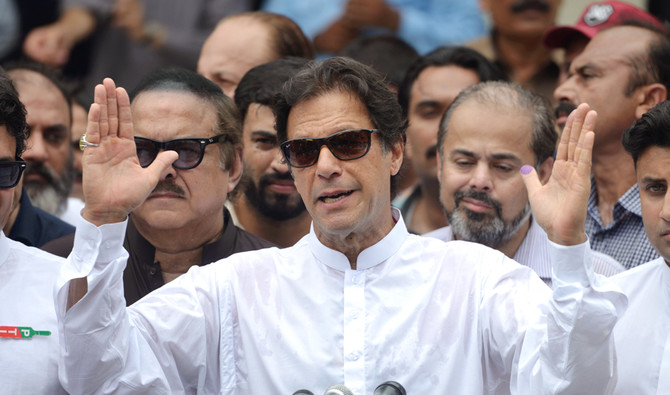
Imran Khan takes firm lead in Pakistani election marred by violence and rigging claims
- PML-N crise foul, says 'this is not an election, it is complete selection'
- PPP says reports of voting irregularities can render 'the whole election null and void'
Related


Latest updates


© 2026 SAUDI RESEARCH & PUBLISHING COMPANY, All Rights Reserved And subject to Terms of Use Agreement.