

Wildfires kill at least 74 near Athens, families embrace as flames close in

1 / 4
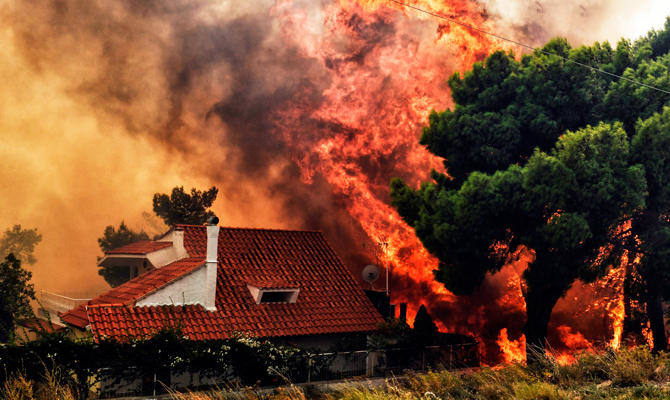
A house is threatened by a huge blaze during a wildfire in Kineta, near Athens, on July 23, 2018. (AFP)
2 / 4
Firefighters, soldiers and local residents carry a hose as a wildfire burns in the town of Rafina, near Athens, Greece, July 23, 2018. (REUTERS)
3 / 4
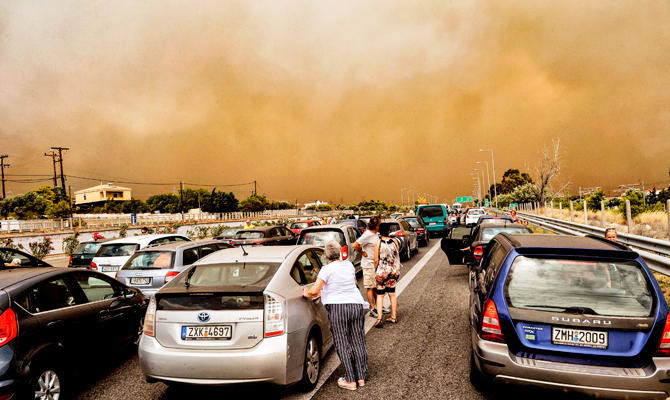
Cars are blocked at the closed National Road during a wildfire in Kineta, near Athens, on July 23, 2018. (AFP)
4 / 4
A man walks his dog past a man holding a hose as smoke billows in background during a wildfire in Kineta, near Athens, on July 23, 2018. (AFP)
Updated 25 July 2018
Follow

Wildfires kill at least 74 near Athens, families embrace as flames close in

  • At least 74 people have died in fires that tore through an area close to Athens
  • The majority of victims were found in their homes or cars in the seaside resort of Mati

MATI, Greece: Wildfires sweeping through a Greek resort town killed at least 74 people, officials said, including families with children found clasped in a last embrace as they tried to flee the flames.
The inferno was by far Greece’s worst since fires devastated the southern Peloponnese peninsula in August 2007, killing dozens. It broke out in Mati, east of Athens, late Monday afternoon and was still burning in some areas on Tuesday.
“Greece is going through an unspeakable tragedy,” Prime Minister Alexis Tsipras said as he appeared on television to declare three days of national mourning.
Emergency crews found one group of 26 victims, some of them youngsters, lying close together near the top of a cliff overlooking a beach.
“They had tried to find an escape route but unfortunately these people and their kids didn’t make it in time. Instinctively, seeing the end nearing, they embraced,” Nikos Economopoulos, the head of Greece’s Red Cross, told Skai TV.
The strong smell of charred buildings and trees lingered in the air in parts of Mati on Tuesday, where white smoke rose from smoldering fires.
Residents wandered the streets, some searching for their burned-out cars, others for their pets. The eerie silence was punctured by fire-fighting helicopters and the chatter of rescue crews.

A Reuters photographer saw at least four dead people on a narrow road clogged with cars heading to a beach.
“Residents and visitors in the area did not escape in time even though they were a few meters from the sea or in their homes,” fire brigade spokeswoman Stavroula Maliri said.
Coast Guard vessels and other boats rescued almost 700 people who had managed to get to the shoreline and pulled another 19 survivors and six dead bodies from the sea, the coast guard said.
In total, at least 74 people were killed and the death toll was expected to rise, Evangelos Bournous, mayor of nearby Rafina-Pikermi, said.
It was unclear how many people remained unaccounted for as coast guard vessels combed beaches to find any remaining survivors, with military hospitals on full alert, the government’s spokesman said.
One of the youngest victims was thought to be a six-month-old baby who died of smoke inhalation, officials said. Of the at least 94 people injured, 11 were in intensive care, and 23 were children, they added.
“KILLER FIRE“
Mati, 29 km (18 miles) east of the capital, is a popular spot for Greek holiday-makers, particularly pensioners and children at camps. Poland said two of its citizens, a mother and her son, were among the victims.
Greece’s fire brigade said the intensity and spread of the wildfire at Mati had slowed on Tuesday as winds died down, but it was still not fully under control.
The service urged residents to report missing relatives and friends. Some took to Twitter and Facebook, posting photographs of young children and elderly couples they hoped to locate.
Newspapers printed banner headlines including “Killer Fire” and “Hell.”
Greece issued an urgent appeal for help to tackle fires that raged out of control in several places across the country, destroying homes and disrupting major transport links.
Cyprus and Spain offered assistance after Greece said it needed air and land assets from European Union partners.
“Our thoughts go to Greece and the victims of the terrible fires,” French President Emmanuel Macron said in tweets published in French and Greek. Forest fires are also raging in Sweden.
Authorities said they would use an unmanned drone from the United States to monitor and track any suspicious activity.
Tsipras and Greek officials have expressed misgivings at the fact that several major fires broke out at the same time.
Wildfires are not uncommon in Greece, and a relatively dry winter helped create the current tinder-box conditions. It was not immediately clear what ignited the fires.
A hillside of homes was gutted by flames east of Athens. A mayor said he saw at least 100 homes and 200 vehicles burning.
On Monday, Greek authorities urged residents of a coastal region west of Athens to abandon their homes as another wildfire burned ferociously, closing one of Greece’s busiest motorways, halting trains and sending plumes of smoke over the capital.


WHO chief says reasons US gave for withdrawing ‘untrue’

Updated 25 January 2026
Follow

WHO chief says reasons US gave for withdrawing ‘untrue’

  • US Secretary of State Marco Rubio and US Health Secretary Robert F. Kennedy Jr. announced in a joint statement Thursday that Washington had formally withdrawn from the WHO
  • And in a post on X, Tedros added: “Unfortunately, the reasons cited for the US decision to withdraw from WHO are untrue”

GENEVA: The head of the UN’s health agency on Saturday pushed back against Washington’s stated reasons for withdrawing from the World Health Organization, dismissing US criticism of the WHO as “untrue.”
Tedros Adhanom Ghebreyesus warned that US announcement this week that it had formally withdrawn from the WHO “makes both the US and the world less safe.”
And in a post on X, he added: “Unfortunately, the reasons cited for the US decision to withdraw from WHO are untrue.”
He insisted: “WHO has always engaged with the US, and all Member States, with full respect for their sovereignty.”
US Secretary of State Marco Rubio and US Health Secretary Robert F. Kennedy Jr. announced in a joint statement Thursday that Washington had formally withdrawn from the WHO.
They accused the agency, of numerous “failures during the Covid-19 pandemic” and of acting “repeatedly against the interests of the United States.”
The WHO has not yet confirmed that the US withdrawal has taken effect.

- ‘Trashed and tarnished’ -

The two US officials said the WHO had “trashed and tarnished” the United States, and had compromised its independence.
“The reverse is true,” the WHO said in a statement.
“As we do with every Member State, WHO has always sought to engage with the United States in good faith.”
The agency strenuously rejected the accusation from Rubio and Kennedy that its Covid response had “obstructed the timely and accurate sharing of critical information that could have saved American lives and then concealed those failures.”
Kennedy also suggested in a video posted to X Friday that the WHO was responsible for “the Americans who died alone in nursing homes (and) the small businesses that were destroyed by reckless mandates” to wear masks and get vaccinated.
The US withdrawal, he insisted, was about “protecting American sovereignty, and putting US public health back in the hands of the American people.”
Tedros warned on X that the statement “contains inaccurate information.”
“Throughout the pandemic, WHO acted quickly, shared all information it had rapidly and transparently with the world, and advised Member States on the basis of the best available evidence,” the agency said.
“WHO recommended the use of masks, vaccines and physical distancing, but at no stage recommended mask mandates, vaccine mandates or lockdowns,” it added.
“We supported sovereign governments to make decisions they believed were in the best interests of their people, but the decisions were theirs.”

- Withdrawal ‘raises issues’ -

The row came as Washington struggled to dislodge itself from the WHO, a year after US President Donald Trump signed an executive order to that effect.
The one-year withdrawal process reached completion on Thursday, but Kennedy and Rubio regretted in their statement that the UN health agency had “not approved our withdrawal and, in fact, claims that we owe it compensation.”
WHO has highlighted that when Washington joined the organization in 1948, it reserved the right to withdraw, as long as it gave one year’s notice and had met “its financial obligations to the organization in full for the current fiscal year.”
But Washington has not paid its 2024 or 2025 dues, and is behind around $260 million.
“The notification of withdrawal raises issues,” WHO said Saturday, adding that the topic would be examined during WHO’s Executive Board meeting next month and by the annual World Health Assembly meeting in May.
“We hope the US will return to active participation in WHO in the future,” Tedros said Saturday.
“Meanwhile, WHO remains steadfastly committed to working with all countries in pursuit of its core mission and constitutional mandate: the highest attainable standard of health as a fundamental right for all people.”