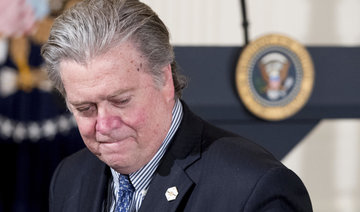
Steve Bannon planning foundation to boost far right in Europe: report

France's far-right party Front National (FN) president Marine Le Pen (R) applauds former US President advisor Steve Bannon after his speech during the Front National party annual congress, on March 10, 2018 at the Grand Palais in Lille, northern France. (AFP)
Updated 22 July 2018
Follow

Steve Bannon planning foundation to boost far right in Europe: report

  • The organization will likely be based out of Brussels initially and has set its sights on the 2019 European parliament elections

WASHINGTON: US President Donald Trump’s controversial former adviser Steve Bannon plans to set up a foundation in Europe called “The Movement” to spark a populist rightwing revolt, according to a report.
Bannon envisages the organization rivalling George Soros’ Open Foundation, which has given away $32 billion to liberal causes since it was established in 1984, according to the report by the Daily Beast published late Friday.
The non-profit will be a central source of polling, advice on messaging, data targeting, and think-tank research.
He told the Daily Beat he was convinced the coming years will see an end to decades of European integration.
“Right-wing populist nationalism is what will happen. That’s what will govern,” he said. “You’re going to have individual nation states with their own identities, their own borders.”
He added he had held talks with right-wing groups across the continent, from Nigel Farage and members of Marine Le Pen’s Front National (recently renamed Rassemblement National) in the West, to Hungary’s Viktor Orban and the Polish populists in the East.
The organization will likely be based out of Brussels initially and has set its sights on the 2019 European parliament elections.
The architect of Trump’s nationalist-populist campaign and his election victory, White House chief strategist Steve Bannon was nicknamed the “Prince of Darkness” and the “Shadow President.”
His economic nationalism became the lynchpin of Trump policies, even as many of his other ideas were rebuffed by policy rivals.
After new Chief of Staff John Kelly arrived, Bannon’s constant clashes with other advisers became untenable, as did his ties to the extreme right, which drew accusations that Trump fostered racists. Bannon left the White House last August.


Ugandan opposition turns national flag into protest symbol

Updated 4 sec ago
Follow

Ugandan opposition turns national flag into protest symbol

KAMPALA: Hundreds screamed with excitement as Uganda’s opposition leader passed by a recent rally, with the crowd waving a sea of national flags — a dangerously politicized symbol in the run-up to this week’s election.
Analysts say it is almost a foregone conclusion that President Yoweri Museveni, 81, will win a seventh term in Thursday’s vote, given his near-total control over the state apparatus in the east African country.
But his opponent, 43-year-old Robert Kyagulanyi, better known as Bobi Wine, has framed the election as a protest vote and cannily turned the national flag into a symbol of resistance.
Police last month warned against using the flag “casually and inappropriately.”
Wine’s supporters have faced frequent intimidation by the security forces during the campaign, according to the United Nations Human Rights Office and other observers.
But the flag is “the only weapon we have,” said woodworker Conrad Olwenyi, 31, at a Wine rally this week.
“We cannot fight the security, because they have a gun. We only have the flag,” he said. But “if they shoot you when you have the flag, they are shooting the country.”

- ‘Reclaiming patriotism’ -

Uganda’s flag — created when the country achieved independence from Britain in 1962 — has stripes of black to represent Africa, yellow for its sunshine, and red to represent African brotherhood, with a grey crowned crane overlaid.
In the 2021 elections, Wine’s National Unity Platform (NUP) adopted red berets as a symbol, but the government ruled that was illegal since they were part of the military uniform, and used that ruling to justify raids on the party’s offices.
The flag is a clever alternative and a way of “reclaiming patriotism,” said Uganda expert Kristof Titeca.
“It’s kind of taken the government by surprise, and so that’s why they started this clampdown,” he told AFP.
Like many countries in east Africa, there are laws governing how the national flag may be used, though these were rarely enforced in Uganda in the past.
“It shows the panic,” prominent cartoonist Jimmy Spire Ssentongo told AFP.
“I don’t think they are threatened by misuse of the flag. They are threatened by the visibility of the support toward NUP,” said Ssentongo, adding that as Museveni ages and nears 40 years in power, “the space for freedom of expression also shrinks.”
“Everyone has a right to use the national flag, but it depends on in what context they’re using it for. I believe the opposition is politicizing it,” said Israel Kyarisiima, a national youth co-ordinator for Museveni’s National Resistance Movement party.
Security services have repeatedly been accused by Wine’s supporters of targeting those carrying the flag at rallies, with the leader urging followers in his Christmas address to “come to the defense of anyone assaulted for carrying the flag.”
And the threats from police have not stopped Wine’s supporters brandishing the flag at rallies.
“Now we’ve got something that can really show our unity as Ugandans, and they are trying to make it criminal,” said one attendee this week, Ruth Excellent Mirembe, 25, waving a flag.
Trying to stop its use is “oppression in the highest form,” she told AFP. “This represents us as Ugandans.”