KARACHI: There was an outpouring of criticism on social media after photos of election candidates requesting support from outlawed and sectarian organizations made it to cybersphere, prompting the Pakistan People’s Party led by Bilawal Bhutto Zardari to issue show-cause notices to three candidates.
“The PPP has expelled federal council member Muzaffar Shajjra and issued a show cause notice to two candidates for getting the support of ASWJ against party policy,” Saeed Ghani, Karachi chapter head, tweeted along with a show cause notice.
The show cause notice served to Jamil Zia, a candidate from NA-251, and Agha Zahir Shah, a PPP’s contester on PS-119, has asked them to clarify their position within three days.
“I have also served a show cause notice to Shehzad Memon, our candidate from 103 for his meeting with ASWJ leaders,” Ghani told Arab News.
“We are not against the religious vote,” Ghani, who during local government elections in December 2015 met with the administrator of Jamia Binoria Site for election support, said. “However, we will never make an alliance with or ask for a vote from a proscribed organization.”
The ASWJ, which is contesting general polls under the banner of Pakistan Rah-e-Haq Party (PRHP), has fielded 17 candidates from Karachi.
Umar Muawiyah, spokesman of the ASWJ, said that the party had announced to support Pakistan Peoples Party’s Jamil Zia (NA-251) and Agha Zahir Shah (NA-251), Pakistan Tehreek-e-Insaf’s Faisal Vawda (NA-249, Ijaz Swati (PS-90) and Abdul Rehman (PS-116), candidate grand democratic alliance, Irfanullah Marwat (PS-104) and PMLN’s Javed Arsala Khan (PS-89).
The popularity of ASWJ in Malir has earned it an election alliance in the name Awami Khidmat Panel (AKP). According to the agreement, ASWJ chief Maulana Aurangzeb Farooqi (NA-238), PMLN’s Javed Arsala Khan (PS-89), former PPP president Hajji Muzaffar SHajjra (PS-91) and PTI’s Ijaz Swati (PS-90) will be candidates of AKP joint panel.
Commenting on Saeed Ghani’s notice to his party’s candidates, an ASWJ spokesman said: “They have come to us for support. We haven’t visited a single party for support.”
Earlier, PPP leader Arif Qureshi (PS-128) and Liaquat Askani (PS-112) visited Allama Taj Hanafi to seek electoral support. The PMLN’s leader and former federal minister Finance Miftah Ismail and the PPP’s candidate Shehzad Memon (PS-103) had also requested support. But Muawiyah said none of them has been assured of support yet.
“There is not a single party which hasn’t visited our offices for support. The MQM-P has contacted, the PSP has requested our support for their candidates in district central,” he said.
As Ghani was talking of action against violators, the ASWJ issued handout on Thursday evening, reading, “the Pakistan Peoples Party's candidate for NA-252 Abdul Khaliq and candidate for PS-121 Ali Akber Kachelo visited the ASWJ headquarters in Karachi and informed media that they have won the support of Ahle Sunnat Wal Jamaat”. The PPP leaders were accompanied of ASWJ leader Allama Taj Hanafi.
Majlis Wahdat-e-Muslimeen Pakistan (MWM), a Shiite political organization, has made an electoral alliance with PTI. “The PTI will support MWM’s candidates Mir Taqi Zafar (PS-125), Muhammad Ali Abidi (NA-254) and Ali Hussain Naqvi (PS-98). Zafar and Abidi are contesting on the MWM’s symbol tent whereas Naqvi is contesting on Bat, which is PTI’s symbol,” said Ali Ahmar, the MWM’s spokesman in Karachi.
“The MQM and PPP have requested for support, Mustafa Kamal’s PSP had asked for seat adjustment but we opted for seat adjustment with PTI and are supporting its candidates across Sindh,” Ahmar told Arab News.
“Whether secular left and religious right candidates of every party has contacted us for support,” said Muhammad Asif, spokesman Milli Muslimeen League, a group enlisted by US as a terrorist organization, which is contesting from 300 seats, including 26 from Karachi.
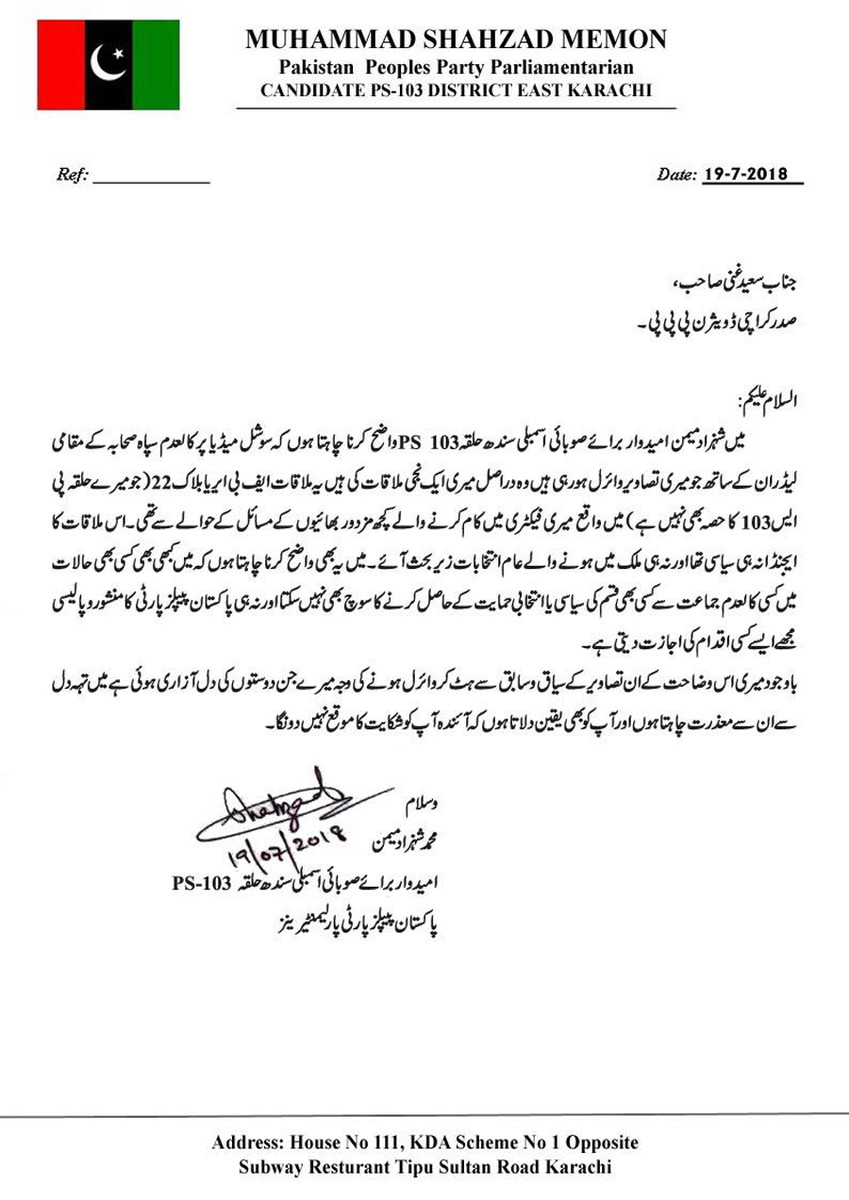
The show cause notice served to the Pakistan People’s Party (PPP) candidate for seeking the support of ASWJ.
“Syeda Shehla Raza, former deputy speaker and leader of the Pakistan People’s Party has contacted Dr. Muzzamil Hashmi, our vice president, for her support on NA-243,” Asif said, adding several other PPP’s candidates have also sought support. “No decision of alliance or seat adjustment with any party has been reached,” he told Arab News.
Shehla Raza didn’t respond to Arab News. However Karachi chief of PPP, when told about the contacts, said: “No one will be speared for contacting or seeking support from a proscribed organization.”
A day earlier the US-designated terrorist Fazlur Rehman Khalil pledged political support to Imran Khan’s Pakistan Tehreek-e-Insaf (PTI) party.
Senior analyst Raza Rumi said that the alliances were made at local levels to win constituencies where there were strong ultra-right groups. “For any candidate to get those 500,000 votes makes difference so that’s why they make these alliances.”
“I don’t really think that the political parties would like to strengthen or even support the ultra-right groups and but the reality is that they exist and they have existed because of other reasons, mainly the security policy — the internal and external — where in the past the jihadis were seen as some kind of an instrument.”
“Liberal and secular politics have been under threat in Pakistan for decades now and there is no truly secular party, presently. The PPP is closest to what we call a secular and liberal alternative and the PMLN has been trying to shift from its right-wing past to a more moderate centrist approach,” Raza said.
Wakeel-ur-Rehman, a Karachi journalist reporting about the religious groups, said no one was secular and liberal when it came to election support.
Seeking support from a proscribed organization is not a new thing, Rehman told Arab News, adding that the ASWJ in the last local election was able to make alliances with PPP, PMLN, ANP and JI in district west and Malir due to its strong support base.