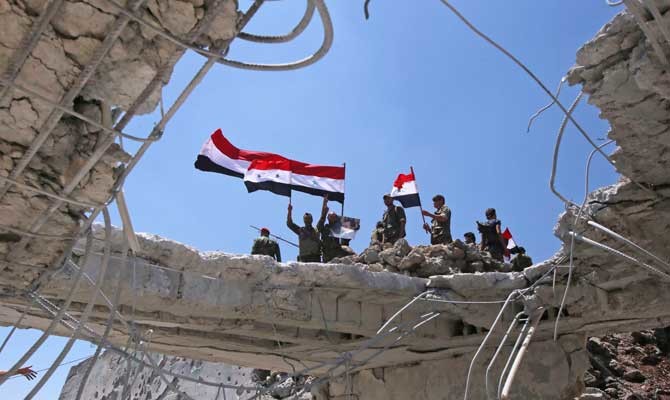
BEIRUT: Syrian rebels agreed to surrender their last pockets of control in southwest Quneitra province to the government, state media reported Thursday, making way for Damascus to re-establish its authority along the Israeli frontier.
The deal, confirmed in its general outlines by a monitoring group and opposition activists in Quneitra, will put the Syrian government face-to-face with Israel along most of its frontier for the first time since 2011, when an uprising against President Bashar Assad’s rule swept through Syria.
A fleet of buses reached Quneitra on Thursday night to pick up fighters, activists and other residents who refuse to accept the terms of surrender, and evacuate them to rebel-held areas in northern Syria, the Syrian Observatory for Human Rights monitoring group said.
An affiliate of the Daesh group continues to hold a sliver of the frontier. The group is not party to the agreement between the government and rebels.
Syria and Israel fought two wars over their shared border, in 1967 and 1973, with Israel occupying the Golan Heights in the Quneitra province in the former confrontation.
But Israel has refrained from taking sides in Syria’s seven-year-long civil war, and Prime Minister Benjamin Netanyahu has indicated he does not object to the government’s return to southwest Syria — as long as Israel’s archenemies Iran and the Lebanese militant group Hezbollah stay clear of the frontier.
Delegations from the government and rebels met several times over the last two days to negotiate the terms of surrender, said opposition activist and photographer Moaz Al-Assaad.
Thousands of residents — including rebel fighters, media activists, medical workers and civilians — may be heading to north Syria instead of staying behind in Quneitra, according to Al-Assaad.
The UN and human rights organizations have condemned such evacuations as forced displacement. Few who have left are expecting to be able to return to their homes in the near-term.
Earlier on Thursday, a fleet of buses helped evacuate the last remaining residents from Shiite, pro-government villages in northern Syria that endured three years of rebel siege, to government territory in the nearby Aleppo province.
Some 7,000 people were evacuated from Foua and Kfraya, according to state media.
The transfers — which have become a fixture of the war’s later stages — are a conspicuous marker of the titanic shifts in Syria’s demographics.
Waves of violence against civilians and unforgiving terms of surrender have resulted in the reassortment of the Syrian population. The country’s majority Sunni population has been pushed out of the cities and, disproportionately, into camps and exile, while minorities have moved closer to the centers of government control.
The government was expected to release 1,500 militants and opposition activists from its jails in exchange for the Foua and Kfraya evacuations, according to Ahmed el-Shiekho, an official for the Syrian Civil Defense, a search-and-rescue group aligned with the opposition.
But it only released 200, el-Sheikho said, including many who were only picked up in the last few months for minor criminal offenses — prisoners with no connection to the ongoing political turmoil.
In southern Syria, rebels have been powerless to stop a month of government advances through southwest Syria’s Daraa and Quneitra provinces, facilitated by a relentless Russian aerial campaign against towns and villages held by the opposition.
Tens of thousands of civilians have been displaced by the fighting, and the UN’s children’s agency, UNICEF, appealed for access to reach some 55,000 children in need of humanitarian assistance in Quneitra.
Earlier this week, dozens of Syrians marched toward the frontier, pleading for help as government forces, backed by Russia, stepped up airstrikes on Quneitra. Israel has quietly treated thousands of displaced Syrians for wounds and illnesses over the years.
Many of those trapped by the Syrian government’s advances were hoping for relief from Israel, or some sort of a safe zone there, said Areej Ghabash, a local health worker in Quneitra.
“In truth, we have more faith in Israel than the (Syrian) government,” she said, adding she would leave Quneitra herself rather than surrender to the authorities.
Al-Assaad said a prisoner exchange involving an Al-Qaeda-linked group fighting alongside the rebels in Quneitra was still to be negotiated before evacuations could start.
President Assad, with unfaltering support from Russia and Iran, has all but crushed the revolt after seven years of destructive war that has taken the lives of more than 400,000 Syrians and displaced half the country’s population. Nearly 6 million Syrians — or roughly a quarter of the country’s pre-war population — are now refugees outside their own country.


![]()

Syria rebels agree to surrender frontier with Israel
Syria rebels agree to surrender frontier with Israel
- If verified, the move would mark another major victory for President Bashar Assad
- Putin, Assad’s most powerful ally, cited the need to restore the situation along the Golan borders


Latest updates


© 2026 SAUDI RESEARCH & PUBLISHING COMPANY, All Rights Reserved And subject to Terms of Use Agreement.