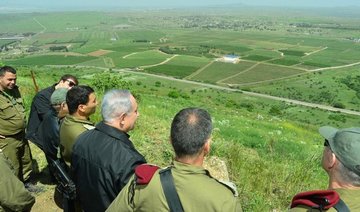
US, Britain condemn alleged Iranian attack in Golan

Britain’s Foreign Secretary Boris Johnson urged Iran to refrain from actions that could destabilize the region, after a suspected Iranian rocket attack against Israeli positions in the Golan Heights. (AFP)
Updated 10 May 2018
Follow

US, Britain condemn alleged Iranian attack in Golan

  • Foreign Secretary Boris Johnson called on Russia to press the Syrian government, its ally, to work toward a broader political settlement.
  • German Chancellor Angela Merkel and French President Emmanuel Macron called for a de-escalation in the Middle East.

JERUSALEM: The United States on Thursday condemned Iran’s “provocative rocket attacks”  from Syria and supported Israel's right to defend itself.

“The Iranian regime’s deployment into Syria of offensive rocket and missile systems aimed at Israel is an unacceptable and highly dangerous development for the entire Middle East,” the White House said in a statement.

It said Iran’s Islamic Revolutionary Guard Corps “bears full responsibility for the consequences of its reckless actions.”

Britain also condemned “in the strongest terms” Iran’s rocket attack against Israeli positions in the Golan Heights and warned against “further escalations” after the attack and retaliatory air strikes by Israel.
In a statement Thursday, Foreign Secretary Boris Johnson urged Iran to refrain from actions that could destabilize the region. Johnson also called on Russia to press the Syrian government, its ally, to work toward a broader political settlement. He warned against “further escalations” between Iran and Israel.

The minister added “we strongly support Israel’s right to defend itself.”
He called for the Iranian regime to “refrain from further actions which will only lead to increased instability in the region.
“We also continue to call on Russia to use its influence to press those in Syria to cease their destabilising activity and work toward a broader political settlement,” he added.

The attack in the Golan prompted Israel to launch a wave of missile strikes at Iranian targets inside Syria. Iran has not commented on the exchange of fire. Syria’s military said the Israeli strikes killed three people and damaged a number of its air defense units.
German Chancellor Angela Merkel and French President Emmanuel Macron called for a de-escalation in the Middle East after an alleged Iranian rocket barrage on Israeli positions in the Golan Heights prompted Israeli strikes on Iranian targets in Syria.
Merkel and Macron met in Aachen, Germany Thursday on the sidelines of a ceremony where Macron was awarded a prize for contributions to European unity. The German government said they discussed events in the Middle East and called for “level-headedness and de-escalation in the region.”
Merkel alluded to the two countries’ support for the Iran nuclear deal. She said: “We know that we face an extremely complicated situation here. The escalation of the last few hours shows it is truly a matter of war and peace, and I can only call on all involved to exercise restraint.”

Chancellor Angela Merkel's office also said that the German leader has condemned an Iranian rocket barrage on Israeli positions in the Golan Heights in a phone conversation with Iranian President Hassan Rouhani.
Merkel's office said the two leaders spoke Thursday.
Merkel's office also said that she condemned the overnight attacks on Israeli positions "and called on Iran to contribute to de-escalation in the region." It didn't say how Rouhani responded.

Russian Foreign Minister Sergei Lavrov Thursday called for dialogue between Israel and Iran following Israeli strikes on Iranian targets in Syria that marked a sharp escalation between the two enemies.
“This is a very disturbing trend. We proceed from the fact that all issues should be solved through dialogue,” Lavrov said at a press conference.
He added that Russia had warned Israel to avoid “all actions that could be seen as provocative” the day before the strikes, when Israeli Prime Minister Benjamin Netanyahu was in Moscow for talks with Russian President Vladimir Putin.

Syria’s military said overnight Israeli airstrikes killed three people, wounded two and destroyed a radar station, an ammunition warehouse, and damaged a number of air defense units.
Syrian Brig. Gen. Ali Mayhoub, who read the statement on Syrian television Thursday, said Syrian air defense systems had intercepted “the large part” of the incoming Israeli strikes.

Israel’s defense minister said the military has struck “nearly all” of the Iranian infrastructure sites in Syria.
Avigdor Lieberman said Thursday Israel responded fiercely to an unprecedented rocket attack by Iranian forces in Syria against Israel. He said no one was harmed in Israel and all the rockets were either intercepted or fell short.


Refugees, migrants in Lebanon find rare sanctuary from Israeli strikes in Beirut church 

Updated 07 March 2026
Follow

Refugees, migrants in Lebanon find rare sanctuary from Israeli strikes in Beirut church 

  • Beirut church offers safe haven for displaced migrants, refugees
  • Many refugees lived through 2024 war, but are now more vulnerable

BEIRUT: When Israeli strikes began pummelling Beirut’s southern suburbs early on Monday, Sudanese refugee Ridina Muhammad and her family ​had no choice but to flee home on foot, eventually reaching the only shelter that would accept them: a church.
Eight months pregnant, Muhammad, 32, walked with her husband and three children for hours in the dark streets until they found a car to take them to the St. Joseph Tabaris Parish, which has opened its doors to refugees and migrants.
They are among 300,000 people displaced across Lebanon this week by heavy Israeli strikes, launched in response to a rocket and drone attackinto Israel by the Lebanese armed group Hezbollah.
Just 100,000 of the displaced are in government shelters. Others are staying ‌with relatives ‌or sleeping in the streets. But migrants and refugees say government ​shelters ‌were ⁠never an option ​for ⁠them, saying they were turned away during the last war between Hezbollah and Israel.
Muhammad’s oldest daughter, now seven, stopped speaking after the 2024 war.
This time, they are even more vulnerable: their home was destroyed in this week’s strikes and Muhammad is due to give birth at the end of the month.
“I don’t know if there’s a doctor or not, but I’m really scared about it because I haven’t prepared any clothes for the baby, nor arranged a hospital, and I don’t know where to go,” she told ⁠Reuters as her younger daughter leaned against her pregnant belly.
Muhammad ‌said she was registered with the United Nations’ refugee agency (UNHCR) ‌but had not received support.
“Us, as refugees, why did we ​register with the UN, if they are not ‌helping us in the most difficult times?” she said.
Dalal Harb, a spokesperson for UNHCR ‌Lebanon, said the agency had mobilized but reaching everyone immediately was extremely challenging given the scale and speed of displacement. The UNHCR operation in Lebanon is currently only around 14 percent funded, she said.
The Jesuit Refugee Service (JRS), which helped the church host displaced in 2024, is doing so again.
Michael Petro, JRS’ Emergency Shelter Director, said the church was ‌full within the first day of strikes, with 140 people from South Sudan, Ethiopia, Bangladesh, and other countries sheltering there.
“There are many, many more ⁠people coming than there ⁠were in 2024, and we have fewer and fewer places to put them,” he said.
Petro said he was told weeks ago that government shelters would be open to migrants if war erupted.
But when the strikes began and even Lebanese struggled to find shelter, the policy seemed to change, he said.
“We’re hearing from hotlines up to government officials and ministries that migrants are not welcome,” Petro said.
Lebanon’s Minister for Social Affairs Haneen Sayyed did not respond to a request for comment. On Thursday, Sayyed said Beirut shelters were full.
When Israeli strikes began, Othman Yahyeh Dawood, a 41-year-old Sudanese man, put his two young sons on his motorcycle.
They drove 75 kilometers (46 miles) from the southern Lebanese town of Nabatieh to St. Joseph’s, where they had sheltered in 2024.
“I know the area ​is safe and there are people who ​will welcome us,” he said.
“We don’t know where to go; there’s war there (in the south), war here (in Beirut), war in Sudan, and nowhere else to go,” he said.