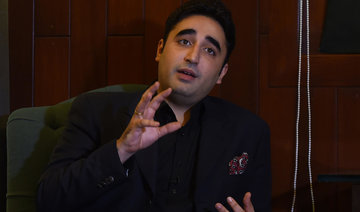
KARACHI: The Pakistan People’s Party (PPP) has pledged to protect the national economy and the most vulnerable in society from the upcoming issues the country may have to face.
The party said that it would immediately introduce four measures if elected to power, including initiating contact with key global economic players to create a home-grown plan for stabilization.
The party, which was founded in 1967 and has used the slogan ‘Roti, kapra aur makaan’ (food, clothes and shelter) since its inception, has now added ‘Ilm, sehat, sab ko kaam’ (education, health and jobs for all) to its election slogan.
Deputy Chairman of Senate, Saleem Mandviwala told Arab News: “A major difference between PPP’s 2013 and 2018 manifesto is that now we are talking more about people’s right to economy rather than business economy. Our plan is people-driven.”
Mandviwala, the former finance minister of Pakistan, who is a strong candidate for the position in the upcoming elections, said that the upcoming government will have to face tough challenges with enlarged trade and fiscal deficits.
“The trade deficit is very dangerous. If no immediate action is taken, the country will have big problems,” he warned.
In its manifesto the party announced that it will set up a joint parliamentary committee to prepare a basic national economic agenda to ensure cross-party commitment to reforms of taxation, government spending and public debt.
“To enhance competitiveness of the export sector, surcharges for the five export-oriented sectors will be rationalized. All free trade agreements will be reviewed,” the 2018 manifesto said.
The PPP also announced that it would restructure the Federal Board of Revenue (FBR) by splitting it into three. Reform of agriculture would focus on hunger eradication and food security, the reduction of poverty and restructuring economic growth.
The party has also promised to review the current trade policy, restructuring trade and industry, to reform the energy sector, rationalize oil and gas policies, and also to reform state-owned enterprises reforms and labor policy.
Commenting on the manifesto, Muzamil Aslam, a senior economist, said: “The PPP manifesto has listed issues and their solutions taking into account concerns of the general public. While all of this looks great on paper, the reality is that their solutions are very difficult to implement.”
As a left-leaning party, adopting socialist values and supporting public ownership of entities, egalitarianism, equality and a strong national defense, PPP has ruled Sindh for the past 10 years.
A report by Topline Securities showed that a series of reports (FY14, FY17 and FY18), published by PRIME on the performance of provincial governments in Pakistan, showed that Sindh had the lowest rating at just 3.3 points out of 10 while Punjab and Khyber-Pakhtunkhwa scored 5.5 and 4.7 points respectively.
The party leadership has been faced with serious allegations of corruption and misuse of public funds in the province during its tenure, with the National Accountability Bureau (NAB) currently investigating a number of corruption cases against the party.
Senior analyst Mazhar Abbas said: “No government made any necessary legislation against corruption or the de-politicization of NAB, and now they are worried because the watchdog is taking action. They did not empower local governments and kept control of the finances in their hands, which is one of the reasons they are facing corruption allegations.”
However, Mandviwala, said that the corruption allegations were a sign of a “personal agenda” against the party and its leadership. “If I do not want to commit corruption, nobody can force me. Corruption has nothing to do with the party,” Mandviwala said confidently.
Economists and analysts believe that if the party implements between 60 to 70 percent of its promises, it can make a huge difference, especially in Sindh.