

PPP suspends rallies in KP after deadly attacks

1 / 3
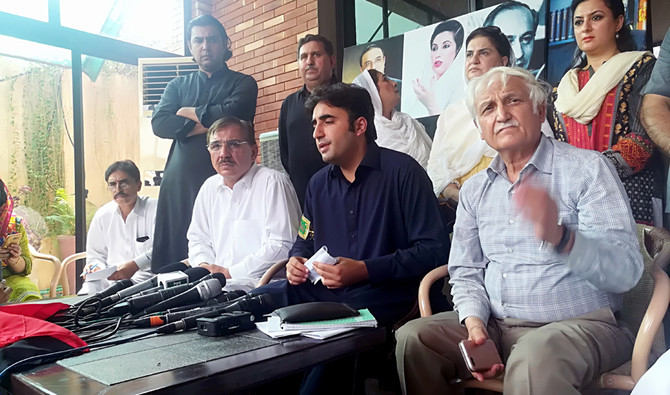
PPP chairman Bilawal Bhutto Zardari and other party leaders addressed a news conference in Peshawar on Saturday. (AN Photo)
2 / 3
PPP chairman Bilawal Bhutto Zardari and other party leaders addressed a news conference in Peshawar on Saturday. (AN Photo)
3 / 3
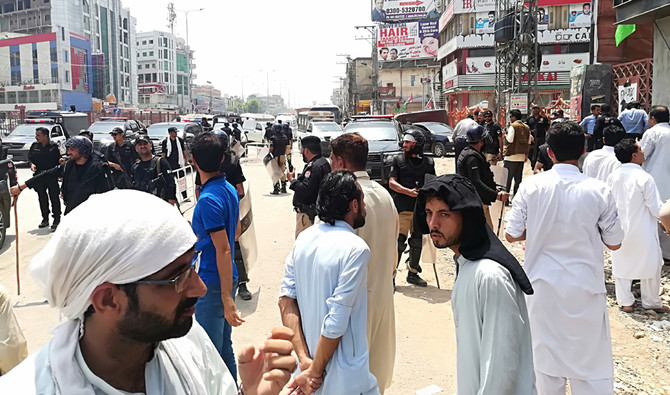
Security personnel stand guard ahead of Bilawal Bhutto Zardari’s for press conference. (AN Photo)
Updated 24 July 2018
Follow

PPP suspends rallies in KP after deadly attacks

  • PPP Chairman Bilawal is contesting election on a National Assembly (NA-9) seat for Malakand, a district of KP
  • Now Bilawal will meet his party activist only and not address any public gathering in Khyber Pakhtunhwa

PESHAWAR: Pakistan People’s Party (PPP) Chairman Bilawal Bhutto Zardari announced the suspension of political rallies in the northwestern province of Khyber Pakhtunkhwa (KP) after a recent wave of deadly terrorist attacks on political gatherings.

He also alleged that his party is not getting a level playing field for the forthcoming elections.
Speaking at a news conference in Peshawar, on Saturday, Bilawal said he has been told by provincial authorities not to move out of Peshawar cantonment and also not to hold rallies in KP.
“I am suspending my political rallies because of the recent attacks in KP and Balochistan (provinces) that claimed dozens of lives. We had planned to hold rallies in Peshawar and Malakand during my visit to KP but now we have canceled these events. How can I carry out my campaign when people are grieving for their loved ones?” he said.
However, Bilawal added that he was going to meet party activists in Malakand area but will not address public gatherings.
The PPP Chairman himself is contesting the election on a National Assembly (NA-9) seat for Malakand, a district of KP.
Bilawal urged that the authorities should fully implement the national action plan against terrorism that was formulated after the deadly terrorist attack on an army public school in Peshawar in 2014.
“The pre-poll rigging is under way as my rallies are also not covered well in the media,” he said.
He added that Awami National Party (ANP) and Balochistan Awami Party’s rallies were targeted with bombs, and PPP leaders are also being asked by law enforcement departments to avoid campaigns.
“In several areas we were impeded. I had issues in South Punjab and also my flight to Peshawar was once denied permission. Also, my workers were even pressurized to switch loyalties.”
But he clarified that the PPP would never boycott polls and his party has always demanded on-time elections.
Elaborated security arrangements were made for Bilawal’s visit to Peshawar.
Nighat Aurakzai, the PPP’s KP president, told Arab News that Pakistan Tehreek-e-Insaf (PTI) promoted militancy by funding a madrassa, a religious seminary.
PTI’s provincial government, before completing its term in May this year, announced that it was granting 227 million rupees ($2 million) to Darul Uloom Haqqania which is run by renowned cleric-turned-politician Maulana Samiul Haq, who is known to have some influence on Afghan Taliban leaders as many of them were his students.
PPP Senator Behamand Tangi told Arab News that the party enjoys support in different areas and particularly has a good vote bank in Charsadda, Nowshera, Swat, Upper Dir, Lower Dir, Chitral and in Peshawar districts.
However, he also alleged that the PTI enjoys the support of the military establishment.
“ANP and JUI-F rallies were targeted with bomb attacks, while PPP leaders are also being prevented from election campaigning, while the PTI is freely holding rallies and doing their election campaign,” he said.
A senior analyst, Rahimullah Yusufzai, says that the PPP might win more seats in the coming elections than in 2013, but he maintained that the deteriorating security situation is disturbing the elections scenario.
“I don’t see a big change for PPP but it seems they can win a few more seats in the 2018 polls, compared with the previous elections,” he added.

Rubio to visit eastern Europe, bolster ties with pro-Trump leaders

Updated 2 sec ago
Follow

Rubio to visit eastern Europe, bolster ties with pro-Trump leaders

  • Energy cooperation and NATO commitments will be discussed
  • Trump’s hard-right supporters view ‌Hungary’s Orban as a model
MUNICH: US Secretary of State Marco Rubio is set to begin a two-day trip on Sunday, to bolster ties with Slovakia and Hungary, ​whose conservative leaders, often at odds with other European Union countries, have warm ties with President Donald Trump.
Rubio will use the trip to discuss energy cooperation and bilateral issues, including NATO commitments, the State Department said in an announcement last week.
“These are countries that are very strong with us, very cooperative with the United States, work very closely with us, and it’s a good opportunity to go see them and two countries I’ve never been in,” Rubio told reporters before departing for Europe on Thursday.
Rubio, who in his dual role also serves as Trump’s national security adviser, will meet ‌in Bratislava on ‌Sunday with Slovak Prime Minister Robert Fico, who visited Trump ​in ‌Florida ⁠last month. The ​US ⁠diplomat’s trip follows his participation in the Munich Security Conference over the last few days.

WILL MEET VIKTOR ORBAN ON MONDAY
On Monday, Rubio is expected to meet with Hungarian leader Viktor Orban, who is trailing in most polls ahead of an election in April when he could be voted out of power.
“The President said he’s very supportive of him, and so are we,” Rubio said. “But obviously we were going to do that visit as a bilateral visit.”
Orban, one of Trump’s closest allies in Europe, is considered ⁠by many on the American hard-right as a model for the US ‌president’s tough policies on immigration and support for families and ‌Christian conservatism. Budapest has repeatedly hosted Conservative Political Action Conference ​events, which bring together conservative activists and leaders, ‌with another due in March.

TIES WITH MOSCOW AND CLASHES WITH THE EU
Both Fico and Orban have ‌clashed with EU institutions over probes into backsliding on democratic rules.
They have also maintained ties with Moscow, criticized and at times delayed the imposition of EU sanctions on Russia and opposed sending military aid to Ukraine.
Even as other European Union countries have secured alternative energy supplies after Moscow invaded Ukraine in 2022, including by buying ‌US natural gas, Slovakia and Hungary have also continued to buy Russian gas and oil, a practice the United States has criticized.
Rubio said ⁠this would be discussed ⁠during his brief tour, but did not give any details.
Fico, who has described the European Union as an institution that is in “deep crisis”, has showered Trump with praise saying he would bring peace back to Europe.
But Fico criticized the US capture of Venezuelan President Nicolas Maduro in early January.
Hungary and Slovakia have also so far diverged from Trump on NATO spending.
They have raised defense spending to NATO’s minimum threshold of 2 percent of GDP.
Fico has, however, refused to raise expenditure above that level for now, even though Trump has repeatedly asked all NATO members to increase their military spending to 5 percent. Hungary has also planned for 2 percent defense spending in this year’s budget.
On nuclear cooperation, Slovakia signed an agreement with the United States last month and Fico has said US-based Westinghouse was ​likely to build a new nuclear power ​plant.
He also said after meeting the chief of France’s nuclear engineering company Framatome during the week he would welcome more companies taking part in the project.