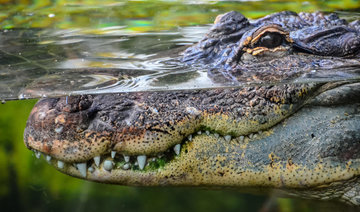
SYDNEY: An elusive monster saltwater crocodile weighing 600 kilograms (1,328 pounds) has finally been caught after an eight-year hunt in Australia, officials said on Tuesday.
The 4.7-meter (15.4-foot) beast was found in a trap downstream from the northern outback town of Katherine after first being spotted in 2010.
Authorities had tried in vain for years to bag the croc, which is estimated to be 60 years old.
“We’ve called it a lot of things over the years because it’s been so hard to catch,” senior wildlife officer John Burke told broadcaster ABC.
“It is a bit of a thrill, but you’ve also got to admire the size of the animal and how old it is. You’ve got to have a bit of respect for it.”
The animal was taken to a crocodile farm to keep it separate from the local human population, said Northern Territory wildlife operations chief Tracey Duldig.
“He is the biggest crocodile ever removed from the Katherine River by the Wildlife Operations Unit,” Duldig said in a statement.
Wildlife rangers capture around 250 “problem crocodiles” each year.
Saltwater crocodiles are a common feature of Australia’s tropical north and kill an average of two people a year.
The crocodile population has exploded since they were declared a protected species in the 1970s, with the killing of an elderly woman last year reigniting calls to curb their numbers.

Australia monster crocodile caught after eight-year hunt
Second doctor in Matthew Perry overdose case sentenced to home confinement
- Dr. Mark Chavez, 55, a onetime San Diego-based physician, pleaded guilty in federal court in October
- Judge Sherilyn Peace Garnett also sentenced Chavez to 300 hours of community service
LOS ANGELES: A second California doctor was sentenced on Tuesday to eight months of home confinement for illegally supplying “Friends” star Matthew Perry with ketamine, the powerful sedative that caused the actor’s fatal drug overdose in a hot tub in 2023.
Dr. Mark Chavez, 55, a onetime San Diego-based physician, pleaded guilty in federal court in October to a single felony count of conspiracy to distribute the prescription anesthetic and surrendered his medical license in November.
Judge Sherilyn Peace Garnett also sentenced Chavez to 300 hours of community service. As part of his plea agreement, Chavez admitted to selling ketamine to another physician Dr. Salvador Plasencia, 44, who in turn supplied the drug to Perry, though not the dose that ultimately killed the performer. Plasencia, who pleaded guilty to four counts of unlawful drug distribution, was sentenced earlier this month to 2 1/2 years behind bars.
He and Chavez were the first two of five people convicted in connection with Perry’s ketamine-induced death to be sent off to prison.
The three others scheduled to be sentenced in the coming weeks — Jasveen Sangha, 42, a drug dealer known as the “Ketamine Queen;” a go-between dealer Erik Fleming, 56; and Perry’s former personal assistant, Iwamasa, 60.
Sangha admitted to supplying the ketamine dose that killed Perry, and Iwamasa acknowledged injecting Perry with it. It was Iwamasa who later found Perry, aged 54, face down and lifeless, in the jacuzzi of his Los Angeles home on October 28, 2023.
An autopsy report concluded the actor died from the acute effects of ketamine,” which combined with other factors in causing him to lose consciousness and drown.
Perry had publicly acknowledged decades of substance abuse, including the years he starred as Chandler Bing on the hit 1990s NBC television series “Friends.”
According to federal law enforcement officials, Perry had been receiving ketamine infusions for treatment of depression and anxiety at a clinic where he became addicted to the drug.
When doctors there refused to increase his dosage, he turned to unscrupulous providers elsewhere willing to exploit Perry’s drug dependency as a way to make quick money, authorities said. Ketamine is a short-acting anesthetic with hallucinogenic properties that is sometimes prescribed to treat depression and other psychiatric disorders. It also has seen widespread abuse as an illicit party drug.


