Desperate rescue efforts as Japan rains toll continues to rise

1 / 3
In this July 7, 2018 photo, a resident is rescued in a flooded area in Kurashiki, Okayama prefecture, following heavy rain. Heavy rainfall hammered southern Japan for the third day, prompting new disaster warnings on Kyushu and Shikoku islands Sunday. (Shohei Miyano/Kyodo News via AP)
2 / 3
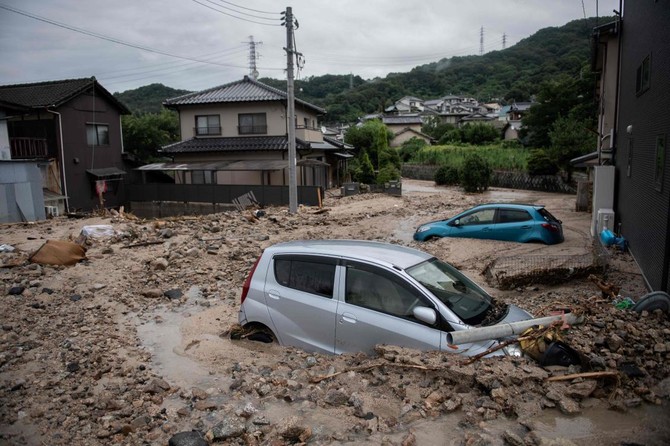
A picture shows cars trapped in the mud after floods in Saka, Hiroshima prefecture on July 8, 2018. (AFP)
3 / 3
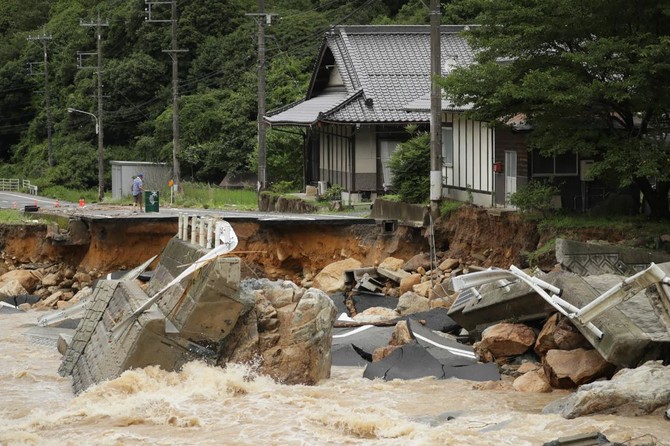
This picture shows a collapsed road due to heavy rain in Higashihiroshima, Hiroshima prefecture on July 7, 2018.(AFP / JIJI PRESS)
Updated 09 July 2018
Follow

Desperate rescue efforts as Japan rains toll continues to rise

KUMANO, Japan: Rescue workers, police and troops in Japan battled Monday to reach people feared trapped by devastating flooding and landslides after days of record rainfall killed at least 75 people.
As the rains finally began to ease, the government said several dozen more people remain missing.
And the death toll was expected to rise further, with local media reporting nearly 90 people killed and over 50 others unaccounted for.
The rains are the deadliest weather disaster in Japan since two typhoons that hit back-to-back in August and September 2011, killing nearly 100 people.
By Monday morning, the downpours had mostly ended across the worst-affected parts of central and western Japan, where entire villages were engulfed by flood waters or sudden landslides.
The meteorological agency downgraded its alerts for affected areas, but authorities warned that the risk of fresh landslides caused by rain-loosened earth remained high.
In the town of Kumano in Hiroshima prefecture, rescue workers were still digging through the dirt of a landslide that enveloped homes over the weekend, crushing some into little more than scrap wood.
Desperate family members of missing locals waited nearby for word of their relatives.
The nose of a white car was just visible underneath the entire top floor of one home that had been torn from the rest of a building and swept down a hillside.
Japan’s Prime Minister Shinzo Abe warned Sunday that rescue workers faced a “race against time” to reach people who remained trapped.
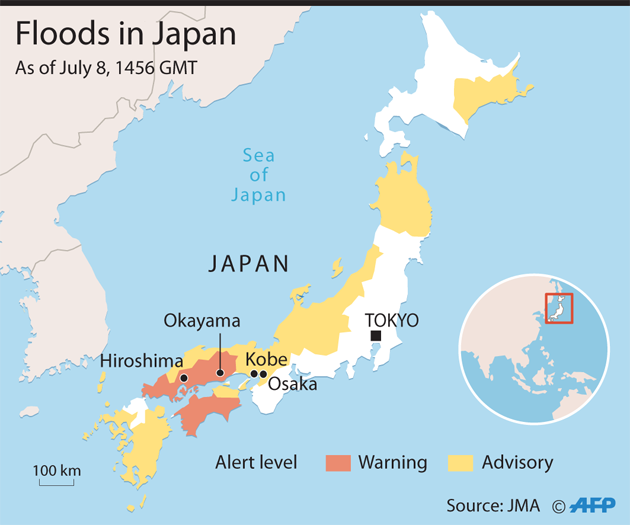

More than 54,000 emergency workers, police and troops have been deployed to help people, with the Self Defense Forces dispatching several planes to help airlift residents to safety.
In Okayama prefecture, rescue workers flew in helicopters over areas that are still under flood water and otherwise unreachable, looking for signs of life.
“As far as we could see from the helicopter, no-one is now waving for help,” a rescue worker from Kurashiki city told AFP.
Local government officials said pumping trucks were being deployed to help restore access to some of the worst-hit areas in the area, and with the rains stopped, water was starting to recede.
“Rescuers had to go by boat yesterday due to flooding but water is gradually receding today. If the water level drops low enough, they may be able to access hard-hit areas by road or on foot,” a spokeswoman at the area’s disaster control office said.
“It’s not raining today but we must stay alert for the possibility of landslides,” she told AFP.
At one point around five million people were told to evacuate, but the orders are not mandatory and many people remained at home, becoming trapped by rapidly rising water or sudden landslides.
In the town of Mihara, roads were transformed into muddy flowing rivers, with dirt piled up on either side as flood water gushed around the wheels of stranded cars.
“The area became an ocean,” 82-year-old resident Nobue Kakumoto told AFP Sunday, surveying the scene.
Several dozen Mihara residents ventured down from shelters on Sunday to inspect the damage to their homes in the Hongo district of the city, where many locals are rice farmers.
They found the flood waters had engulfed their rice fields and homes alike.
In the town of Saka, Eiichi Tsuiki opted to stay in his home, and survived only by moving to the top floor as flood waters rose, washing cars away outside.
“I’ve lived here for 40 years... I’ve never seen this before,” the 69-year-old oyster farmer told AFP.
Authorities said high temperatures were forecast for Monday, posing new challenges for the many people stuck in modestly equipped shelters with few possessions or damaged homes with no water or electricity.

Related


US lifts some Venezuela sanctions to ease oil sales

Updated 2 sec ago
Follow

US lifts some Venezuela sanctions to ease oil sales

  • Broad US license eases some sanctions on Venezuelan oil
  • Does not ease measures on production of Venezuelan crude
WASHINGTON: The administration of President Donald Trump lifted some sanctions on Venezuela’s oil industry on Thursday to make it easier for US companies to sell its crude oil, and said more restrictions on the country would be lifted soon.
The move by the Treasury’s Office of Foreign Assets Control authorizes US companies to buy, sell, transport, store and refine Venezuelan crude oil, but does not lift existing US sanctions on production.
A White House official said the measure “would help flow existing product” from Venezuela and that there will soon be more announcements on the easing of sanctions.
Trump has said the United States intends to control Venezuela’s oil sales and revenues indefinitely since US forces seized the country’s leader Nicolas Maduro in a raid on the capital Caracas on January ‌3.
He has said ‌he also wants US oil companies to eventually invest $100 billion dollars to ‌restore ⁠the OPEC-member nation’s production ‌to its historic peaks following years of underinvestment and mismanagement.
In the meantime, Washington and Caracas have already agreed an initial deal to sell 50 million barrels of Venezuelan crude oil, with European trading houses Vitol and Trafigura marketing the supply.
Treasury’s new authorization, known as a general license, opens up Venezuela oil trade to additional companies, provided they are from the United States.
It allows transactions involving the government of Venezuela and state oil company PDVSA related to “the lifting, exportation, reexportation, sale, resale, supply, storage, marketing, purchase, delivery, or transportation of Venezuelan-origin oil, including the refining of such oil, by an established US entity.”
It specifically excludes ⁠firms and individuals from rivals like China, Iran, North Korea, Cuba and Russia.
During President Donald Trump’s first administration, Treasury designated Venezuela’s entire energy industry as subject ‌to US sanctions in 2019 after Maduro’s first re-election, which Washington did ‍not recognize.
The new license does not authorize any payment ‍terms that are not commercially reasonable, involve debt swaps or payments in gold, or are denominated in digital ‍currency.
America first
Oil producers Chevron, Repsol and ENI, refiner Reliance Industries, and some US oil service providers had sought licenses in recent weeks to expand output or exports from the OPEC member.
Expanding production in the country would require additional US authorizations.
Jeremy Paner, a lawyer at Hughes Hubbard & Reed and a former OFAC sanctions investigator, said the authorization is broad in the sense that it opens up many operations including refining, transportation and “lifting” of Venezuelan oil.
But he said the scope is narrow in that it only applies to US companies.
Kevin Book, an analyst at ClearView Energy ⁠Partners, said the authorization could provide clarity for US companies while maintaining the previous standard of case-by-case review for non-US entities.
“In short, it appears to offer ‘America First, Others Ask’ sanctions relief.”
The large number of individual requests to the US government had delayed progress on plans to expand exports and get investment moving quickly into Venezuela, two sources said this week.
The new OFAC license, meanwhile, came as lawmakers in Venezuela on Thursday approved a sweetened reform of the country’s main oil law that is expected to grant autonomy to private producers in joint ventures or under new contracts to operate their projects and commercialize the output.
It also formalizes an oil production-sharing model first introduced by Maduro and negotiated with little-known energy firms in recent years.
Francisco Monaldi, director of the Latin American Energy Program at Rice University’s Baker Institute in Houston, said he wondered if the exclusion of Russian and Chinese entities would make it hard for PDVSA to operate or market oil from those ventures. Ventures ‌with those countries produce about 22 percent of the oil, he said.
“If they cannot export the oil coming from these ventures, that’s a big problem.”