


ISLAMABAD: As the world marks the 50th anniversary of the Nuclear Non-Proliferation Treaty, South Asia remains volatile and unstable, making one of the leading experts on the subject warn of more intractable nuclear crises in the future.
Dr. Moeed Yusuf is associate vice president of the Asia Center at the United States Institute of Peace. His new book, Brokering Peace in Nuclear Environments: US Crisis Management in South Asia, examines three crises between India and Pakistan soon after the two states demonstrated their nuclear capability in May 1998.
Unlike previous works in the area, Yusuf’s book does not provide a history of the region’s nuclearization. Instead, he takes the conversation beyond the idea of deterrence and brinkmanship, as understood in the classic sense and which has dominated the thinking of policymakers across the world for several generations.

Author, Moeed Yusuf, associate vice president of the Asia Center at the US Institute of Peace (USIP) — (Courtesy: USIP)
The result is a highly original contribution to nuclear theory –- an area that has largely remained the preserve of Euro-American scholars in the past — as Yusuf presents his own model of “brokered bargaining” to conceptualize crises in regional contexts.
“All nuclear deterrence and crisis literature comes from the Cold War when the crises remained, directly or indirectly, between the two strongest powers of the world,” he said in an exclusive interview with Arab News. “There was never a question of a third party that was stronger or could influence the crisis for any reason.
“Now the real crises in the world with nuclear weapons states will not be between the United States and the Soviet Union. They will be between new nuclear powers and will attract third-party intervention.”
Yusuf’s assertion makes ample sense in South Asia’s context, where India and Pakistan lack bilateral risk control mechanisms and where third parties have always tried to defuse tensions in the past before calamitous circumstances between the two countries could spiral out of control. As the book convincingly demonstrates, however, brokered bargaining is also generalizable in other regional contexts. Unsurprisingly, third-party intervention is central to the author’s thinking, making him claim that traditional notions of deterrence and brinkmanship have limited explanatory value in emerging nuclear crises where one must “internalize the centrality of the stronger third parties to study nuclear crisis behavior.”
“Most people who have written about this subject while looking at South Asia recognize the importance of third parties but consider them exogenous to such situations,” he maintained. “I believe that the third party is a vital factor in crisis planning, crisis thinking, crisis behavior and crisis strategy.”
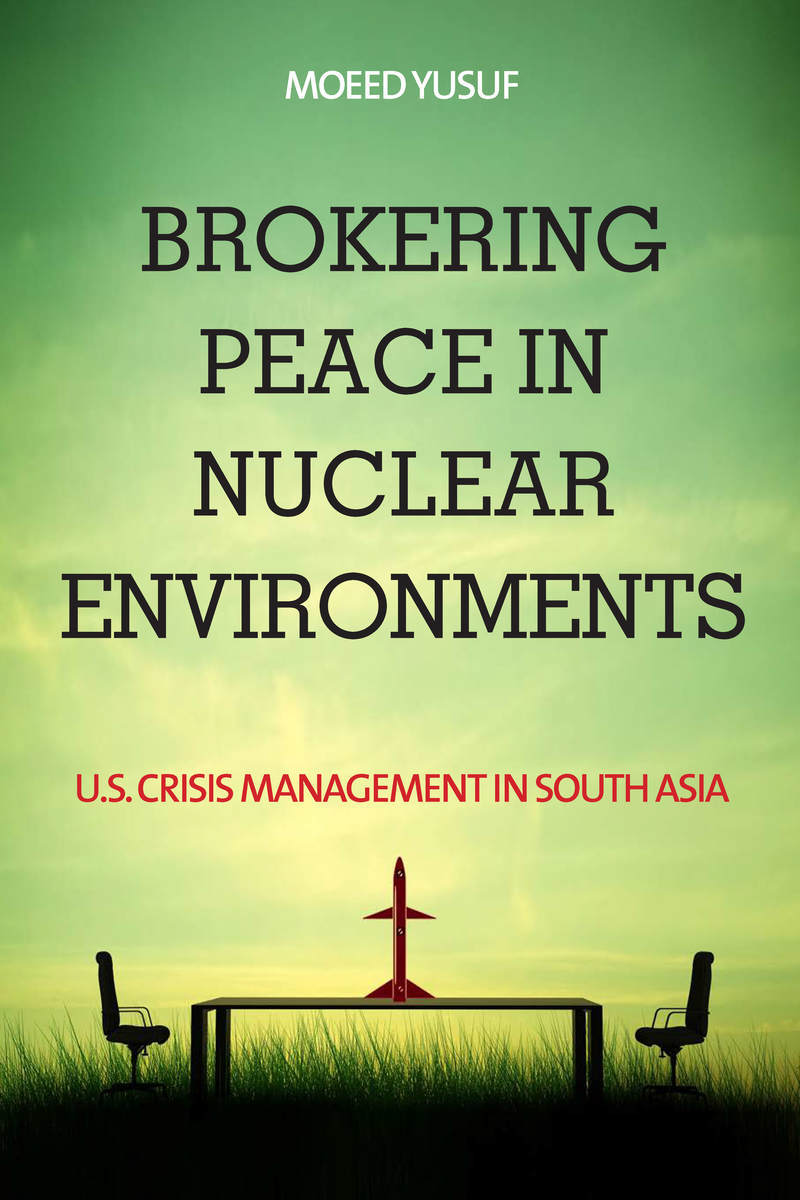
Book Cover — (Courtesy: Stanford University Press)
Yusuf’s conceptualization raises some interesting questions. If he is right and regional nuclear crises will always attract stronger powers to defuse the situation, for instance, what is to prevent smaller states in possession of nuclear weapons from manufacturing crises to extract concessions from global powers?
“This is exactly the mistake General Pervez Musharraf made in Kargil. He thought that because nuclear weapons were present, it was going to force the world not only to come and de-escalate the crisis but also to force India to find a permanent solution to Kashmir,” he responded.
Yusuf makes another significant observation, saying that the US and other powers “suspend their larger foreign policy interests” in such crisis situations and “show up with one principle object: to deescalate.”
“That is why India has always been disappointed with the US,” he points out. “After Mumbai, for instance, it thought that the world would descend upon Pakistan because of the circumstances and back India. In reality, the US played the middle and its goal was to separate India and Pakistan and make sure that things did not blow up.”
Yusuf’s analysis also raises questions about the role of third parties: What if they are not on the same page? What if one of them considers the situation as alarmingly dangerous while the other believes it still offers enough space to it to indulge in geopolitical maneuvering?
“Great power competition has resurged,” he admitted, “which means that the ability of the third parties to coordinate a de-escalation strategy is lower. But the Indian and Pakistani expectations from the third parties are still as high.”
He added: “It is crucial for third parties to create what I call contact groups during peace time … so that if a crisis is brewing they know how to activate themselves to ensure de-escalation rather than figuring out on the job, which is what has happened in the past.”
Yusuf’s study is so innovative and significant that a former US national security adviser, Stephen Hadley, has described it as “an absolute must-read for policymakers.” What is even better is his ability to make a technical subject accessible to ordinary readers.
Discussing the ongoing tensions between India and Pakistan, Yusuf points out that third-party crisis management is very tactical and only relevant to the crisis moment. Unless the world begins to focus on crisis prevention, he warns, it will continue to face difficult situations and every subsequent crisis will become more intractable.
“What we really need is a resolution of bilateral disputes,” he maintained. “In the case of South Asia, the two that stand out are the management of terrorist threats and the Kashmir dispute. Unless these are resolved, we will keep falling into crises -– and they will become more and more difficult to manage.”


