NEW YORK: Senior Myanmar military officials, including the commanders of its defense services and army, should face trial for crimes against humanity over the treatment of Rohingya minorities, Amnesty International said in a report on Tuesday.
Amnesty called for the United Nations Security Council to refer the report’s findings to the International Criminal Court (ICC) and impose a “comprehensive arms embargo” on the Southeast Asian country and financial sanctions against senior officials.
Contacted late on Tuesday, neither the Russian delegation to the United Nations, currently presiding over the UN Security Council, nor the Myanmar Mission to the United Nations were available for comment.
A spokesman for the Myanmar government also was not available for comment.
About 700,000 mostly Muslim Rohingya have fled to Bangladesh from largely Buddhist Myanmar since a military crackdown last August that the United Nations has called a “textbook example of ethnic cleansing.”
A separate Reuters special report https://reut.rs/2yLzrsV on Tuesday gave a comprehensive account of the roles played by two light infantry divisions in the offensive against the Rohingya.
Amnesty, which began its investigation in September, said in its report that the “military-led operations ... amounted to an orchestrated campaign of murder, rape, torture, and destruction aimed at punishing the Rohingya population in northern Rakhine State and at driving them out of the country.”
It named Senior General Min Aung Hlaing, the commander of Myanmar’s Defense Services, and his deputy and commander of the army, Vice Senior General Soe Win, and commanders of specific units that “committed many of the worst atrocities.”
The report also named eight other military members and three members of the Border Guard Police.
Amnesty said these people should face justice “for their command responsibility, their direct responsibility, or both.”
A spokesman for the Myanmar military was not available for comment.
In Myanmar, Rohingya are widely called “Bengali,” which they see as a derogatory term implying they are illegal immigrants from Bangladesh. Despite many Rohingya tracing their roots in Myanmar back generations, they have been denied citizenship.
Amnesty called on Myanmar to halt restrictions on freedom of movement and restore citizenship to the Rohingya.
In February, Reuters reported on the killing of 10 Rohingya men and boys by Rakhine Buddhists and security forces in the village of Inn Din.
Two Reuters journalists were jailed in December in Myanmar while reporting that story and remain in prison in Yangon, facing up to 14 years behind bars for allegedly violating Myanmar’s Official Secrets Act.
Myanmar has rejected most accusations of wrongdoing and has said it launched a legitimate counter-insurgency operation after attacks against its military by Rohingya militants last August.
In Myanmar there is no civilian oversight of military justice. The International Criminal Court, the world’s first permanent war crimes court, does not have automatic jurisdiction over Myanmar because it is not a member state.
However, the ICC has already been asked to consider a separate case dealing with Myanmar allegedly deporting Rohingya to Bangladesh, which is an ICC member state.
The ICC did not immediately respond to requests for comment outside business hours in The Hague.
If the UN Security Council referred Amnesty’s findings to the ICC, it would also grant the court jurisdiction to investigate.

Top Myanmar military officers should be tried for crimes against humanity -Amnesty
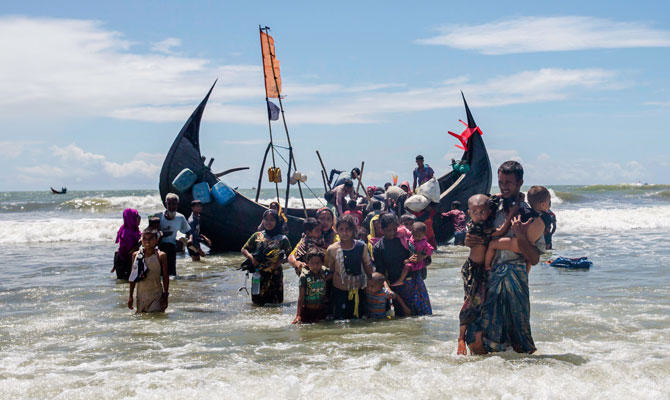
- Amnesty, which began its investigation in September, said in its report that the “military-led operations ... amounted to an orchestrated campaign of murder, rape, torture, and destruction aimed at punishing the Rohingya population
- About 700,000 mostly Muslim Rohingya have fled to Bangladesh from largely Buddhist Myanmar since a military crackdown last August that the United Nations has called a “textbook example of ethnic cleansing
Israel is risking global security, warns Somali Information Minister
- Tel Aviv’s actions boost terror groups he tells Arab News in exclusive interview
- Jama accuses Tel Aviv of wanting to relocate Palestinians from Gaza to region
RIYADH: Israel’s recognition of Somaliland and its presence in the region risks inflaming the situation there, allowing terrorist groups to undermine regional security and stability, according to Somali Information, Culture and Tourism Minister Daud Aweis Jama.
In a special interview with Arab News, Jama insisted that Israel’s unprecedented Dec. 26 move to recognize Somaliland as a sovereign state represents a major setback for Mogadishu’s fight against terrorist organizations like Al-Shabab and Daesh.
“The presence of Israel will be used by the terrorist groups to expand their operations in the region. (They will) have a pretext to spread their ideologies in the region,” he said.
“That is another factor that is also risking global security and regional stability, because we have been in the last stage of overcoming the challenges of the terrorist groups Al-Shabab and ISIS,” he added, using another term for Daesh.
Jama added: “We have been putting all our resources and all our time into making sure that we finalize the final stages of the fight against Al-Shabab. So, if something else interrupts us, that means that we are not going to focus fully on the operations against Al-Shabab. And that means we are giving more opportunities to Al-Shabab or other organizations.”
The consequences of this hit to Somalia’s ability to fight terror will not be restricted to the country’s borders, according to Jama, but will spread across the region and beyond.
“This might invite other, external terrorist groups to the region, because they will take advantage of this crisis and will make sure that they take over all the areas that have been defeated before,” the minister said.
“We believe this has come at a time that is going to affect our security as a Somali government, the security of the Horn of Africa, the security of the Gulf of Aden, the security of the Red Sea, the security of the Middle East and global stability. This is a very important location that holds the trade of the world.”
The minister underlined that Israel’s recognition and larger presence in the region are leading to more challenges, “putting more fuel on the ongoing challenges that exist in the region, especially in Somalia.” He added: “And at this time, it is not only limited to Somalia, but it’s going to be a challenge that is going to spread like a fire all over the region and all over the world.”
Jama told Arab News that Israel has other strategic motives for its recognition of Somaliland — including the forced resettlement of Palestinians from Gaza.
“According to reliable sources that our intelligence gathered, one of the conditions that Israel put forward (for recognizing Somaliland) was to have a place that they can settle the people from Gaza,” he said.
“We find that it is a violation also of the people of Palestine, because we believe that the people of Palestine have the right to self-determination. The two-state solution that has been the call of the international community has to be adhered to and implemented.”
Israel’s coalition government, the most right-wing and religiously conservative in its history, includes far-right politicians who advocate the annexation of both Gaza and the West Bank and encouraging Palestinians to leave their homeland.
Somalia’s UN Ambassador Abukar Dahir Osman said Security Council members Algeria, Guyana, Sierra Leone and Somalia “unequivocally reject any steps aimed at advancing this objective, including any attempt by Israel to relocate the Palestinian population from Gaza to the northwestern region of Somalia.”
Israel last month became the first country to recognize Somaliland as an independent nation. In the three-plus decades since its self-declaration of independence in 1991, no state had recognized the northwestern territory as being separate from Somalia.
Mogadishu immediately rejected the Israeli move, alongside countries all over the world.
Saudi Arabia affirmed its rejection of any attempts to impose parallel entities that conflict with the unity of Somalia. It also affirmed its support for the legitimate institutions of the Somali state and its keenness to preserve the stability of Somalia and its people.
A group of foreign ministers from Arab and Islamic countries, alongside the Organization of Islamic Cooperation, also firmly rejected Israel’s announcement. In a joint statement, the ministers warned that the move carries “serious repercussions for peace and security in the Horn of Africa and the Red Sea region” and undermines international peace and security.
The 22-member Arab League rejected “any measures arising from this illegitimate recognition aimed at facilitating forced displacement of the Palestinian people or exploiting northern Somali ports to establish military bases,” the organization’s UN Ambassador Maged Abdelfattah Abdelaziz told the UN Security Council.
In the most recent development in Israel-Somaliland relations, less than two weeks after Tel Aviv’s recognition, Israeli Foreign Minister Gideon Saar visited the region on Tuesday to publicly formalize diplomatic relations.
“It was a blatant violation of Somalia’s sovereignty that Israel recognized a region within the Somali Federal Republic as an independent state,” Jama underlined. “That was a total violation of international laws. It was a violation of the territorial integrity and sovereignty of Somalia.
“From the beginning, our path was to follow diplomatic efforts. And we kind of started with a successful UN Security Council meeting that supported Somalia’s territorial integrity and sovereignty. (This was) followed by other international actors like the Arab League, the Organization of Islamic Cooperation, the African Union and regional bodies like the East African Community and IGAD.
“Also, the Peace and Security Council of the African Union has reiterated the importance of supporting Somali sovereignty and territorial integrity.”


