

Pakistani politicians urge dialogue with Imran Khan’s party as PM offers talks

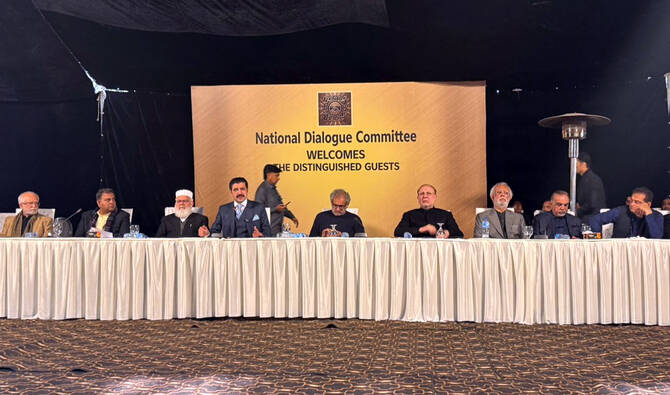
Member of the National Assembly (MNA), Sher Afzal Marwat (fourth left), addresses the National Dialogue Committee (NDC) in Islamabad, Pakistan, on January 7, 2026. (Faisal Fareed Chaudhry)
Short Url
Updated 07 January 2026
Follow

Pakistani politicians urge dialogue with Imran Khan’s party as PM offers talks

  • National Dialogue Committee group organizes summit attended by prominent lawyers, politicians and journalists in Islamabad
  • Participants urge government to lift alleged ban on political activities and media restrictions, form committee for negotiations 

ISLAMABAD: Participants of a meeting featuring prominent politicians, lawyers and civil society members on Wednesday urged the government to initiate talks with former prime minister Imran Khan’s Pakistan Tehreek-e-Insaf (PTI) party, lift alleged bans on political activities after Prime Minister Shehbaz Sharif recently invited the PTI for talks. 

The summit was organized by the National Dialogue Committee (NDC), a political group formed last month by former PTI members Chaudhry Fawad Husain, ex-Sindh governor Imran Ismail and Mehmood Moulvi. The NDC has called for efforts to ease political tensions in the country and facilitate dialogue between the government and Khan’s party. 

The development takes place amid rising tensions between the PTI and Pakistan’s military and government. Khan, who remains in jail on a slew of charges he says are politically motivated, blames the military and the government for colluding to keep him away from power by rigging the 2024 general election and implicating him in false cases. Both deny his allegations. 

Since Khan was ousted in a parliamentary vote in April 2022, the PTI has complained of a widespread state crackdown, while Khan and his senior party colleagues have been embroiled in dozens of legal cases. Prime Minister Shehbaz Sharif last month invited the PTI for talks during a meeting of the federal cabinet, saying harmony among political forces was essential for the country’s progress.

“The prime objective of the dialogue is that we want to bring the political temperatures down,” Ismail told Arab News after the conference concluded. 

“At the moment, the heat is so much that people— especially in politics— they do not want to sit across the table and discuss the pertaining issues of Pakistan which is blocking the way for investment.”

Former prime minister Shahid Khaqan Abbasi, who heads the Awaam Pakistan political party, attended the summit along with Jamaat-e-Islami senior leader Liaquat Baloch, Muttahida Quami Movement-Pakistan’s Waseem Akhtar and Haroon Ur Rashid, president of the Supreme Court Bar Association. Journalists Asma Shirazi and Fahd Husain also attended the meeting. 

Members of the Pakistan Peoples Party, the ruling Pakistan Muslim League-Nawaz (PML-N) and the PTI did not attend the gathering. 

The NDC urged Prime Minister Shehbaz Sharif, President Asif Ali Zardari and PML-N chief Nawaz Sharif to initiate talks with the opposition. It said after the government forms its team, the NDC will announce the names of the opposition negotiating team after holding consultations with its jailed members. 

“Let us create some environment. Let us bring some temperatures down and then we will do it,” Ismail said regarding a potential meeting with the jailed Khan. 

Muhammad Ali Saif, a former adviser to the Khyber Pakhtunkhwa chief minister, told participants of the meeting that Pakistan was currently in a “dysfunctional state” due to extreme political polarization.

“The tension between the PTI and the institutions, particularly the army, at the moment is the most fundamental, the most prominent and the most crucial issue,” Saif noted. 

‘CHANGED FACES’

The summit proposed six specific confidence-building measures. These included lifting an alleged ban on political activities and the appointment of the leaders of opposition in Pakistan’s Senate and National Assembly. 

The joint communique called for the immediate release of women political prisoners, such as Khan’s wife Bushra Bibi and PTI leader Yasmin Rashid, and the withdrawal of cases against supporters of political parties.

The communiqué also called for an end to media censorship and proposed that the government and opposition should “neither use the Pakistan Armed Forces for their politics nor engage in negative propaganda against them.”

Amir Khan, an overseas Pakistani businessperson, complained that frequent political changes in the country had undermined investors’ confidence.

“I came here with investment ideas, I came to know that faces have changed after a year,” Amir Khan said, referring to the frequent change in government personnel. 

Khan’s party, on the other hand, has been calling for a “meaningful” political dialogue with the government. 

However, it has accused the government of denying PTI members meetings with Khan in the Rawalpindi prison where he remains incarcerated. 

“For dialogue to be meaningful, it is essential that these authorized representatives are allowed regular and unhindered access to Imran Khan so that any engagement accurately reflects his views and PTI’s collective position,” PTI leader Azhar Leghari told Arab News last week.


Pakistani companies likely to raise over $89 million in new stock listings this year

Updated 5 sec ago
Follow

Pakistani companies likely to raise over $89 million in new stock listings this year

  • Farrukh H. Sabzwari says approvals for two listings already granted while 10 more Initial Public Offerings are expected over next 12 months
  • Economists expect KSE-100 index to reach 208,000 points by Dec., reflecting pent-up demand, strategic expansions and broader investor appetite

KARACHI: The Pakistan Stock Exchange (PSX) expects at least a dozen new listings this year, the PSX chief executive officer said on Monday, with the new entrants likely to raise as much as Rs25 billion ($89.3 million) in funding through the equity market.

Pakistan’s benchmark KSE-100 index has rallied to new highs and recorded returns of around 50 percent in Calendar Year (CY) 2025. The market closed at 182,384 points on Monday.

Around 135,000 new investors have also joined the PSX over the last 18 months, according to Pakistani state media.

“Continuing with the momentum, in CY2026, approvals for two Main Board listings have been granted,” PSX CEO Farrukh H. Sabzwari, who has previously served as a local partner of BoA Merrill Lynch and country head of CLSA Emerging Markets in Pakistan, told Arab News.

“PSX is expecting 10 more IPOs (Initial Public Offerings) over next 12 months across various sectors.”

Pakistan’s growing stocks mirror the country’s stabilizing economy which Prime Minister Shehbaz Sharif’s government expects would expand 3.9 percent this fiscal year through June with the help of the International Monetary Fund’s reforms-oriented $7 billion loan program.

The new IPOs would cover food, pharmaceutical, real estate investment trust (REIT), engineering, technology, oil and gas marketing, insurance, auto parts, manufacturing and energy sectors of the economy, according to Sabzwari.

Last year, the PSX listed Zarea Limited, Barkat Frisian Agro Limited, Image REIT, Pak Qatar Family Takaful, Blue-Ex Limited, Nets International Communication Limited and the Pakistan Credit Rating Agency Limited. These listings helped companies raise Rs4.3 billion ($15.4 million) of funding.

In addition, the PSX debt market witnessed seven issuances, valuing Rs10.5 billion ($37.5 million). Pakistan’s finance ministry raises funds through PSX by selling borrowing instruments like Islamic sukuk.

The PSX recorded the highest eight IPOs in a single year in 2021, according to Shankar Talreja, head of research at Topline Securities Ltd. It would be a record if the market lists 12 new entrants this year.

Sana Tawfiq, an economist at Karachi-based brokerage research firm AHL, described the market performance last year as “exceptional.”

“With projected fundraising of up to Rs25 billion ($89.3 million), the upcoming pipeline reflects pent-up demand, strategic expansions, and a broader investor appetite,” she said.

Tawfiq expects the KSE-100 index to reach 208,000 points by Dec. this year.

“As we look toward 2026, Pakistan’s equity market is entering a phase defined by stability, depth, and sustainable growth,” the economist said.

“The market is now transitioning toward a more measured trajectory.”

Key drivers in 2026 would likely include sustained domestic liquidity in equities, strengthening foreign reserves and a contained current account deficit, successful completion of the Pakistan International Airlines (PIA) privatization alongside accelerating progress on privatization and restructuring of power distribution companies (DISCOs), continued efforts to resolve circular debt in both power and gas sectors, and supportive global commodity prices, according to Tawfiq.

In a recent note to its clients, Topline Securities said the current IPO momentum was driven by macroeconomic stability under the IMF program, improving investor confidence and a declining interest rate environment.

Pakistan’s central bank last month cut its interest rate by 50 basis points to 10.5 percent in a surprising move aimed at boosting economic growth in the inflation-hit country.

“Despite ongoing geopolitical and macroeconomic uncertainties, investor sentiment continues to improve,” it said.