Pakistan biometric verification for Hajj pilgrims follows KSA directive

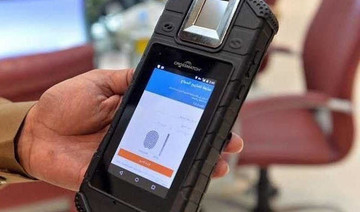
Pakistan’s Ministry of Religious Affairs and Interfaith Harmony has asked intending pilgrims to visit Etimad offices for biometric verification of fingerprints at their scheduled time. (SPA photo)
Updated 26 June 2018
Follow

Pakistan biometric verification for Hajj pilgrims follows KSA directive

  • Saudi authorities take initiatives each year to help Hajj pilgrims and improve their experience
  • Biometric verification of intending pilgrims is free of cost at 26 Etimad centers in Faisalabad, Multan, Islamabad, Karachi, Lahore, Peshawar, Quetta, Sukkar, Sialkot and Rahim Yar Khan

ISLAMABAD: Saudi Arabia has made biometric verification mandatory for Hajj pilgrims to streamline the identification process in the Kingdom, APP reports.
Pakistan’s Ministry of Religious Affairs and Interfaith Harmony has asked intending pilgrims to visit Etimad offices for biometric verification of fingerprints at their scheduled time and date and to bring original bank receipts, copies of Computerized National Identity Cards (CNIC) and passports before leaving for Saudi Arabia for Hajj 2018. 
The ministry’s press release said that biometric verification of pilgrims was continuing free of cost at 26 Etimad centers in Faisalabad, Multan, Islamabad, Karachi, Lahore. Peshawar, Quetta, Sukkar, Sialkot and Rahim Yar Khan. 
Pilgrims under 6 years of age and above 80 years of age are exempted from biometric verification. The ministry has already issued a schedule for the biometric verification of intending pilgrims. Information is available from www.hajjinfo.org or via the ministry’s helplines (042) 111725425; (051) 9205696, (051) 9216980-82, and through Hajji camps.
A biometric system for private Hajj pilgrims has been made mandatory. The process is intended to save time at Jeddah airport where pilgrims usually queue up to undergo the process, the ministry said. 
Once the verification is completed in Pakistan, pilgrims will only be required to have their passports stamped after entering the Kingdom.
Every year, Saudi authorities take various initiatives to help Hajj pilgrims and improve their experience.
The Kingdom has already inaugurated its dual-track light railway, connecting the three holy sites of Mina, Muzdalifah and Mount Arafat, to prevent unnecessary congestion and make it easier for pilgrims to travel.
In the past, it has created several entry and exit points at the Jamarat bridge to prevent a stampede.
The Ministry of Religious Affairs and Interfaith Harmony has informed intending pilgrims through phone calls and SMS about the need for biometric verification before submitting their passports for visa applications.


Militants kill 6 officers and a civilian in ambushes on police vehicles in northwest Pakistan

Updated 2 sec ago
Follow

Militants kill 6 officers and a civilian in ambushes on police vehicles in northwest Pakistan

  • Assailants ambushed a police vehicle and killed one officer in Kohat — When police reinforcements arrived minutes later, they launched another attack and killed five more officers and a civilian
  • No group claimed responsibility for this week’s attacks, but suspicion may fall on the Pakistani Taliban, also known as Tehrik-e-Taliban Pakistan, or the TTP
PESHAWAR, Pakistan: A pair of attacks on police vehicles by suspected militants killed at least six police officers and a civilian in northwest Pakistan on Tuesday, authorities said.
The assailants ambushed a police vehicle and killed one officer in Kohat, a district in Khyber Pakhtunkhwa province. When police reinforcements arrived minutes later, they launched another attack and killed five more officers and a civilian, police official Kamran Khan said.
Separately on Tuesday, a suicide bomber detonated explosives at a police post in Bukkur, a district in eastern Punjab province, killing two officers and wounding four others, police official Shahzad Rafiq said.
He provided no further details and only said officers were still investigating.
No group immediately claimed responsibility for the attacks, which have increased across the country in recent months.
President Asif Ali Zardari condemned the attacks in Kohat and Bukkur and offered condolences to the victims’ families.
The latest violence followed an attack on a paramilitary post in Karak on Monday, when a drone loaded with explosives wounded several officers. The attackers later ambushed two ambulances transporting the wounded, killing three officers and burning their bodies before fleeing. The driver of the second ambulance transported several wounded officers despite suffering burn injuries and authorities recovered the remains of the three officers.
No group claimed responsibility for this week’s attacks, but suspicion may fall on the Pakistani Taliban, also known as Tehrik-e-Taliban Pakistan, or the TTP. The TTP is separate from, but closely allied with, Afghanistan’s Taliban. Islamabad has accused the group of operating from inside Afghanistan, a claim the TTP and Kabul deny.
Pakistan’s military said it killed at least 70 militants on Sunday in strikes along the Afghan border, targeting hideouts of Pakistani militants blamed for recent attacks inside the country.