

Pakistan’s general polls keep Karachi’s printing market busy

1 / 11
Muttahida Majlis-e-Amal (MMA), an alliance of the religo-political parties, has decorated its vehicles after strict implementation of Election Commission of Pakistan’s code of conduct, which prohibits display of banners on private and public properties. (AN photo by M.F.Sabir)
2 / 11
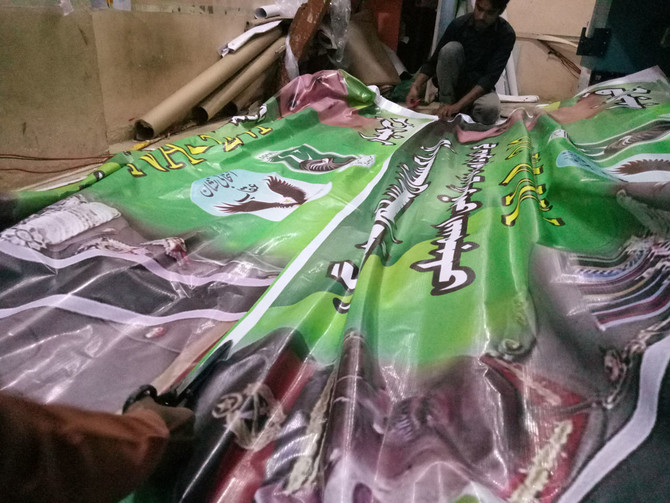
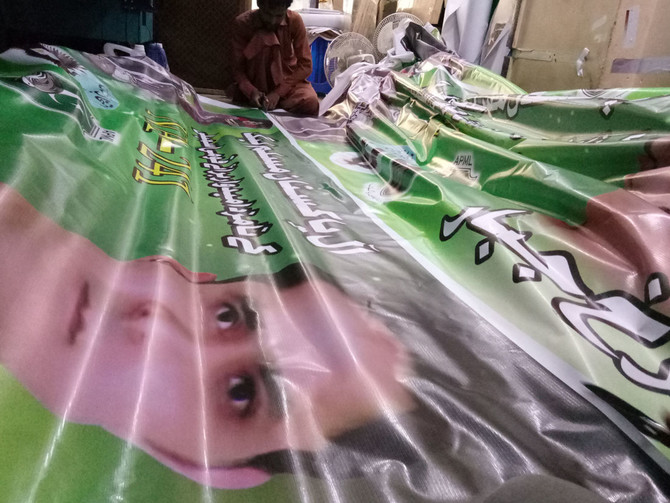
Staff at a printing press at Pakistan Chowk, Karachi, prepare banners for an All Pakistan Muslim League (APML) candidate. (AN photo by M.F.Sabir)
3 / 11
Staff at a printing press at Pakistan Chowk, Karachi, prepare banners for an All Pakistan Muslim League (APML) candidate. (AN photo by M.F.Sabir). General (Retd.) Pervez Musharraf has resigned as chief but will continue to be patron in chief of APML, according to party’s spokesman. (AN photo by M.F.Sabir)
4 / 11
A candidate for national assembly spends from Rs0.5million to Rs2million on printing material for his campaign, according to estimates by printing agents. (AN photo by M.F.Sabir)
5 / 11
Staff at a printing press at Pakistan Chowk, Karachi is preparing banners for a candidate of All Pakistan Muslim League (APML) here on Tuesday, June 26, 2018. General (R) Pervez Musharraf has resigned as chief but will continue to be patron in chief of APML, according to party’s spokesman. (AN photo by M.F.Sabir)
6 / 11
A printer shows candidates’ voter cards. (AN photo by M.F.Sabir)
7 / 11
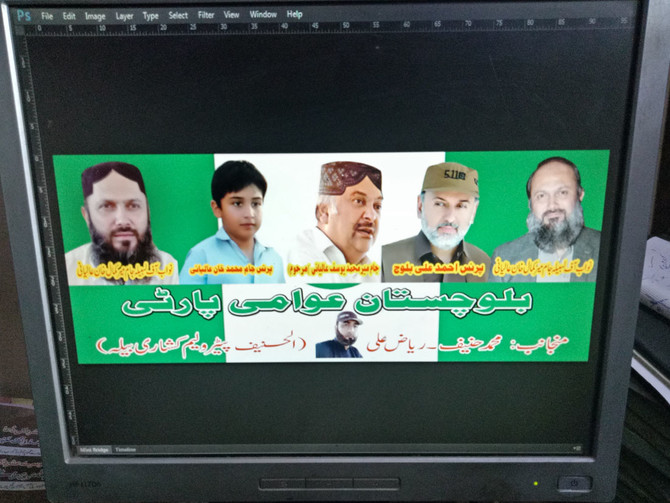
Candidates of recently formed Balochistan Awami Party (BAP) are also printing election material at Karachi’s Pakistan Chowk. (A photo by M.F.Sabir)
8 / 11
Adnan Qaiser, a printer at Pakistan Chowk, designing a poster for a candidate of the Awami National Party from Balochistan. (AN photo by M.F.Sabir)
9 / 11
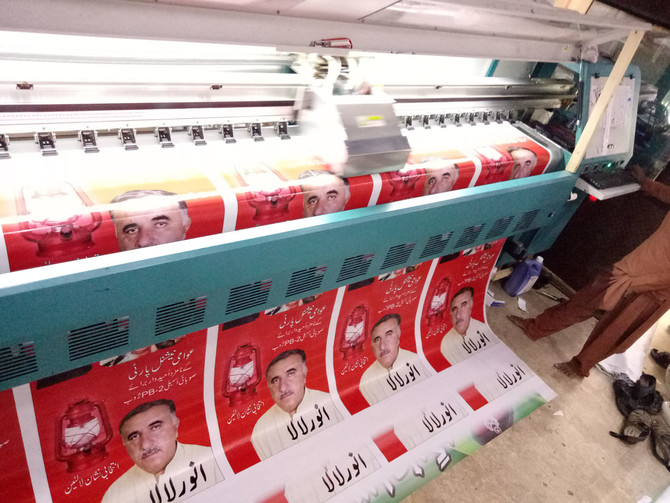
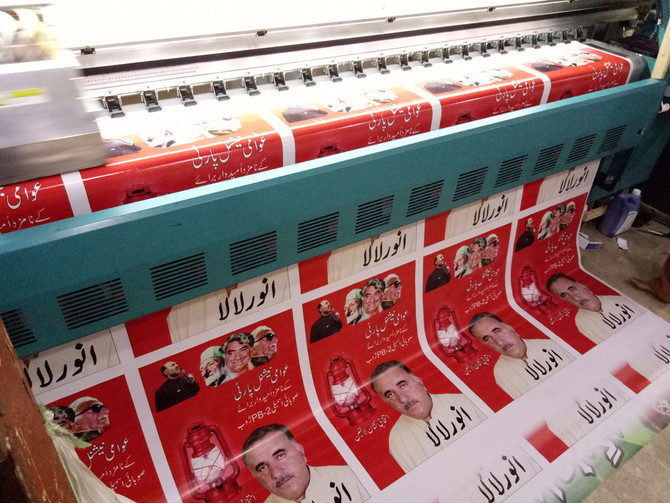
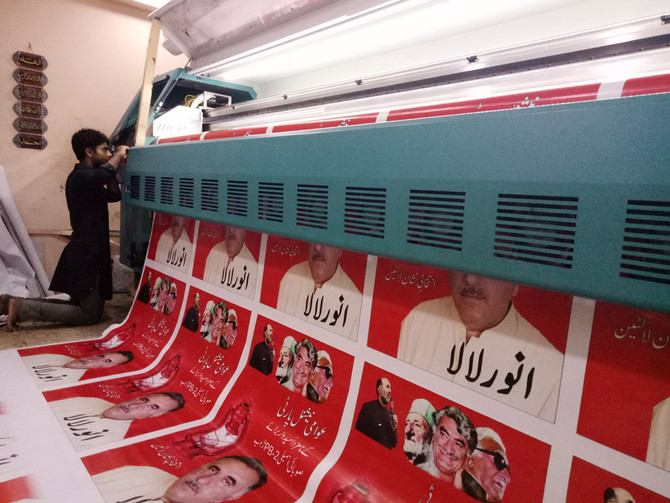
A printing machine at Pakistan Chowk, Karachi produces posters of Anwar Lala, an Awami National Party candidate from Zhob, Balochistan. (AN photo by M.F.Sabir)
10 / 11
A candidate for national assembly spends from Rs0.5million to Rs2million on printing material for his campaign, according to estimates by printing agents (AN photo by M.F.Sabir)
11 / 11
A printing machine at Pakistan Chowk, Karachi is processing posters of Anwar Lala, an Awami National Party’s candidate from Zhob, Balochistan here on Tuesday, June 26, 2018. (AN photo by M.F.Sabir)
Updated 26 June 2018
Follow

Pakistan’s general polls keep Karachi’s printing market busy

  • Nearly 7,000 candidates, including 2,100 from Karachi, are contesting 61 national and 130 provincial assembly seats from Sindh
  • Candidates spend between Rs 0.5 million to 2 million on printing election literature such as banners, hoardings, posters, pole banners, stickers, handbills, symbols, badges, flags and voters cards, says the printing agent

KARACHI: Printers at Pakistan Chowk Market in the seaside metropolis of Karachi are working until the small hours to keep up with demand for election campaign posters and fliers.

Pakistan is to hold general elections for national and four provincial assemblies on July 25, according to the Election Commission of Pakistan (ECP).

Final lists of the candidates will be issued in the next couple of days. However, according to ECP, nearly 7,000 candidates, including 2,100 from Karachi, have been cleared to contest 61 national and 130 provincial assembly seats from Sindh.

Those who know that they will be standing for election have already approached printing markets for printing of different display material, including banners, hoardings, hanging banners, symbols, handbills, badges, stickers and posters. Party flags and voter cards are also mandatory printing material, which have made the printers in several printing markets of the city busy.

“We close our press for four hours by 4am in the morning,” Adnan Qaiser, a printer at Pakistan Chowk told Arab News, adding as the election inches nearer, the work orders from clients will increase and there will be no break at all.

“Within the next couple of days, we will be working 24 hours a day and seven days a week,” Qaiser says. After the ECP issues final list of contenders everyone will start publicity, he adds.

Rehan Ahmed, a printing agent who collects orders from clients, said that a candidate for national assembly spends between Rs0.5million to Rs2million on campaign literature.

He added that influential candidates have a budget of up to Rs 2 million for printing, including thousands of banners, posters, steamers, pole banners and nearly 200,000 voters’ cards, which is distributed among electorates at their doorstep in advance.

Inquiry office, Landhi, Al-karam square Liaquatabad and Korangi industrial areas are other busiest places of printing in Karachi.

Pakistan Chowk, which the country’s largest market of digital and offset printing, receives printing orders from across Sindh and Balochistan provinces. 

“Although there printing presses in Quetta, most of the orders are placed in Karachi,” Ahmed told Arab News, who had printed material for former Chief Minister Balochistan, Sardar Sanaullah Zehri, besides other politicians during the last general elections.
Ahmed said that in Karachi the printing orders from MQM are down from the last election.

Qaiser said that in local government elections the independent candidates print most of the material, however, in general polls the political parties spend more on publicity.

Salman Ali, in-charge of printing for the Muttahida Majlis Amal (MMA), said the religious alliance has printed up to one lack square feet of material and printing is still under way.

He added that strict rules which prohibit candidates from displaying posters at public places and government properties have forced candidates to consider other options.

In the last general election the number of posters and banners was higher, but now the political parties and candidates are using funds to decorate election offices and vehicles.

The hike in dollar rates has increased the rates of Panaflex and other material imported from abroad, said Maqsood Ahmed, another printer in Pakistan Chowk market, who added that “neither the dollar rates nor the ECP code of conduct has shrunk the workload.”


Pakistan alleges India behind Balochistan attacks that killed 18 civilians, 15 troops

Updated 6 sec ago
Follow

Pakistan alleges India behind Balochistan attacks that killed 18 civilians, 15 troops

  • Interior Minister Mohsin Naqvi accuses India of planning coordinated attacks across Balochistan this week 
  • Military says it killed 133 militants on Friday and Saturday in separate operations across various areas in Balochistan

ISLAMABAD: Pakistan’s Interior Minister Mohsin Naqvi this week alleged that India was behind the recent coordinated attacks in the southwestern Balochistan province that the military says killed 18 civilians and 15 troops, vowing to go after those responsible for the violence. 

Pakistan’s military said on Saturday that it had killed 133 militants in the past two days in separate operations in Balochistan. The Inter-Services Public Relations (ISPR) said 41 militants were killed in operations in Panjgur and Harnai areas on Friday while 92 militants, including three suicide bombers, were killed on Saturday as security forces repelled coordinated attacks on civilians and law enforcement personnel in Quetta, Gwadar, Mastung, Nushki, Dalbandin, Kharan, Panjgur, Tump and Pasni areas. 

It added that 18 civilians, including women, children, elderly people and laborers, were killed in the attacks in Gwadar and Kharan, while 15 security personnel were also killed during clearance operations and armed standoffs.

“India is behind these attacks,” Naqvi said during a joint press conference in Quetta late Saturday night with Balochistan Chief Minister Sarfraz Bugti. “I can tell you for sure that India planned these attacks along with these terrorists.”

He vowed that Islamabad would go after the militants who carried out these attacks and their “masters.”

“At this time it is very necessary that the world knows that the main country that is behind terrorism is India, who not only financially supports terrorists but also supports them in their planning and strategy as well,” the minister said. 

In its statement on Saturday, the ISPR said the attacks were launched by “Indian sponsored Fitna al Hindustan,” a reference the military frequently uses for the separatist Balochistan Liberation Army (BLA) militant group. 

The BLA also issued a statement on Saturday, saying it had launched what it called “Operation Herof 2.0,” claiming responsibility for attacks in multiple locations across Balochistan. 

The military had said intelligence reports have confirmed the attacks were orchestrated and directed by militant leaders operating from outside Pakistan who were in direct communication with attackers during the assaults.

Pakistan has frequently blamed India for supporting militant attacks in Balochistan and its northwestern Khyber Pakhtunkhwa (KP) provinces, charges that New Delhi has vehemently denied. 

Balochistan, which borders Iran and Afghanistan, has faced a decades-long insurgency by separatist militant groups, with Pakistani authorities frequently accusing foreign actors of backing the violence. India has repeatedly denied such allegations.