

The Hezbollah connection: Missile chain of evidence from Tehran, to Lebanon, to Houthis

1 / 3
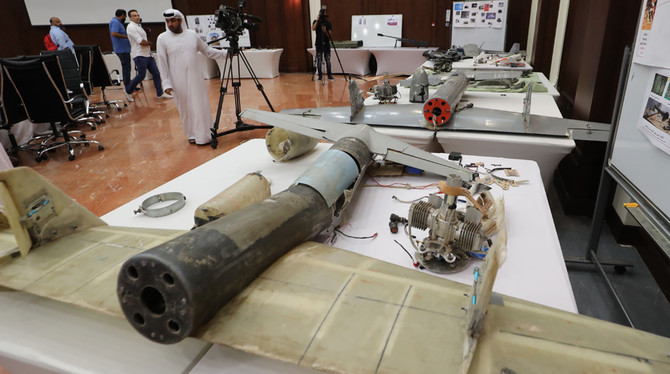
A picture taken on June 19, 2018 shows debris of Iranian-made Ababil drones displayed Abu Dhabi, which the Emirati armed forces say were used by Houthi rebels in Yemen in battles against the coalition forces led by the UAE and Saudi Arabia. (AFP / KARIM SAHIB)
2 / 3
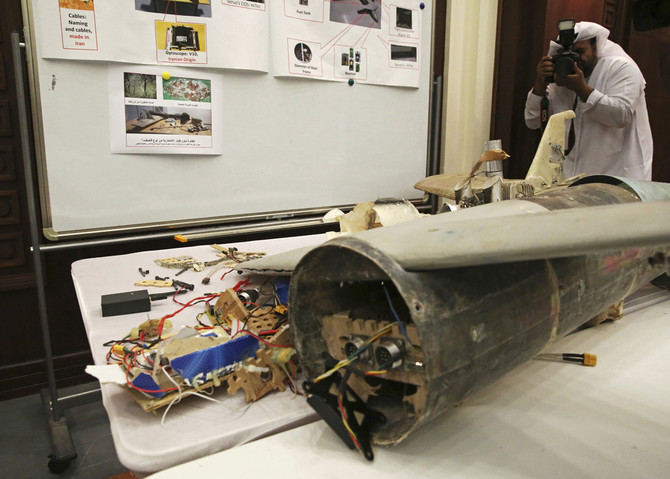
A photographer takes pictures of what officials describe as an Iranian Qasef drone captured on the battlefield in Yemen, during a news conference in Abu Dhabi, United Arab Emirates, on June 19, 2018. (AP Photo/Jon Gambrell)
3 / 3
Houthi supporters demonstrate in Yemen's capital, Sanaa, on June 25, 2018, in support of their allies engaged in battles against the coalition forces led by the UAE and Saudi Arabia in the Red Sea port city of Hodeidah. (AFP / Mohammed Huwais)
Updated 26 June 2018
Follow

The Hezbollah connection: Missile chain of evidence from Tehran, to Lebanon, to Houthis

  • Missile parts are smuggled into Yemen through the Red Sea port of Hodeidah, and coalition forces launched a military offensive on June 12 to wrest control of the port from the Houthis. 
  • Dozens of missiles fired from Yemen into Saudi Arabia have targeted Riyadh, Makkah and the southern cities of Jazan and Najran.

JEDDAH: Eight Hezbollah militants from Lebanon have been killed in a Saudi-led coalition attack in Maran in northern Yemen, near the Saudi border.

The presence of Iran-backed Lebanese Shiite militia members in the Houthi stronghold of Saada province supports the coalition accusation that Tehran supplies ballistic missiles to the Houthis, and Hezbollah technicians launch them at targets in Saudi Arabia.

“The coalition killed 41 terrorist elements in Maran and destroyed their vehicles and equipment. Among the dead were eight members of Lebanese Hezbollah, including a commander,” coalition spokesman Col. Turki Al-Maliki said on Monday.

Dozens of missiles fired from Yemen into Saudi Arabia have targeted Riyadh, Makkah and the southern cities of Jazan and Najran. After one attack last November, the Saudi Foreign Minister Adel Al-Jubeir accused Hezbollah of being responsible.

The coalition has produced evidence that the missiles are made in Iran, including fuel delivery mechanisms with Iranian labels.

Missile parts are smuggled into Yemen through the Red Sea port of Hodeidah, and coalition forces launched a military offensive on June 12 to wrest control of the port from the Houthis. 

Saudi officials have consistently maintained that their military intervention in Yemen is a war of necessity, not a war of choice, said Fahad Nazer, a Saudi political analyst and an International Fellow at the National Council on US-Arab Relations.

 “The fact that the Houthis continue to fire Iranian-supplied ballistic missile at civilian targets across Saudi Arabia, including as far as the capital Riyadh, is proof that the Houthis do pose a serious threat to the security of the countries in the region, including Saudi Arabia,” he told Arab News. 

“The Houthis have repeatedly shown a callous disregard for the safety and well-being of the people of Yemen, so it is not a surprise that they are showing the same disregard for the laws of war by targeting civilian infrastructure in Saudi Arabia.”

 Nazer was in Riyadh in April, when the Houthis fired a ballistic missile which was intercepted over the Saudi capital.

 “While these attacks do not disrupt life in the Kingdom, Saudi Arabia is well within its rights to take every measure necessary to make sure that its civilians and infrastructure are not vulnerable to the whims and callousness of this militant group,” he said. “It is not an accident that the legitimate government of Yemen and the Saudi-led coalition have the support of the entire international community.”

In Riyadh, meanwhile, the clear-up continued after the most recent attack on Sunday night, when Saudi air defenses intercepted two missiles over the capital.

Debris fell near the US mission and at a school in the diplomatic quarter, and on the roof of a private residence, but there was no serious damage.

Coalition spokesman Al-Maliki said the alliance’s advances on Hodeidah and other fronts were pushing the Houthis to try to project strength through such attacks.


Arab, Islamic youth explore Saudi heritage, holy sites, progress 

Updated 31 January 2026
Follow

Arab, Islamic youth explore Saudi heritage, holy sites, progress 

  • Participants in Holy Sites Journey program tour Makkah, Madinah, and Jeddah, witnessing world-class pilgrim services

JEDDAH: The 11th Holy Sites Journey Program recently concluded in Jeddah, with more than 114 youth from 33 Arab and Islamic countries participating.

The 10-day program was organized by the Ministry of Sport, in cooperation with the Organization of Islamic Cooperation and the League of Arab States.

Participants traveled across Makkah, Madinah, and Jeddah, exploring sacred sites, performing Umrah, and witnessing the Kingdom’s exemplary Hajj organizational practices.

They also visited historical landmarks, experienced modern sports facilities, and observed urban development projects, gaining insights into Saudi Arabia’s rich heritage, spirituality, and progress.

At a closing event in Jeddah on Thursday, Ahmed Al-Ghamlas, assistant deputy minister of sports for youth affairs, praised the participants and emphasized the Kingdom’s commitment to hosting programs that empower the next generation.

He also encouraged those taking part to serve, on returning to their home countries, as ambassadors conveying the Kingdom’s advancements in services for pilgrims.

Al-Ghamlas added: “The program aimed to strengthen cultural and youth communication between Arab and Islamic countries, highlight the Kingdom's leading role in serving Islam and Muslims, and empower youth by building their capabilities.”

Ambassador Tarig Ali Bakheet, assistant secretary-general for humanitarian, cultural, and social affairs at the Organization of Islamic Cooperation, praised Saudi Arabia's efforts in organizing the program for young people from Arab and Muslim countries, noting it as a step to promote cultural dialogue among youth from Islamic nations.

Participants expressed their appreciation and gratitude for the opportunity to be part of the journey, witness the Kingdom’s transformative projects and world-class facilities, and pledged to share the knowledge, experiences, and insights they gained with peers in their home countries.

Bilal Jabiro, head of the Syrian Ministry of Youth delegation, told Arab News: “It was a great journey, and I enjoyed every minute of it. We sincerely thank Saudi Arabia for giving us this opportunity to strengthen our ties with youth from other Islamic nations and to see firsthand the great services and facilities the Kingdom offers to visitors and pilgrims.”

Youssef Issa Al-Sharifi, a member of the Supreme Council for Algerian Youth, praised the program’s objectives, saying: “Participation is an opportunity for every Arab Muslim.”

Meanwhile, Hussain Saeed from Oman told Arab News that he was happy to see the expansion of the Two Holy Mosques, adding: “It was a very informative and educational journey.”

Syrian influencer Azam Al-Khaldi said the program combined worship, knowledge, and history.

“It was an amazing journey, and I had the pleasure of showing my followers every step of the 10-day program,” he added.