Iraq plans manual election recount only for suspect ballots

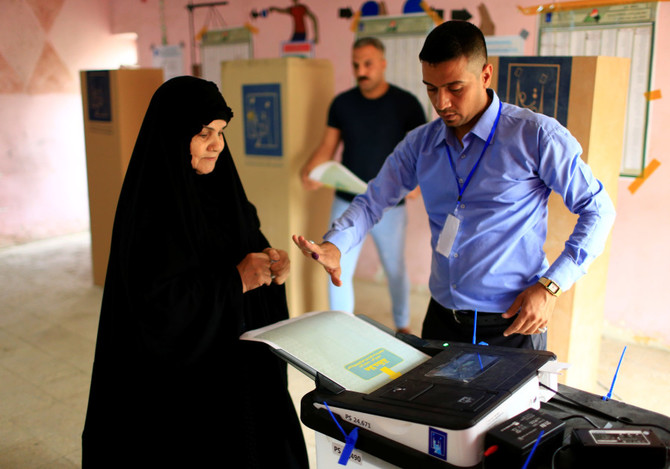
An Iraqi woman casts her vote at a polling station during the parliamentary election in Baghdad, Iraq May 12, 2018. (Reuters)
Updated 24 June 2018
Follow

Iraq plans manual election recount only for suspect ballots

  • The parliamentary election has been marred by historically low turnout and fraud allegations

BAGHDAD: Iraq will conduct a manual recount of votes from a May election only for ballots mentioned in official reports on fraud or in formal complaints, a move likely to speed up the ratification of final results and the formation of a new government.
The parliamentary election has been marred by historically low turnout and fraud allegations.
The outgoing parliament this month passed a law mandating a nationwide manual recount of votes, but the panel of judges now in charge of the recount said it would only be conducted for problematic ballots.
Interpreting a ruling from the Supreme Federal Court, a panel of judges who are now in charge of the elections commission said on Sunday they would only manually recount problematic ballots “out of respect for the will of voters and their rights ... and to preserve their vote which came without any violation.”
The law passed by parliament had also suspended the Independent High Election Commission’s nine-member board of commissioners and replaced them with judges.
Ballot boxes from areas where there were fraud allegations will be moved to the capital Baghdad, where the recount will be held in the presence of United Nations representatives at a time and place to be determined later, the panel said in a statement.
The historically slow and complex process of forming an Iraqi government after an election has been further complicated this time round because of the fraud allegations and subsequent recount. Now that only specific ballots will be recounted, a new government could be formed faster.
The full recount was voted for by an outgoing parliament in which a majority of lawmakers, including the speaker, failed to retain their seats in the May poll. The vote came after a government report said there were serious electoral violations, but the report only recommended a partial recount.
Parliament met on Sunday to discuss another law that would allow it to remain in session until final results are ratified, even though its term constitutionally ends next week on June 30.
Prime Minister Haider Al-Abadi, who’s electoral list came third in the poll, and the winner, cleric Moqtada Al-Sadr, entered into a political alliance on Saturday night, less than two weeks after Sadr announced a similar alliance with second-placed Iran ally Hadi Al-Amiri’s bloc, thus bringing the top three blocs together.
Sadr’s bloc has been boycotting parliament’s sessions. He and Amiri were against a full recount. Both Sadr and Abadi oppose the idea of the current parliament extending its mandate.


US condemns RSF drone attack on World Food Programme convoy in Sudan’s North Kordofan

Updated 42 min 27 sec ago
Follow

US condemns RSF drone attack on World Food Programme convoy in Sudan’s North Kordofan

  • Denise Brown, the UN Humanitarian Coordinator for Sudan, also expresses concern over the drone attack

WASHINGTON: The US has condemned a drone attack by Rapid Support Forces on an aid convoy in Sudan’s North Kordofan state that killed one person and injured three others.

“The United States condemns the recent drone attack on a World Food Program convoy in North Kordofan transporting food to famine-stricken people which killed one and wounded many others,” US Senior Adviser for Arab and African Affairs Massad Boulos wrote on X.

“Destroying food intended for people in need and killing humanitarian workers is sickening,” the US envoy wrote.

“The Trump Administration has zero tolerance for this destruction of life and of U.S.-funded assistance; we demand accountability and extend our condolences to all those affected by these inexcusable events and terrible war,” he added.

The Sudan Doctors Network said the convoy was struck by RSF drones in the Allah Karim area as it headed toward displaced people in El-Obeid, the state capital, Anadolu Agency reported.

The network described the attack as a “clear violation of international humanitarian law,” warning that it undermines efforts to deliver life-saving aid to civilians amid worsening humanitarian conditions across the country.

There was no immediate comment from the rebel group.


Denise Brown, the UN Humanitarian Coordinator for Sudan, in a statement also expressed concern over the drone attack which hit the aid trucks in North Kordofan.

“I am deeply concerned by a drone attack earlier today on trucks contracted by the World Food Programme (WFP) in North Kordofan, the aftermath of which I came across a few hours later, as I left the state capital, El Obeid.”

“The trucks were en route from Kosti to deliver life-saving food assistance to displaced families near El Obeid when they were struck, tragically killing at least one individual and injuring many more. The trucks caught fire, destroying food commodities intended for life-saving humanitarian response.”

Brown added that “Humanitarian personnel, assets and supplies must be protected at all times. Attacks on aid operations undermine efforts to reach people facing hunger and displacement.”

“Safe and unimpeded humanitarian access remains critical to ensure assistance reaches the most vulnerable people across Sudan.”

Since April 2023, the conflict between Sudan’s army and the paramilitary forces has killed tens of thousands, displaced 11 million and which the UN has described as one of the world’s worst humanitarian crises.

An alert issued by the Integrated Food Security Phase Classification (IPC), confirmed famine conditions in El-Fasher and Kadugli, the capital of South Kordofan, about 800 kilometers to the east.

The IPC said that 20 more areas in Sudan’s Darfur and neighboring Kordofan were at risk of famine.

Of Sudan’s 18 states, the RSF controls all five states in the western Darfur region, except for parts of North Darfur that remain under army control. The army holds most areas of the remaining 13 states across the south, north, east and center of the country, including the capital, Khartoum.

The conflict between the army and the RSF, which erupted in April 2023, has killed thousands of people and displaced millions.