Rights court dismisses Breivik’s complaint about jail conditions

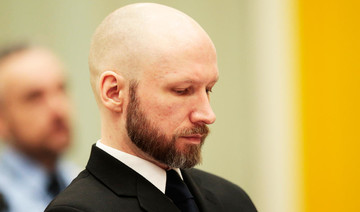
Breivik is serving a 21-year sentence for the July 2011 massacre of 77 people. (Lise Aaserud via Reuters)
Updated 22 June 2018
Follow

Rights court dismisses Breivik’s complaint about jail conditions

  • Norwegian officials have repeatedly rejected allegations that Breivik is isolated, arguing that he is treated as a “VIP prisoner” and has regular contact with prison staff, his lawyer and visitors
  • Breivik has the use of three cells, each measuring more than 10 square meters and equipped with a television, computer, DVD player and gym gear

STRASBOURG: The European Court of Human Rights on Thursday dismissed a complaint by Norwegian mass murderer Anders Behring Breivik over his prison conditions, ending a long-running saga that kept him in the public eye, tormenting his victims.
Breivik is serving a 21-year sentence for the July 2011 massacre of 77 people, most of them teenagers gunned down while attending a Labour Party youth camp on the small island of Utoeya.
The far-right, anti-Islam extremist took his case to the ECHR after Norway’s Supreme Court refused to hear his appeal last year against a ruling that his near-isolation in a three-room cell respected his human rights.
His lawyer argued that the prison conditions breached articles 3 and 8 of the European Convention on Human Rights: the former prohibits inhuman or degrading treatment, the latter guarantees a right to privacy and family life.
“His state (of mind) is deteriorating,” his lawyer Oystein Storrvik told AFP. “He is no longer able to study for example.”
But the court based in Strasbourg said that “its examination of the case did not reveal any violations of the Convention, and rejected the application as inadmissible for being manifestly ill-founded.”
Norwegian officials have repeatedly rejected allegations that Breivik is isolated, arguing that he is treated as a “VIP prisoner” and has regular contact with prison staff, his lawyer and visitors.
He has the use of three cells, each measuring more than 10 square meters and equipped with a television, computer, DVD player and gym gear. He has no Internet connection, however.
Survivors of the Utoeya massacre expressed satisfaction at the ruling.
“It’s a relief. We’re hoping not to hear his name again for many years to come,” Lisbeth Kristine Royneland, the head of a victims’ support group whose 18-year-old daughter was killed by Breivik, told AFP.
Writing on Twitter, a survivor of the massacre, Tore Remi Christensen, wrote: “The Breivik case is rejected in Strasbourg. Delighted. May he and all those who share his shitty message rot in hell.”
Breivik’s killing spree began on July 22, 2011, when he set off a bomb outside a government building in Oslo, killing eight people.
Disguised as a police officer and armed with a semi-automatic rifle and pistol, he then went to Utoya where the Labour Party was holding a youth camp, killing 69.
During his trial the extremist, who has changed his name to Fjotolf Hansen, repeatedly addressed the courts with Nazi salutes and complained about the cold coffee and frozen meals served in prison, among other things.
His sentence can be extended indefinitely if judges determine he remains a threat to society.


Lawsuit challenges Trump administration’s ending of protections for Somalis

Updated 10 March 2026
Follow

Lawsuit challenges Trump administration’s ending of protections for Somalis

  • The lawsuit cites a series of statements Trump has made describing Somalis as “garbage” and “low IQ people” who “contribute nothing.”

BOSTON: Immigrant rights advocates filed a lawsuit on Monday seeking to stop US President Donald Trump’s administration from next ​week ending legal protections that allow nearly 1,100 Somalis to live and work in the United States. The lawsuit, brought by four Somalis and two advocacy groups, challenges the US Department of Homeland Security’s decision to end Temporary Protected Status for Somali immigrants, whom Trump has derided in public remarks. Outgoing Homeland Security Secretary Kristi Noem in January announced that TPS for Somalis would end on March 17, arguing that Somalia’s conditions had improved, despite fighting continuing between Somali forces and Al-Shabab militants. The plaintiffs, who ‌include the groups ‌African Communities Together and Partnership for the Advancement ​of ‌New ⁠Americans, in the ​lawsuit filed ⁠in Boston federal court argue the move was procedurally flawed and driven by a discriminatory, predetermined agenda.
The lawsuit cites a series of statements Trump has made describing Somalis as “garbage” and “low IQ people” who “contribute nothing.”
The plaintiffs said the administration is ending TPS for Somalia and other countries due to unconstitutional bias against non-white immigrants, not based on objective assessments of country conditions.
“The termination of TPS for Somalia is racism masking as immigration policy,” ⁠Omar Farah, executive director at the legal group Muslim Advocates, said ‌in a statement.
DHS did not respond to ‌a request for comment. It has previously said TPS ​was “never intended to be a de ‌facto amnesty program.”
TPS is a form of humanitarian immigration protection that shields eligible migrants ‌from deportation and allows them to work. Under Noem, DHS has moved to end TPS for a dozen countries, sparking legal challenges. The administration on Saturday announced plans to pursue an appeal at the US Supreme Court in order to end TPS for over 350,000 Haitians. It ‌also wants the high court to allow it to end TPS for about 6,000 Syrians.

SOMALI COMMUNITY TARGETED
Somalia was first designated ⁠for TPS in ⁠1991, with its latest extension in 2024. About 1,082 Somalis currently hold TPS, and 1,383 more have pending applications, according to DHS. Somalis in Minnesota in recent months had become a target of Trump’s immigration crackdown, with officials pointing to a fraud scandal in which many people charged come from the state’s large Somali community. The Trump administration cited those fraud allegations as a basis for a months-long immigration enforcement surge in Democratic-led Minnesota, during which about 3,000 immigration agents were deployed, spurring protests and leading to the killing of two US citizens by federal agents.
In November, Trump announced he would end TPS for Somalis in Minnesota, and a month later said ​he wanted them sent “back to where they ​came from.”
The US Department of State advises against traveling to Somalia, citing crime and civil unrest among numerous factors.