Breivik blames prison isolation for becoming more radical

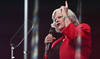
Anders Behring Breivik, center. (NTB Scanpix via AP)
Updated 13 January 2017
Follow

Breivik blames prison isolation for becoming more radical

SKIEN: Norwegian mass murderer Anders Behring Breivik said on Thursday he felt he had become “stranger and stranger” and more radical in his right-wing views in jail and blamed it on near-isolation since he massacred 77 people in 2011.
He expressed no remorse, however, for the massacre during a court hearing at which the Norwegian state is appealing against a lower court ruling in 2015 that the tough conditions violate Breivik’s human rights.
Breivik, who gave a Nazi-style salute at the start of the week-long court hearing on Tuesday, said that he lacked critical feedback about his ideas while in jail and that he would benefit from contact with other inmates.
“The last five years I’ve been completely isolated, not corrected a single time. I’ve sat in a cell 23 hours a day for almost 6 years ... I’ve become stranger and stranger as a direct consequence of this,” he said.
“I’ve become a lot more radical while I’ve been jailed,” he said in a subdued three-hour appearance in court, adding that he was “shocked by many of the things I have written.”
On July 22, 2011, Breivik killed eight people with a car bomb outside the prime minister’s office in Oslo and then shot 69 others on an island near the capital, many of them teenagers attending a youth camp of Norway’s then-ruling Labour Party.
Attorney General Fredrik Sejersted said the court would have to decide whether Breivik, 37, truly regretted his neo-Nazi extremism or was merely pretending to sound contrite in order to persuade the court to give him more freedom in jail.
“He’s saying what is rational for him to say in the circumstances,” Sejersted told Reuters.
On Wednesday, Sejersted also argued that Breivik had become more radical in jail but drew the opposite conclusion to Breivik, arguing he should still be kept away from other prisoners because he was still dangerous and wanted to spread a neo-Nazi ideology.
Breivik, who only meets professionals such as guards and health personnel, is compensated with a three-room cell that includes a personal gym, television, newspapers and playstation.
He declined to answer when Sejersted pressed him for a “yes” or “no” about whether he regretted the 2011 massacre.
Despite the Nazi salute and increasingly radical letters and writings in jail, Breivik told the court that his underlying commitment was now to peaceful means. “I am not a militant any more, not since 2012,” he said.
Breivik’s lawyer, Oeystein Storrvik, said his client’s isolation violates a ban on “inhuman and degrading treatment” under the European Convention on Human Rights.
Breivik is serving Norway’s longest possible jail term, 21 years, which can be extended.


Trump administration labels 3 Muslim Brotherhood branches as terrorist organizations

Updated 13 January 2026
Follow

Trump administration labels 3 Muslim Brotherhood branches as terrorist organizations

  • The State Department designated the Lebanese branch a foreign terrorist organization
  • “These designations reflect the opening actions of an ongoing, sustained effort to thwart Muslim Brotherhood chapters’ violence,” Rubio said

WASHINGTON: President Donald Trump’s administration has made good on its pledge to label three Middle Eastern branches of the Muslim Brotherhood as terrorist organizations, imposing sanctions on them and their members in a decision that could have implications for US relationships with allies Qatar and Turkiye.
The Treasury and State departments announced the actions Tuesday against the Lebanese, Jordanian and Egyptian chapters of the Muslim Brotherhood, which they said pose a risk to the United States and American interests.
The State Department designated the Lebanese branch a foreign terrorist organization, the most severe of the labels, which makes it a criminal offense to provide material support to the group. The Jordanian and Egyptian branches were listed by Treasury as specially designated global terrorists for providing support to Hamas.
“These designations reflect the opening actions of an ongoing, sustained effort to thwart Muslim Brotherhood chapters’ violence and destabilization wherever it occurs,” Secretary of State Marco Rubio said in a statement. “The United States will use all available tools to deprive these Muslim Brotherhood chapters of the resources to engage in or support terrorism.”
Rubio and Treasury Secretary Scott Bessent were mandated last year under an executive order signed by Trump to determine the most appropriate way to impose sanctions on the groups, which US officials say engage in or support violence and destabilization campaigns that harm the United States and other regions.
Muslim Brotherhood leaders have said they renounce violence.
Trump’s executive order had singled out the chapters in Lebanon, Jordan and Egypt, noting that a wing of the Lebanese chapter had launched rockets on Israel after Hamas’ Oct. 7, 2023, attack in Israel that set off the war in Gaza. Leaders of the group in Jordan have provided support to Hamas, the order said.
The Muslim Brotherhood was founded in Egypt in 1928 but was banned in that country in 2013. Jordan announced a sweeping ban on the Muslim Brotherhood in April.
Nathan Brown, a professor of political science and international affairs at George Washington University, said some allies of the US, including the United Arab Emirates and Egypt, would likely be pleased with the designation.
“For other governments where the brotherhood is tolerated, it would be a thorn in bilateral relations,” including in Qatar and Turkiye, he said.
Brown also said a designation on the chapters may have effects on visa and asylum claims for people entering not just the US but also Western European countries and Canada.
“I think this would give immigration officials a stronger basis for suspicion, and it might make courts less likely to question any kind of official action against Brotherhood members who are seeking to stay in this country, seeking political asylum,” he said.
Trump, a Republican, weighed whether to designate the Muslim Brotherhood a terrorist organization in 2019 during his first term in office. Some prominent Trump supporters, including right-wing influencer Laura Loomer, have pushed his administration to take aggressive action against the group.
Two Republican-led state governments — Florida and Texas — designated the group as a terrorist organization this year.