Colombia president-elect vows to unite nation, alter peace deal

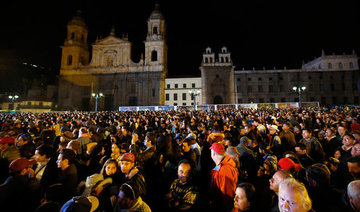
Newly elected Colombian president Ivan Duque celebrates with supporters in Bogota, after winning the presidential runoff election on June 17, 2018. (AFP)
Updated 18 June 2018
Follow

Colombia president-elect vows to unite nation, alter peace deal

  • Ivan Duque has vowed to make “structural changes” to the 2016 agreement, which led to the group’s disarmament and conversion into a political party
  • Duque has railed against the Colombian left, voicing fears that it would drag the country into the same economic quagmire in which neighboring Venezuela is mired

BOGOTA: Colombia’s President-elect Ivan Duque, who swept aside leftist Gustavo Petro in Sunday’s election, pledged to unite his South American nation after a divisive campaign but insisted he would change a landmark peace accord with leftist rebels.
Duque’s decisive victory in Sunday’s poll, with 54 percent of votes to Petro’s 42 percent, is likely to reassure investors in Latin America’s fourth-largest economy who were alarmed by the leftist candidate’s promise to overturn Colombia’s orthodox economic model.
Yet, in the first presidential election since the 2016 peace deal with the Revolutionary Armed Forces of Colombia (FARC), Duque worried Colombians with a promise to overhaul the accord that ended a five-decade conflict which killed more than 220,000 people and displaced millions. He has promised to impose tougher punishments on rebels for war crimes.
Surrounded by friends and family, Duque thanked voters for handing him the biggest electoral victory in Colombia’s history based on number of votes received. He struck a conciliatory tone, calling for the nation of more than 50 million people to unite behind him after a polarizing campaign.
“With humility and honor, I tell the Colombian people that I will give all my energies to unite our country. No more divisions,” Duque told a crowd of cheering supporters in Bogota.
“I will not govern with hatred.”
Duque, 41, the business friendly protégé of hard-line former President Alvaro Uribe, has promised to toughen the peace deal while keeping Colombia’s business friendly economic policies intact.
By contrast, former guerrilla Petro had pledged to take on political elites, redistribute land to the poor and gradually eliminate the need for oil and coal in Latin America’s fourth-largest economy. His positions prompted critics to compare him to Venezuela’s former socialist President Hugo Chavez.
Although Petro won a majority in only eight of 32 provinces, and the capital Bogota, the fact that a leftist advanced to the presidential runoff is historic in Colombia, where traditionally conservative politicians have held sway. Petro won 8 million votes versus 10.3 million for Duque.
Petro, 58, had called on supporters to take to the streets if he felt there was widespread manipulation of the tally, but he accepted the outcome of Sunday’s election.
“We accept Duque’s triumph. He is the president of the Republic of Colombia... Today we are the opposition to his government,” Petro, he will return to the Senate, told cheering supporters in Bogota.

FRACTURED LEFT
Duque will face significant challenges when he takes office in August. The economy remains weak; drug trafficking gangs have moved into areas once controlled by the FARC and more than half a million Venezuelan migrants have crossed into Colombia, looking for food and work.
His plans to change the peace deal will face considerable opposition in Congress and from Colombia’s Constitutional Court.
On Sunday, he said he would make necessary “corrections” to the accord so victims’ rights receive greater priority and justice and reparations are respected.
“Peace is something all Colombians yearn for, and peace means that we turn the page on the fractures that have divided us into friends and enemies of peace,” he said, as confetti rained down and supporters danced and honked horns.
“Today, we’re all friends to build that peace and it must be a peace that above all allows the guerrilla base its demobilization, its disarmament and its effective reinsertion.”
FARC leader Rodrigo Londono, known as Timochenko, congratulated Duque on Twitter, calling for reconciliation and saying he respected Colombians’ decision.
Duque has also promised to bolster the $324 billion economy, keep investors happy by cutting business taxes, support the oil and coal sectors — top exports — and help manufacturing.
“It is a result that’s very in line with what the market had been expecting and it guarantees that Colombia’s reputation — political and economic stability — is still valid,” Felipe Campos, head economist at Alianza brokerage, said.
Duque is the candidate for the Democratic Center Party, a movement started in 2013 by Uribe, seen as the power behind the throne.
A one-term senator, Duque worked at the Inter-American Development Bank in Washington until 2014, when Uribe asked him to return to Colombia and take a seat in Congress. Duque’s running mate, Marta Lucia Ramirez, will be Colombia’s first female vice president.
“Our hope has arrived,” said 52-year-old publicist Carlos Cortes, a Duque supporter. “Now, with more respect for private enterprise, more jobs will be generated and we’ll move forward as a country.”
For decades, Colombia’s fractured left has failed to come close to winning the presidency or exercising control in Congress, overshadowed by right-wing contenders who have promised strong security policies.
Yet the 2016 deal with the FARC clearly shifted priorities for many voters in the Andean country of nearly 50 million people.
Despite Petro’s loss, voter interest in tackling inequality, corruption and inadequate social services looks set to create opportunities for the left in future, possibly as soon as 2022.


UK cyclists to ride 550km in Saudi Arabia to save children with heart defects

Updated 3 sec ago
Follow

UK cyclists to ride 550km in Saudi Arabia to save children with heart defects

  • The H&K Cycle Club was the first team to take the Hejaz route, and their endeavour has since 2022 inspired hundreds of other cyclists to follow suit
  • The cyclists expect to face scorching heat, brutal headwinds, sandstorms, and long no-U-turn stretches of roads, along with physical and mental exhaustion

LONDON: A cycling team from London set out on Sunday on a 550km journey from Makkah to Madinah in Saudi Arabia to raise funds for children in developing countries with congenital heart defects.

This is the fifth year that Shamsul Abdin, the head of the H&K Cycle Club, and 40 riders aged between 18 and 65, are taking on the challenge through the Hejaz region.

Abdin told Arab News that the “Hijrah Ride” was a replication of the journey made by Prophet Muhammad over 1,400 years ago, when he migrated from Makkah to Madinah, where he established the first city-state of Islam. This migration, known as Hijrah, also marked the beginning of the Islamic Hijri calendar.

The H&K Cycle Club has expanded from just six riders 14 years ago to more than 40 members from various cities across the UK, including London, Manchester, Oxford, and Birmingham. In November, they began their training in the freezing temperatures of the UK, aiming to cycle over 100 kilometers each day within 6 to 7 hours for a 4-day ride in Saudi Arabia. On Wednesday, they are expected to arrive in Madinah.

Riders from the H&K Cycle Club are expected to arrive in Madinah on Wednesday. (Muntada Aid)

They have cycled throughout the UK and parts of Europe, riding from London to Istanbul to raise funds for various causes through Muntada Aid, a charity that works on projects in developing countries and organizes the “Hijrah Ride”.

They were also the first cycling team to take the Hejaz route, and their endeavour has since inspired hundreds of other cyclists to follow suit. Abdin has seen Saudi Arabia become more bike-friendly over the past five years, with cycling lanes integrated into city development, while drivers, locals, and authorities are now more aware of cyclists on the roads.

The cyclists expect to face scorching heat, brutal headwinds, sandstorms, and long no-U-turn stretches of roads, along with physical and mental exhaustion. For many riders, this will be their fifth ride in Hejaz. Some of them include Uber and bus drivers, business analysts, and even entrepreneurs, according to Abdin.

“The headwind feels like climbing a mountain; it’s a constant resistance. To overcome this challenge, we ride in a peloton, taking turns at the front. One person heads into the wind while the others line up behind, shielded from the gusts. After a while, we rotate, allowing everyone a chance to lead,” Abdin explained.

Almost £923,000 has been raised by the “Hijrah Ride” since its inception, to reach a target of one million pounds this year. Some of the money went into emergency aid programs in Gaza and Sudan. Muntada Aid aims to raise about £250,000 for its flagship project, “Little Hearts,” which will fund 150 surgeries for children with congenital heart defects in Pakistan and Bangladesh this year.

“I fell in love with this project, which gives children the opportunity to live up to their potential as adults, truly,” said Abdin, who was awarded the MBE (Member of the Order of the British Empire) in December for his contribution to charitable fundraising.

Shamsul Abdin, the head of the H&K Cycle Club. (Muntada Aid)

The riders will be escorted by two vehicles, one in front and one in the rear, carrying paramedics and media staff, along with food and water. They will split into two groups based on their cycling powers. Along the route, they will pass several locations, including Jeddah on the Red Sea, King Abdullah Economic City, Rabigh, Masturah, and Badr, before reaching the elevated roads of Madinah, where their journey, which started with performing Umrah in Makkah, will end.

Muntada Aid is a part of Al-Muntada Trust, which was founded in 1986 by a group of Middle Eastern students, including individuals from Qatar and Saudi Arabia, to address the famine crisis in Ethiopia. Since then, the organization has assisted children in 17 countries, including Somalia, Sudan, Chad, Kosovo, Bosnia, Bangladesh, Pakistan, Mali, and Niger. They focus on developing infrastructure in education, health, water and sanitation sectors.

Nasrun Mir, the marketing director of Muntada Aid, told Arab News that they support “Hijrah Ride” with financial backing and logistics, and that they have obtained permits through communication with the Saudi Ministry of Transport, the Ministry of Foreign Affairs, the Saudi embassy in London, and the British Consulate in Jeddah.

Muntada Aid is a part of Al-Muntada Trust, which was founded in 1986 by a group of students, including individuals from Qatar and Saudi Arabia. (Muntada Aid)

Mir, who is joining the journey as part of the media team this week, said that the reception in Saudi Arabia could not be friendlier.

“People offer us free food and drinks. They want to have conversations with us. They want to know what we do. In the Middle East, there is still no concept of using sports as a tool for charity. The general idea is that if I want to give money to the charity, I’ll give it to them. You don’t need to run. You don’t need to cycle,” Mir said.

In one incident, a local community prevented the riders from passing through their village unless they disembarked and sat down to eat with them. In particular sections of the road near Madinah, a Saudi police vehicle has escorted the riders for a few kilometers, he added.

“There have been incidents where people have stopped us from eating our own food during the break. 
They literally took our food and said, ‘No, you come to our village; you cannot eat your food. You have to have food, which we will prepare.’ This delayed ride for a couple of hours,” Mir said.