SEOUL: President Donald Trump’s sudden pledge to discontinue US-South Korean “war games” has sent shockwaves through the South Korean military.
Many security experts have expressed concern that a halt to the annual military exercises could be seen as a major concession to North Korea and eventually lead to the withdrawal of, or a major reduction in, US forces in the South.
“You simply can’t have troops stationed anywhere and not train them,” said Bruce E. Bechtol Jr., associate professor of political science at Angelo State University, Texas.
“So what he (Trump) called ‘war games’ may be changed to something else like ‘field exercises’ or ‘table-top drills,’ but hopefully that doesn’t mean we’re going to stop training to maintain the readiness of the troops defending our friend South Korea.”
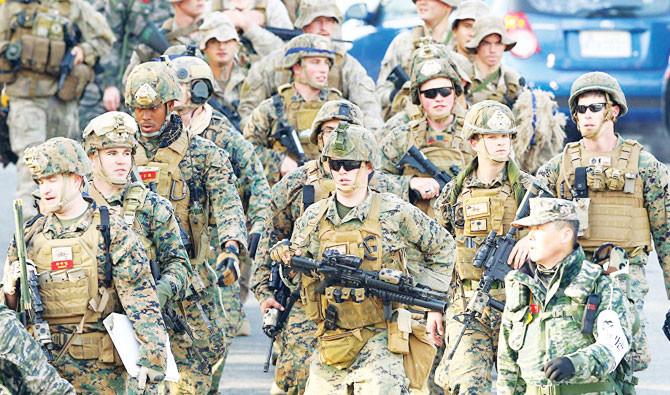
About 28,500 US troops are stationed in the South, holding large-scale exercises and computer simulation-based command post drills with South Korean forces every spring and autumn.
The exercises largely focus on enhancing their defense readiness against an attack, with an operational scenario of up to 690,000 US forces being deployed from outside the Korean Peninsula in wartime.
“We haven’t seen any details regarding North Korea’s nuclear disarmament pledge, even though the leaders of the US and North Korea took a symbolic step toward ending their 70 years of hostility during their summit in Singapore,” said Park Hwee-rak, professor of political science at Kookmin University in Seoul.
“Any move or change to weaken the decades-old joint defense posture is likely to bring great risk to the security of South Korea before the North’s complete disarmament,” he added.
“Security is very different from business or gambling. You may decide to invest all your money in a business or gamble for a huge win, but as far as security is concerned, you shouldn’t call an all-in bet. You must prepare for the worst-case scenario.”
South Korean President Moon Jae-in said on Thursday: “If North Korea truly carries out denuclearization measures, sincere dialogue continues and hostilities with the US and South Korea are resolved, there is a need for flexible change in military pressure and a careful review of US-South Korea joint training.”
He referred to “the spirit of mutual trust of the Panmunjom Declaration” of April 27, in which both Koreas promised to end hostile actions against each other.
US and South Korean defense authorities are in close consultation over the matter of stopping joint exercises, said the South’s Ministry of National Defense.
The US ambassador-designate to South Korea, Harry B. Harris Jr., backed Trump’s decision to freeze the drills “in good faith” on the peninsula.
“I believe we should give exercises, major exercises, a pause to see if (North Korean leader) Kim Jong Un is in fact serious about his part of the negotiations,” Harris Jr. said at his Senate confirmation hearing on June 14.
“We were in a different place in 2017,” he added, referring to Pyongyang’s test-firing of ballistic missiles and its sixth nuclear test.
“Today, following the president’s summit with Kim Jong Un in Singapore, I think we’re in a dramatically different place.”
But worries over an eventual pull-out of US troops from the South are lingering, said Shin Won-shik, former deputy commander of South Korea’s joint chiefs of staff.
“It’s like pulling out the linchpins sustaining the security posture in Northeast Asia as well as on the peninsula,” the former three-star general added.
“What I’m most worried about is that a prolonged freeze of joint drills could lead to the pulling of troops out of Korea,” he said.
“It remains unclear how long the denuclearization negotiations will take and how fast it will be completed. If the negotiations are prolonged, talk of US troops pulling out will emerge inevitably.”
Trump said after the summit: “We will be stopping the war games, which will save us a tremendous amount of money.”
Kim Dae-young, an analyst at the Korea Research Institute of National Strategy in Seoul, said: “If cost-sharing negotiations for US troops between Washington and Seoul fail, Trump could have an excuse to push forward with large troop reductions. Then inevitably, the South Korean military would face a major shift in its defense policy, probably with much more burdens in terms of costs and capabilities.”
Seoul’s initiative to take back wartime operational control of its armed forces from the US military will pick up speed, the analyst added.
South Korean generals are in charge of peacetime command of their forces, while in wartime operational control is supposed to be handed over to the chief of the US-South Korea Combined Forces Command. The South aims to take back command authority by 2023.
“Even if inter-Korean relations have improved, strong national defense power is necessary to cope with various threats,” the analyst said, referring to potential territorial disputes with Japan and China.
“But questions still linger over how we could bolster our military power for self-reliant defense, reducing dependence on US forces and not eroding confidence on the alliance of the two militaries.”


![]()

Freezing of military drills with US raises South Korean concerns
Freezing of military drills with US raises South Korean concerns
- The exercises largely focus on enhancing their defense readiness against an attack, with an operational scenario of up to 690,000 US forces being deployed from outside the Korean Peninsula in wartime
- US and South Korean defense authorities are in close consultation over the matter of stopping joint exercises, said the South’s Ministry of National Defense


Latest updates


Recommended


© 2026 SAUDI RESEARCH & PUBLISHING COMPANY, All Rights Reserved And subject to Terms of Use Agreement.