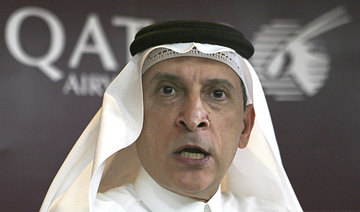
SYDNEY: The head of Qatar Airways apologized on Wednesday for saying that a woman could not do his job, while global airlines pledged to speed up efforts to break down gender imbalances in aviation.
Qatar Airways Chief Executive Akbar Al-Baker said his remarks at the closing of a global airlines gathering on Tuesday had been intended as a joke and taken out of context.
He defended his airline’s record of gender diversity, saying 44 percent of its staff were female including some in senior positions.
“Quite frankly I think the press took it out of context. They ... blew it out of proportion. It was just a joke...I apologize for it,” Al-Baker told a CAPA-Center for Aviation conference in Sydney.
Asked on Tuesday about female employment among Middle East airlines and why his job as CEO could not be done by a woman, Al-Baker had said: “Of course it has to be led by a man because it is a very challenging position.”
He made the comments at a news conference following a meeting of airlines group International Air Transport Association (IATA), moments after being elected its chairman.
The remarks drew criticism on social media.
The issue of gender imbalance in aviation was a hot topic at the three-day annual meeting of IATA — only six of whose 280-member airlines, or 2 percent, have female chief executives.
Al-Baker later said Qatar Airways was the first carrier in the Middle East to have female pilots.
On Wednesday, the director-general of IATA noted that Al-Baker had earlier apologized for his comments.
“But the immediate reaction illustrated that expectations for change are high. And it is absolutely clear that aviation has a lot of work to do on gender balance at senior levels,” Alexandre de Juniac added in a blog on IATA’s website.
Al-Baker is one of the airline industry’s most outspoken figures, known for provocative and often humorous criticism of rival airlines or suppliers, but he has also drawn criticism over the judgment of some of his declarations.
In 2017 he apologized after calling US flight attendants “grandmothers” during a trade row with US airlines, prompting an airline union to accuse him of sexism and age discrimination.
In 2014, Qatar Airways defended policies on pregnancy and marriage for cabin crew after coming under fire over working conditions in the conservative Gulf emirate.
Asked at Wednesday’s CAPA conference whether he truly believed that only a man could do his job, Al-Baker said, “No, I don’t believe that. As a matter of fact (at) Air Italy the majority shareholder has shortlisted women to be CEO and as minority shareholder we are actively encouraging that.”
Sharing a podium, Willie Walsh, the head of British Airways owner IAG, said the industry had a long way to go in promoting women, starting with IATA, a quasi-international organization with two women on its 31-person board.
“This whole debate should encourage more,” Walsh said.
“If you look at the board it is predominantly middle-aged white men from Europe. We have more diversity on the board now than we have had for a long time, and we have to strive to improve that situation.”
Al-Baker pledged to bring more women onto IATA’s board, but said there had been few applicants. Board members must be a CEO. IATA says just 3 percent of airlines have a female leader.
Delegates said seats are also divided up by region, meaning some national airlines may have to release influential board seats to favor a female candidate from their own region, but a woman in one region could not benefit from a vacancy in another.
“Bridging the gap at senior levels will not be simple,” de Juniac wrote.
The gender row comes amid a deeper debate about whether airlines based on different national social models, recruitment policies and wage structures can compete on equal terms.
US and some European airlines have accused Gulf carriers of unfair competition based on subsidies and social policies, but Walsh — whose group counts Qatar Airways as a shareholder — said he believed Gulf airlines competed on an equal footing.


Qatar Airways boss apologizes for remarks on women CEOs

Qatar Airways boss apologizes for remarks on women CEOs


Saudi non-oil exports jump 21% as trade balance improves: GASTAT
RIYADH: Saudi Arabia’s non-oil exports, including re-exports, rose 20.7 percent year on year in November to SR32.69 billion ($8.72 billion), official data showed.
According to preliminary figures released by the General Authority for Statistics, national non-oil exports, excluding re-exports, increased by 4.7 percent in November compared with the same month in 2024.
The strong performance highlights progress under the Kingdom’s Vision 2030 strategy, which aims to diversify the economy and reduce its long-standing dependence on crude oil revenues.
In its latest report, GASTAT stated: “The ratio of non-oil exports, including re-exports, to imports increased in November 2025, reaching 42.2 percent, compared with 34.9 percent in November 2024. This increase was driven by a 20.7 percent rise in non-oil exports, alongside a 0.2 percent decline in imports over the same period.”
It added: “The value of re-exported goods increased by 53.1 percent during the same period, driven by an 81.9 percent increase in ‘machinery, electrical equipment and parts’, which accounted for 51.5 percent of total re-exports.”
Machinery, electrical equipment and parts also led the non-oil export basket, making up 24.2 percent of outbound shipments and recording an 81.5 percent annual increase. This was followed by products of the chemical industries, which represented 20.3 percent of total non-oil exports and rose 0.5 percent year on year.
The data adds to signs of resilience in Saudi Arabia’s non-oil economy, with S&P Global’s Purchasing Managers’ Index at 57.4 in December, well above the 50 threshold that separates expansion from contraction.
Top non-oil destinations
The UAE was the leading destination for Saudi non-oil exports in November, with shipments valued at SR10.48 billion.
India ranked second at SR3.01 billion, followed by China at SR2.32 billion, Singapore at SR1.76 billion and Bahrain at SR900.7 million.
Exports to Egypt totaled SR815.5 million during the month, while Turkiye and Jordan received goods worth SR799.1 million and SR773.3 million, respectively.
GASTAT said ports and airports played a central role in facilitating non-oil shipments in November.
By sea, Jeddah Islamic Seaport handled the largest volume of non-oil exports at SR3.57 billion, followed by King Fahad Industrial Seaport in Jubail at SR3.51 billion.
Ras Al-Khair Seaport was the exit point for non-oil goods valued at SR2.66 billion, while Jubail Seaport and King Abdulaziz Seaport in Dammam handled outbound shipments worth SR2.32 billion and SR2.14 billion, respectively.
By air, King Abdulaziz International Airport handled goods worth SR5.60 billion, while King Khalid International Airport in Riyadh processed exports valued at SR3.53 billion.
Exports and imports
Saudi Arabia’s total merchandise exports reached SR99.73 billion in November, representing a 10 percent increase compared with the same month in 2024.
“Merchandise exports in November 2025 increased by 10.0 percent compared to November 2024, and oil exports increased by 5.4 percent. The percentage of oil exports in total exports declined from 70.1 percent in November 2024 to 67.2 percent in November 2025,” GASTAT added.
China remained the Kingdom’s largest export destination, accounting for 13.5 percent of total exports, followed by the UAE at 11.7 percent and Japan at 9.9 percent. India, South Korea, the US, Egypt, Singapore, Bahrain and Poland were also among the top 10 destinations, which together accounted for 71.4 percent of total exports.
Imports declined by 0.2 percent year on year in November to SR77.38 billion, while the merchandise trade surplus surged by 70.2 percent, the report showed.
China was the Kingdom’s largest source of imports, accounting for 26.7 percent of inbound shipments, followed by the US at 10.2 percent and the UAE at 6.2 percent.
“Germany, Japan, India, Italy, France, Switzerland, and Egypt were also among the top ten import sources, with total imports from these ten countries representing 68.6 percent of Saudi Arabia’s overall imports,” added GASTAT.
King Abdulaziz Port in Dammam was the leading entry point for goods, handling 22.8 percent of imports in November. Jeddah Islamic Port followed with 22.6 percent, ahead of King Khalid International Airport in Riyadh at 17 percent and King Abdulaziz International Airport in Jeddah at 11.9 percent.


