

Turkish envoy heads back to US after spat over Jerusalem

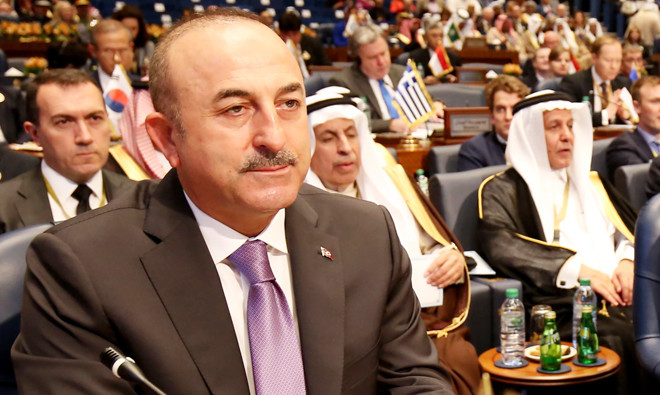
Turkish Foreign Minister Mevlut Cavusoglu Kilic would be back at work by Monday. (AFP)
Updated 31 May 2018
Follow

Turkish envoy heads back to US after spat over Jerusalem

  • Turkish Foreign Minister Mevlut Cavusoglu meanwhile told the Hurriyet daily that Kilic would be back at work by the time he meets his US counterpart Secretary of State Mike Pompeo on Monday

Turkey’s ambassador to Washington was on Thursday heading back to the US after a spat over the official inauguration of the new US Embassy in Jerusalem.

State TRT television said Serdar Kilic had left Ankara to resume his post after an absence of over two weeks from Washington.

Turkish Foreign Minister Mevlut Cavusoglu meanwhile told the Hurriyet daily that Kilic would be back at work by the time he meets his US counterpart Secretary of State Mike Pompeo on Monday.

Turkey recalled its ambassadors to Washington and Tel Aviv early this month for consultations after dozens of Palestinians were killed by Israeli fire along the Gaza border on the same day the US celebrated the opening of its embassy in Jerusalem.

In Washington, Pompeo and Cavusoglu are expected to try and agree terms for the withdrawal of US-backed Kurdish militia from the Syrian town of Manbij, a move long sought by Turkey.

Relations between the two NATO allies Turkey have become increasingly bitter in recent months over issues including US support for the Kurdish People’s Protection Units (YPG) militia.

Ankara argues the YPG is a branch of the outlawed Kurdistan Workers’ Party which has been fighting against Turkey state since 1984 while Washington insists they are part of a legitimate opposition group called the Syrian Democratic Forces.

Manbij hosts a US military presence with American soldiers providing military support to the YPG in the fight against militants.

Turkish President Recep
Tayyip Erdogan threatened to expand an incursion inside Syria to Manbij after clearing the western enclave of Afrin of YPG militia in January.

Cavusoglu told Hurriyet that in Washington both foreign ministers would publicize a timetable on the Manbij roadmap.

“We will make a joint statement that day,” he said. “The concrete step is that YPG will be withdrawn from there,” he added.

Cavusoglu said Turkey and the US would decide together who would replace the YPG in Manbij’s administration and security forces.

Pompeo is also expected to raise the case of US pastor Andrew Brunson who has been held in detention in western Turkey since October 2016 on terror and spying charges. Washington has repeatedly denounced his incarceration.

Trump and Netanyahu to discuss next phase of Gaza plan

Updated 7 sec ago
Follow

Trump and Netanyahu to discuss next phase of Gaza plan

  • Gaza process stalled with difficult steps ahead
  • Iran, Lebanon also on the agenda, says Netanyahu

JERUSALEM/PALM BEACH, Florida: US President Donald Trump is expected to push for progress in the stalled ceasefire in Gaza when he meets with Israeli Prime ​Minister Benjamin Netanyahu on Monday for talks that will include Israel’s concerns over Hezbollah in Lebanon and Iran.
Netanyahu said this month that Trump had invited him for talks, as Washington pushes to establish transitional governance and an international security force for the Palestinian enclave.
Trump has said he could meet with the Israeli leader soon, but the White House has not confirmed details. The White House did not respond to a request for comment about the meeting. Netanyahu, who is expected to visit Trump’s Mar-a-Lago beach club, said on December 22 that discussions were expected to cover the second phase of the Gaza ‌ceasefire, as well ‌as Iran and Lebanon.
Washington brokered ceasefires on all three fronts, but Israel ‌is ⁠wary ​of its ‌foes rebuilding their forces after they were considerably weakened in the war.

Next steps in Gaza ceasefire plan
All sides agreed in October to Trump’s ceasefire plan, which calls for Israel to withdraw from Gaza and Hamas to give up its weapons and forgo a governing role in the enclave.
US Secretary of State Marco Rubio said last week that Washington wants the transitional administration envisioned in Trump’s plan — a Board of Peace and a body made up of Palestinian technocrats -
to be in place soon to govern Gaza, ahead of the deployment of ⁠the international security force that was mandated by a November 17 UN Security Council resolution. But Israel and Hamas have accused each ‌other of major breaches of the deal and look no closer ‍to accepting the much more difficult steps envisaged for ‍the next phase. Hamas, which has refused to disarm and has not returned the remains of ‍the last Israeli hostage, has been reasserting its control, as Israeli troops remain entrenched in about half the territory.
Israel has indicated that if Hamas is not disarmed peacefully, it will resume military action to make it do so.
While the fighting has abated, it has not stopped entirely. Although the ceasefire officially began in October, Israeli strikes have ​killed more than 400 Palestinians — most of them civilians, according to Gaza health officials — and Palestinian militants have killed three Israeli soldiers.

Lebanon ceasefire also tested

In Lebanon, a US-backed ⁠ceasefire that was agreed to in November 2024 ended more than a year of fighting between Israel and Hezbollah and required the disarmament of the powerful Iran-backed Shiite group, beginning in areas south of the river adjacent to Israel.
While Lebanon has said it is close to completing the mission within the year-end deadline of disarming Hezbollah, the group has resisted calls to lay down its weapons.
Israel says progress is partial and slow and has been carrying out near-daily strikes in Lebanon, which it says are meant to stop Hezbollah from rebuilding. Iran, which fought a 12-day war with Israel in June, said last week that it had conducted missile exercises for the second time this month. Netanyahu said Israel is not seeking a confrontation with Iran, but was aware of the reports, and said he would raise Tehran’s activities with Trump.
Trump in June ordered ‌US strikes on Iranian nuclear sites but has since then broached a potential deal with Tehran.