JUBA, South Sudan: There is no shortage of victims in South Sudan’s civil war. But few suffer more than the handicapped.
Nyamet was seven years old when soldiers attacked her town.
Most of the population had hurriedly left, abandoning the elderly, blind and disabled — like Nyamet, afflicted by cerebral palsy — to the mercy of the armed men.
They showed none.
“They killed them,” said Nyamet’s mother, who had remained behind with her daughter. “That’s when we started running,” she added, recalling how she fled with the child in her arms.
Four years later, the family lives in a squalid, congested camp for over 7,000 of South Sudan’s millions of uprooted, in the capital Juba.
Nyamet spends most days lying on a mat outside a tin-roofed shack on one of Mahad camp’s muddy paths.
“I sometimes play under the mango tree, but I mainly do nothing,” said Nyamet.
Two hundred people with disabilities live in Mahad, enduring a predicament compounded by traditional stigma and official neglect.
“If she went to school, children would laugh at her and bully her. That’s why I want her to stay at home,” said Nyamet’s mother.
But, she said, “It’s difficult. I can’t even move far from the camp or go to work. I’m constantly taking care of my daughter.”
Seme Lado, of the Union of Physically Disabled, a pressure group, said Nyamet’s situation is not unusual. “Disabled people lack support and they tend to be deserted by their families. There’s a complete lack of knowledge and no one knows how to take care of them,” he said.Disability affects on average around 15 percent of people worldwide, according to the World Health Organization (WHO) — a definition that the UN agencies says is “an umbrella” term for a wide range of impairments and applies to people aged over 15.
In South Sudan, a poor, war-torn and disfunctional country, reliable figures for health are rare.
According to the disability charity Light for the World, around a quarter of a million of the 12.23 population are disabled.
The International Committee of the Red Cross (ICRC) has put forward an estimate of 50,000 amputees — a figure that has not been updated since 2012, and the war has ground on for another six years since then.
Anecdotal evidence, though, suggests the proportion of people with handicaps is far higher than the global average.
Here, the situation is worsened by preventable diseases such as polio — which was still prevalent a decade ago — or avoidable complications at birth, and by conflict-induced mental illness and injury.
“The disabled are the most marginalized,” said Sophia Mohammed of Light for the World.
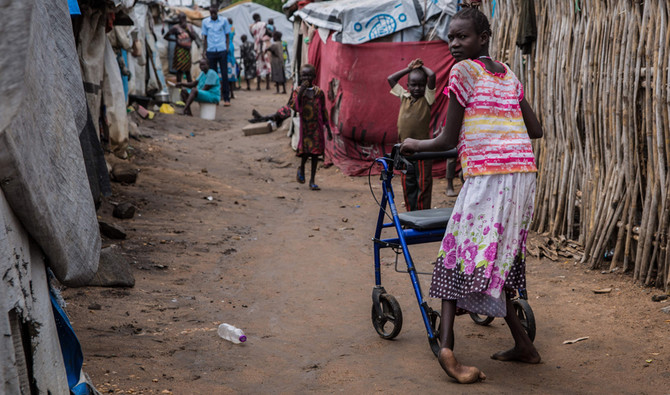
In camps such as Mahad, uneven mud tracks and pit latrines turn a simple visit to the toilet into a challenge.
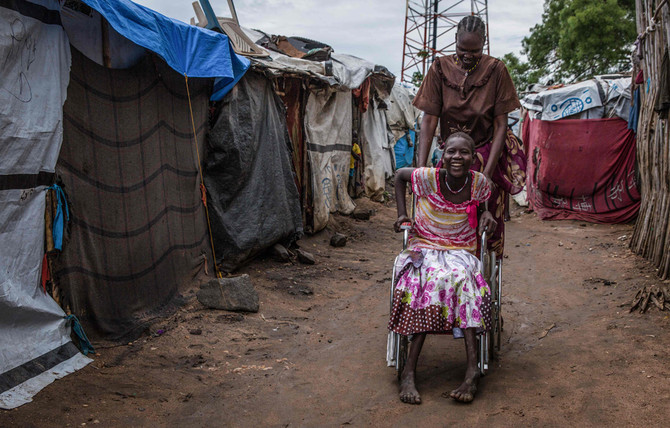
Nyamet now has a walking frame, thanks to Mohammed’s organization, which also builds disabled-friendly toilets — essentially latrines equipped with sidebars — in the camp, and she gets physical therapy treatment.
Also in Mahad, Omod James, 27, sits outside his tent in the scorching sun, trying to sell sweets and chewing gum from plastic jars on a small table.
He is blind and walks with crutches. The left side of his body is paralyzed.
“It has ruined my future. I’m stuck here in the camp and my mother has to take care of me,” he told AFP.
While South Sudan in 2015 passed a pro-disabled law only three percent of the national budget goes on health care (the lion’s share is spent on the armed forces), and the disabled are more often shunned than supported.
“Attitudes in society need to change,” said Kelly Thayer of the charity Humanity and Inclusion, formerly called Handicap International. “Many people are called by their disability rather than by their name. Having a disability is a massive stigma.”


![]()
![]()

Disabled are the hidden victims of South Sudan’s long war
Disabled are the hidden victims of South Sudan’s long war
- According to the disability charity Light for the World, around a quarter of a million of South Sudan's 12.23 population are disabled.
- While South Sudan in 2015 passed a pro-disabled law only three percent of the national budget goes on health care and the disabled are more often shunned than supported.


Latest updates


© 2026 SAUDI RESEARCH & PUBLISHING COMPANY, All Rights Reserved And subject to Terms of Use Agreement.