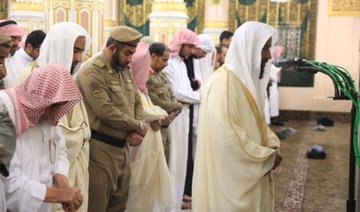
MADINAH: The Prophet’s Mosque Hundreds of thousands of worshippers performed the second Friday prayer at the Prophet’s Mosque during this holy month of Ramadan.
Visitors to Madinah are pleasantly surprised by the minarets of the Prophet’s Mosque, which are considered an Islamic architectural landmark and are visible throughout the city.
During the Prophet Muhammad’s time 1,400 years ago, the call to prayer was performed from the roof of the house closest to the mosque.
But Umayyad Caliph Al-Walid bin Abd Al-Malik ordered the construction of four minarets, one on each corner of the mosque, from where prayers would be called.
Since the establishment of Saudi Arabia, the mosque has undergone massive expansions to cater for the growing number of worshippers.
King Abdul Aziz made the first improvements between 1950 and 1955. The expansions continued between 1986 and 1993 when six minarets were added, raising the total to 10.
Four of them stand at the northern part of the mosque, five at the southeast corner and one at the southwest corner.
Each minaret consists of five floors, each with its own shape, height, diameter and decoration. The end of 2013 saw the largest expansion in the mosque’s history, its capacity increasing to 2 million worshippers.

ThePlace: The Prophet’s Mosque
- King Abdul Aziz made the first improvements between 1950 and 1955
- The end of 2013 saw the largest expansion in the mosque’s history
Program to combat terrorist financing ends
RIYADH: The Islamic Military Counter Terrorism Coalition has concluded its advanced training program in Nairobi, Kenya, which was focused on combating terrorist financing and money laundering.
The five-day program was part of the Saudi-backed coalition’s capacity-building initiative, aimed at strengthening member states’ capabilities to combat financial crimes linked to terrorism.
The closing ceremony was attended by Maj. Gen. Mohamed Nour Hassan, Kenya’s deputy army commander, and several civilian and military officials, the Saudi Press Agency reported.
The program brought together specialists from the banking, financial, and security sectors, including financial compliance officers, investigators, and professionals combating money laundering and terrorist financing, as well as representatives from regulatory and supervisory authorities. It combined theoretical knowledge with practical exercises.
Sessions addressed international legislation frameworks, emerging methods of terrorist financing, money-laundering mechanisms, and the use of digital technologies for monitoring and analysis.
The program also covered leadership skills and corporate compliance management, supported by case studies and exercises to enhance participants’ ability to trace suspicious financial flows and analyze complex patterns.
The coalition said that the program reflected its commitment to helping member states build effective national systems to combat terrorist financing and financial crimes, enhance coordination with regional and international partners, and improve specialist efficiency.
These efforts contribute to integrated responses that keep pace with evolving challenges and support security and stability at national and international levels.