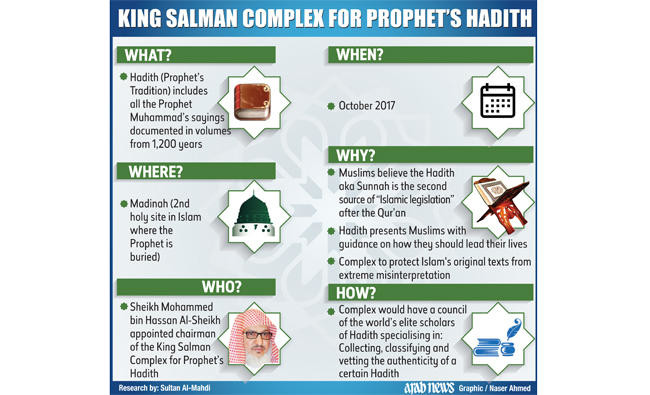
RIYADH: Saudi Arabia, the birthplace of Islam, is to monitor interpretations of the Prophet Muhammad (peace be upon him) teachings to prevent them being used to justify violence or terrorism, the Culture and Information Ministry has said.
In a decree, King Salman ordered the establishment of an authority to scrutinize uses of the “hadith” — accounts of the sayings, actions or habits of the Prophet that are used by preachers and jurists to support teachings and edicts on all aspects of life.
The ministry said late on Tuesday that the body’s aim would be to “eliminate fake and extremist texts and any texts that contradict the teachings of Islam and justify the committing of crimes, murders and terrorist acts.”
The body will be based in Madinah and overseen by a Council of Senior Scholars from around the world, according to the decree. The ministry offered no specific details of how it would work in practice.
Militant groups such as Daesh and Al-Qaeda have used interpretations of hadiths — numbered in the thousands and pored over by scholars for centuries — to justify violence and to urge supporters to carry out attacks.
Foreign Minister Adel Al-Jubeir said last month that thousands of extremist clerics had been dismissed, although he gave no timeframe.
The ministry said the body would serve Islam by creating “a solid scientific reference to vet and verify the authenticity of hadiths,” which are second in importance only to the Qur’an in Islam. It did not say what form the reference would take.
The decree issued by the king, whose official title is Custodian of the Two Holy Mosques — Islam’s most revered places in Makkah and Madinah — said the body would be chaired by Sheikh Mohammed bin Hassan Al-Sheikh, a member of the Council of Senior Scholars, which serves as Saudi Arabia’s highest religious body.

Saudi Arabia to vet use of Prophet’s sayings to counter extremism
National Center for Wildlife releases more than 60 wildlife species at King Khalid Royal Reserve
The Imam Abdulaziz bin Mohammed Royal Reserve Development Authority, in cooperation with the National Center for Wildlife, released more than 60 wildlife species at King Khalid Royal Reserve today near Riyadh, the Saudi Press Agency reported.
This initiative, according to the agency, is part of programs to reintroduce endangered species to their natural habitats, reflecting the integrated national efforts to protect wildlife and promote its sustainability.
“Releasing wildlife into the King Khalid Royal Reserve enhances biodiversity and restores natural habitats within the reserve. This contributes to providing a safe natural environment that supports the stability of wildlife and facilitates its adaptation to its natural habitats”, said the authority’s CEO, Talal Al-Hariqi.
He added that such efforts align with the National Strategy for Environmental Conservation and fulfill one of the objectives of the Kingdom’s Vision 2030, which aims to create an attractive environment that contributes to improving quality of life and promoting sustainability.
He also said that the collaboration with the National Center for Wildlife Development is a model for institutional integration in implementing reintroduction programs. This is achieved by unifying scientific and technical expertise and applying global best practices in wildlife conservation, thus ensuring the success of these programs and the long-term sustainability of their results.
Ziad bin Abdulaziz Al-Tuwaijri, director-general of projects and operations at the authority, said that the King Khalid Royal Reserve has released more than 60 wildlife species, including Arabian oryx, Arabian hares, and Arabian gazelles. This initiative aims to enrich the reserve’s biodiversity, contribute to restoring ecological balance through the reintroduction of endangered animals, promote sustainability, and support and revitalize ecotourism.
He said that over past years, the authority released more than 300 wild animals of different types, including reptiles, mammals, and local birds, all of which are classified on the International Union for Conservation of Nature Red List as species that are vulnerable or threatened with extinction.
He said that animals released in the King Khalid Royal Reserve are subject to periodic and continuous monitoring through field studies and modern monitoring techniques, such as surveillance cameras and tracking collars, where many natural births and herd growth have been recorded, reflecting the success of the release and reintroduction programs.