

Saudi Minister of Energy reviews with his Chinese counterpart current situation in oil market

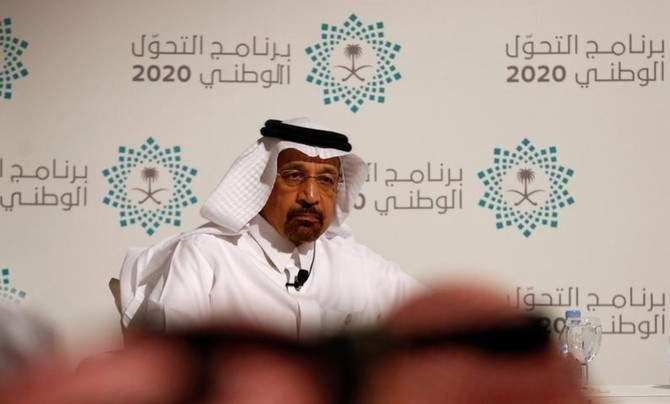
Saudi Energy Minister Khalid al-Falih attends a news conference. (Reuters)
Updated 25 May 2018
Follow

Saudi Minister of Energy reviews with his Chinese counterpart current situation in oil market

  • The two ministers agreed that the foundations of the global oil market are currently strong and that all parties should make joint efforts to ensure market stability
  • Al-Falih informed Bakri of his ongoing consultations with his counterparts from major OPEC oil producers, including the Russian Minister of Energy and the Minister of Energy of the UAE

Saudi Arabia’s Minister of Energy, Industry and Mineral Resources Energy Khalid Al-Falih telephoned China’s Minister of National Energy, Noor Bakri, to discuss the joint cooperation between the two countries in the field of energy and review the current situation in the global oil market.

The two ministers agreed that the foundations of the global oil market are currently strong and that all parties should make joint efforts to ensure market stability, Saudi state TV Al-Ekhbariya reported.

Al-Falih informed Bakri of his ongoing consultations with his counterparts from major OPEC oil producers, including the Russian Minister of Energy and the Minister of Energy of the UAE.

As a major oil consumer, China will continue to monitor developments in the market and hopes that Saudi Arabia, in cooperation with other countries concerned, will be able to take more important steps to ensure adequate supply of crude oil and contribute to the stability of world’s oil prices.

The Saudi minister assured Bakri of the Kingdom’s commitment to maintaining stability in the markets. He stressed that the Kingdom will work with other producing countries to ensure adequate supplies to compensate for any potential shortage of production and meet global demand.


Saudi non-oil growth continues with PMI showing expansion: S&P Global 

Updated 12 sec ago
Follow

Saudi non-oil growth continues with PMI showing expansion: S&P Global 

RIYADH: Saudi Arabia’s non-oil business activity continued to expand at a robust pace in January, driven by output growth, improving market conditions and stronger client activity, an economic tracker showed. 

According to the latest Riyad Bank Purchasing Managers’ Index report compiled by S&P Global, the Kingdom’s PMI stood at 56.3 in January, marginally lower than 57.4 recorded in December. 

Any PMI reading above 50 indicates expansion, while a reading below 50 reflects contraction. 

The latest PMI reading underscores the progress of Saudi Arabia’s Vision 2030 strategy, which aims to reduce reliance on oil by accelerating growth in tourism, manufacturing, logistics and financial services. 

Naif Al-Ghaith, chief economist at Riyad Bank, said: “Saudi Arabia’s non-oil private sector continued to expand at the start of 2026, supported by resilient domestic demand and sustained business activity.” 

He added: “Survey evidence points to ongoing strength in output and sales, underpinned by newly approved projects, steady customer enquiries, and improved investor activity, even as growth momentum moderated.” 

Earlier in February, a report released by the General Authority for Statistics revealed that Saudi Arabia’s real gross domestic product expanded by 4.5 percent year on year in 2025, driven by strong growth in both oil and non-oil activities. 

GASTAT added that non-oil activities in the Kingdom advanced by 4.9 percent in 2025 compared to the previous year. 

According to the PMI report, business conditions in Saudi Arabia’s non-oil private sector improved in January, driven by rising market demand, increased employment and stronger purchasing activity. 

New order volumes continued to rise, as survey panelists highlighted positive domestic conditions and increased client activity, resulting in an upturn in both staffing levels and purchases. 

“Demand conditions remained a key pillar of growth, extending a trend in place since late 2020, reflecting favorable domestic economic conditions, with manufacturing and services firms recording the strongest gains,” said Al-Ghaith. 

He added: “Export demand provided an additional lift, as new export orders expanded at the fastest pace since October 2025, supported by stronger inflows from GCC (Gulf Cooperation Council) and Asian markets. However, pricing conditions continued to limit the pace of expansion in some segments.” 

According to the report, about 23 percent of survey panelists said their output rose in January, while only 2 percent of companies reported a contraction. 

Hiring growth remained strong in January but showed signs of easing. After reaching a 16-year record last October, the rate of job creation slowed to its weakest level in 12 months. 

Companies that expanded their workforce partly attributed this to hiring staff with technical expertise. 

Looking ahead, non-oil firms in Saudi Arabia expressed optimism, supported by rising orders, increased staffing and resilient economic conditions. 

“The survey points to a resilient non-oil sector entering 2026 with solid demand fundamentals, improving supply conditions, and cautious optimism despite firmer cost dynamics,” concluded Al-Ghaith.