

Dhaka relishes traditional ‘Dhakaia iftar’ in Ramadan

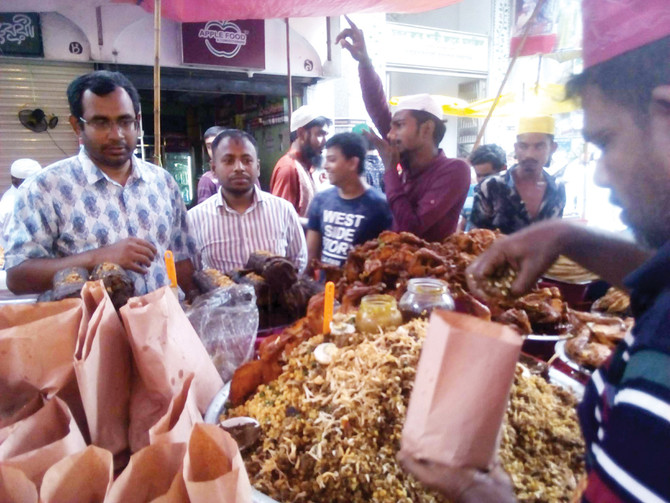
Chawak Bazar Iftar market vendors on a busy Wednesday afternoon. (AN photo)
Updated 25 May 2018
Follow

Dhaka relishes traditional ‘Dhakaia iftar’ in Ramadan

  • While much has changed in Dhaka, its tasty Ramadan dishes have stayed the same in the 400-year old city established by the Mughal dynasty.
  • The exquisite variety of kebabs attracts food lovers from far and wide, reminding them of the existence of Mughals through different food menus — offering tikka, shutli, jaali, shami, irani and other kinds of kebabs.

DHAKA: “To me it’s like a festival. During Ramadan, all of us friends regularly gather at my house and have the ‘Dhakaia Iftar’ together,” said Abdullah Alamin, 48, a city dweller of old Dhaka.

While much has changed in Dhaka, these tasty dishes have stayed the same in the 400-year old city established by the Mughal dynasty.

“Chawak Bazar Iftar market of old Dhaka has a history of more than 100 years. Many things of the area have changed with the passage of time but the Chawak Bazar Iftar remains unchanged,” said renowned historian Muntasir Mamun, a professor at Dhaka University.

Chawak Bazar became the city center of Dhaka during the Mughal regime in the early-16th century. The iftar bazar is a continuity of the retail market set up since then, Muntasir said.

During Ramadan, people from all over Dhaka get something more to add to their regular iftar menu.

In Chawak Bazar, vendors in makeshift shops offer a variety of iftar items. These include “boro baper polai khai” (only the son of an influential father eats this), shahi jilapi, shahi paratha, beef, chicken, mutton, pigeon, quail roast, keema roll, keema paratha, doi bora, borhani.

The exquisite variety of kebabs attracts food lovers from far and wide, reminding them of the existence of Mughals through different food menus — offering tikka, shutli, jaali, shami, irani and other kinds of kebabs.

Boro baper polai khai is the most popular iftar item among the locals. People from old Dhaka can simply not complete their iftar without having a piece of it. This is an exclusive food of the city made of chicken, minced meat, potatoes, brain, chira, egg, spices and ghee.

“This is a traditional food of old Dhaka. I saw my grandfather enjoying eating boro baper polai khai,” said Hajji Joinal Molla, 79, who has been living in the Lalbag area of old Dhaka for many years.

“We love to treat our special guests with this dish,” Joinal said.

Most of the 200 vendors at the market are second- or third-generation businesses. 

“My 11-year-old son is very fond of shami kebab at Chawak Bazar. Today he has invited some of his friends to our house, which brought me here to this iftar market,” said Shamsuddin Ahmed, 55, a resident of Uttara, new Dhaka.

“These traditional Iftar items have become an integral part of our iftar culture,” Shamsuddin said.


Michelin Guide announces 3 new awards at restaurant celebration in Riyadh

Updated 05 February 2026
Follow

Michelin Guide announces 3 new awards at restaurant celebration in Riyadh

RIYADH: The Michelin Guide hosted its inaugural celebration in Riyadh on Wednesday, where they announced three new special awards, delivered in partnership with Saudi Arabia’s Culinary Arts Commission.

The Michelin Service Award, in partnership with RAK Porcelain, went to Jeddah’s Yaza, helmed by chef and owner Hakim Bagabas, for what was described as an exceptional experience from start to finish.

Il Baretto’s manager Santiago Latorre was given the Exceptional Mocktail Award, as the Michelin Guide inspectors said the cocktail list offers a thoughtful mix of elevated classics and original signature mocktails.

The Young Chef Award went to Elia Kaady, at Maiz in Riyadh, who is considered one of the region’s rising talents.

The event honored the 11 restaurants that were awarded the Bib Gourmand distinction for delivering exceptional cuisine at great value.

The winners were Samia’s Dish and The Lucky Llama in Jeddah, Joontos and Tofareya in AlUla, Em Sharif Cafe, Fi Glbak, KAYZO, Mirzam, Najd Village, Sasani, and Tameesa in Riyadh.

Gwendal Poullennec, international director of the Michelin Guide, told Arab News: “​​When we look at what Saudi chefs are offering, they are also inspired by all the food cultures, but they are still really faithful to their roots, to their heritage, to their product.

“They are also really willing to tell quite an authentic and unique story. And for us, at the Michelin Guide, it definitely has a value.”

In addition to the Bib Gourmand category, 40 restaurants recognized in the Selected category were awarded plaques following the final wave of announcements on Dec. 15, bringing the total Saudi Michelin Guide restaurants to 51.

The restaurant celebration was followed by a reception where a culinary showcase brought together six guest chefs.

Three international restaurants showcased their gastronomic creations, including Le Gabriel - La Reserve Paris, which has three Michelin stars, Muse by Tom Aikens and Nusara, which both have a star.

Bib Gourmand title holders The Lucky Llama, KAYZO, and Fi Glbak also brought their unique flavors to the table.

“It’s a unique and authentic food culture (in Saudi Arabia) that deserves to be put on the spotlight, as well as the destination should be on the world culinary map. So, that is definitely what we are willing to achieve with the Michelin Guide,” Poullennec said.