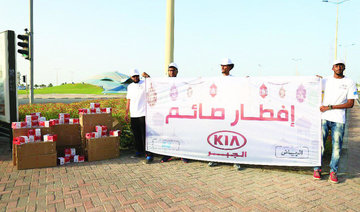
RIYADH: As the sun sets every evening during Ramadan, hundreds of people throng mosques that offer a free iftar meal.
The iftar box comprises dates, laban, juices, fruits and dishes such as the traditional Saudi kabsa. Some mosques also serve full meals with barbecue, cooked chicken or meat mixed with vegetables, and sweets or fruits, for the worshippers after the evening prayer following the iftar meal.
Mohammad Sharif, a Bangladesh worker in the queue at the Askan Building mosque, said: “We come to take this free iftar meal because it helps us to save time and money, which we would have spent on buying from the restaurants, thus adding to the savings to send to the family ahead of Eid Al-Fitr.
Companionship
“Returning from work, we are short of time to prepare iftar ourselves. As many of us receive a low salary, it is one of the reasons for coming to the free iftar meal tents.”
Abdullah, an Ethiopian, echoed this sentiment. “Finishing work and returning to accommodation in the evening leaves us with no time to prepare iftar, so it is easier to go to the nearby mosque tent for a free iftar meal as well as pray with the congregation in the mosque before going home.”
Naved, a Pakistani worker at a city mosque, said: “I usually come to the tent not only to break my fast but also to get a sense of companionship with others present at the iftar, thus to have the feeling of an extended family away from home.”
Besides distribution of the free iftar box, some of the mosques also make arrangements for community iftar, with hundreds of people turning up.
Most of the people who come to the tents for the free iftar are Muslim expatriates, mainly from Bangladesh, Pakistan, Ethiopia, India, Afghanistan and African countries.
There are a few Saudis, including those who come to distribute the free iftar meal or the ones who supervise the distribution at various mosques.
Distribution
Most of the arrangements for the free iftar meal are supported by charities, voluntary organizations and philanthropists, said Ahmed, a Saudi supervising food distribution at a mosque in the Badiyah area in South Riyadh.
He said that the tents are supervised closely to avoid misuse of charity money given for this purpose.
Osama Khan, a Pakistani national living in the Suwaidi-Badiyah area of the capital who has volunteered to distribute free iftar meals at the mosques for some years, told Arab News: “It gives me immense pleasure being involved in this generous charity during the holy month.”
“We should share what we have with those who are less privileged,” he said.