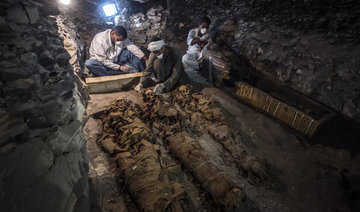
CAIRO: Egyptian archaeologists say they have discovered parts of a huge red brick building dating back to the Greco-Roman period north of Cairo.
The Antiquities Ministry says Wednesday the building was found in the Sa El-Hagar archaeological site in Gharbia province.
It says archaeologists found a gold coin depicting King Ptolemy III, who ruled Egypt in the 3rd century B.C. and was an ancestor of the famed Cleopatra. It says the coin was made during the reign of King Ptolemy IV in memory of his father.
The ministry says archaeologists have unearthed other artifacts in the area, including pottery vessels, terracotta statues, bronze tools and a small statue of a ram.
Egypt hopes such discoveries will spur tourism, which has suffered from political turmoil following the 2011 uprising.

Archaeologists discover Greco-Roman era building in Egypt
- A gold coin depicting King Ptolemy III, who ruled Egypt in the 3rd century B.C. and was an ancestor of the famed Cleopatra, was one of the significant finds.
- Antiquities Ministry says archaeologists have unearthed other artifacts in the area, including pottery vessels, terracotta statues, bronze tools and a small statue of a ram.
Lebanese filmmaker turns archival footage into a love letter to Beirut
LONDON: Lebanese filmmaker Lana Daher’s debut feature “Do You Love Me” is a love letter of sorts to Beirut, composed entirely of archival material spanning seven decades across film, television, home videos and photography.
The film premiered at the 82nd Venice International Film Festival in September and has since traveled to several regional and international festivals.
With minimal dialogue, the film relies heavily on image and sound to reconstruct Lebanon’s fragmented history.
“By resisting voiceover and autobiography, I feel like I had to trust the image and the shared emotional landscape of these archives to carry the meaning,” Daher said.
She explained that in a city like Beirut “where trauma is rarely private,” the socio-political context becomes the atmosphere of the film, with personal memory expanding into a collective experience — “a shared terrain of emotional history.”
Daher said: “By using the accumulated visual representations of Beirut, I was, in a way, rewriting my own representation of home through images that already existed."
Daher, with editor Qutaiba Barhamji, steered clear of long sequences, preferring individual shots that allowed them to “reassemble meaning” while maintaining the integrity of their own work and respecting the original material, she explained.
The film does not feature a voice-over, an intentional decision that influenced the use of sound, music, and silence.
“By resisting the urge to fill every space with dialogue or score, we created room for discomfort,” Daher said, adding that silence allows the audience to sit with the image and enter its emotional space rather than being guided too explicitly.
The film was a labor of love, challenging Daher personally and professionally.
“When you draw from personal memory, you’re not just directing scenes, you’re revisiting parts of yourself and your childhood,” she said. “There’s vulnerability in that.”


