NEW YORK: A guitar that played a key role in Bob Dylan’s artistic evolution from folk music to rock fetched a half million at auction on Saturday.
The guitar, a 1965 Fender Telecaster that belonged to Robbie Robertson, Dylan’s guitarist, was used by Dylan, Eric Clapton and George Harrison, Julien’s Auctions said Saturday.
It had been expected to fetch between $400,000 and $600,000.
The guitar marked the singer’s path from folk stylings like “The Times They Are A-Changin’” (1964), to electric rock, like his 1965 hit “Like a Rolling Stone.”
Other famous guitars went under the hammer on Saturday: George Harrison’s first electric guitar, a $40,000 Hofner Club 40, and a Fender Telecaster rosewood guitar made for Elvis Presley in 1968, priced at a cool $115,200.
More than 40 years after his death, Elvis items still fetch a handsome price.
A heavily decorated Elvis belt, which he wore during a concert in Hawaii in 1972, sold for $354,400.
A star-shaped diamond ring donated by Elvis to an admirer at a concert in 1975 brought in a sparkly $100,000.
The sale also included show costumes that belonged to artists from Elton John, to Britney Spears and Michael Jackson.
A leather jacket and pants suit from the late “Thriller” singer, with a yellow shirt, brought in $217,600, Julien said.


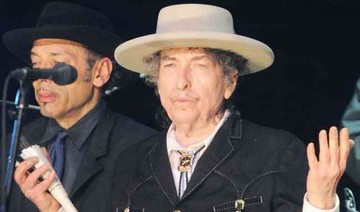
Bob Dylan guitar fetches $495,000 at auction

Bob Dylan guitar fetches $495,000 at auction


Makkah museum displays world’s largest Qur’an
MAKKAH: The Holy Qur’an Museum at the Hira Cultural District in Makkah is showcasing a monumental handwritten copy of the Holy Qur’an, recognized as the largest Qur’an of its kind in the world.
The manuscript measures 312 cm by 220 cm and comprises 700 pages, earning the museum recognition from Guinness World Records for displaying the world’s largest Qur’an, the Saudi Press Agency reported.
The manuscript is a magnified reproduction of a historic Qur’an dating back to the 16th century, the SPA stated.
The original copy measures 45 cm by 30 cm, with the chapters written primarily in Thuluth script, while Surah Al-Fatiha was penned in Naskh, reflecting the refined artistic choices and calligraphic diversity of the era.
The Qur’an is a unique example of Arabic calligraphy, gilding and bookbinding, showcasing Islamic art through intricate decorations, sun-shaped motifs on the opening folio, and elaborately designed frontispiece and title pages that reflect a high level of artistic mastery.
The manuscript was endowed as a waqf in 1883. Its original version is currently preserved at the King Abdulaziz Complex for Endowment Libraries, serving as a lasting testament to Muslims’ enduring reverence for the Qur’an and the richness of Islamic arts across the centuries.


