

UN renewables drive helps Syrian refugees

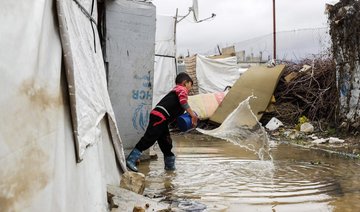
Syrian refugee children play at Azraq refugee camp for Syrians displaced by conflict, in Jordan. (Reuters)
Updated 18 May 2018
Follow

UN renewables drive helps Syrian refugees

  • Displaced people to get access to sustainable energy by 2030
  • Electric power not regarded as a human “right” until now

Aid agencies and governments are transforming the way they provide energy to families forced to flee their homes around the world — including setting up solar power plants at camps for Syrians in Jordan.

Energy has always been needed in the camps and informal settlements home to tens of millions of people uprooted by conflicts or natural disasters.

But it has largely been in the form of polluting diesel generators, fossil fuels for trucks to move relief supplies, or locally harvested firewood for cooking.

That is changing, with UN agencies, aid groups, major refugee-hosting countries and businesses preparing in July to sign up to a global action plan to provide all displaced people with access to sustainable energy by 2030.

“People are beginning to realize that this is an important issue, and something that deserves priority, resources and attention,” said Owen Grafham from the Moving Energy Initiative (MEI), a partnership managed by London-based think tank Chatham House, which is working on the action plan.

In camps, about 90 percent of people lack electricity, while 80 percent rely on firewood and other solid fuels to cook, which are harmful to their health and local forests, according to MEI.

Electric power has not been regarded as a human “right” in emergency situations, unlike shelter, water, food or health care, said Andrew Harper of the UN refugee agency (UNHCR).

“Energy is really not something that is fully taken into account,” he said. But it is “the key to empowering refugees and displaced persons,” added the UNHCR’s director of program support and former representative in Jordan.

In 2012 when Jordan’s Za’atari camp opened — home at one point to as many as 130,000 Syrian refugees — Friday prayers would sometimes be followed by “a riot,” with frustrated, anxious residents destroying things and throwing stones, Harper said.

But once UNHCR began spending up to $450,000 each month on electricity supplied to the camp via a grid connection, refugees used it to set up some 3,000 shops and businesses, and the rampages stopped, he said.

“They started feeling possessive, protective, engaged in the stability of the camp,” he added.

Since last year, two of Jordan’s main refugee camps have used power produced by their own solar plants — one in Za’atari funded by German development bank KfW and the other in Azraq backed by the IKEA Foundation — that can also feed back surplus electricity into the national grid.

Sarah Rosenberg-Jansen, head of humanitarian energy at UK-based charity Practical Action, said Jordan’s government takes the wider view that getting camps connected will improve the country’s infrastructure and support national development.

“They see it as an opportunity, and as a way to change perceptions in host communities that this is good for both of us — not just for refugees,” she told the Thomson Reuters Foundation.

Practical Action is embarking on a project in the north Jordan city of Irbid, also funded by the IKEA Foundation, that will assist landlords renting properties to vulnerable refugee families to install rooftop solar systems for heating water.

Energy underpins many things displaced people need to do in their daily lives, said Rosenberg-Jansen — from charging mobile phones used to contact relatives and transfer money, to washing clothes, lighting, entertainment and moving around.

But the answer is not to distribute energy for free, she added. “There is already a market there (in camps),” with households spending a relatively high proportion of their disposable income on energy, she noted.

Handouts risk destroying that market, and making people worse off by giving them products they do not want, she said.

The forthcoming global action plan will include targets and concrete ways of reaching them, those drafting it said.

UNHCR’s Harper said aid organizations needed to collaborate with business, governments and development banks to overcome barriers to building and operating clean energy services for refugees and displaced people. Problems include high upfront costs, onerous bureaucracy and restrictive regulations.

In Za’atari, for example, UNHCR found refugees were willing to buy electricity but the agency had no mechanism to receive payment.

From barrels to bytes: How AI is powering Saudi Arabia’s industrial transformation

Updated 08 January 2026
Follow

From barrels to bytes: How AI is powering Saudi Arabia’s industrial transformation

  • Inside the Kingdom’s drive to merge energy expertise with digital intelligence

RIYADH: Artificial intelligence is moving beyond concept to become a cornerstone of Saudi Arabia’s energy sector, reshaping how oil, gas, and power systems are managed and optimized.

Industry giants like Saudi Aramco are embedding smart systems into their operations to boost efficiency, reliability, and sustainability—key pillars in the Kingdom’s efforts to modernize its industrial base and diversify its economy.

According to the International Energy Agency, oil and gas companies were among the first to adopt digital technologies. The agency estimates that applying AI to power plant operations and maintenance could save up to $110 billion annually by 2035 through reduced fuel consumption and maintenance costs.

For Saudi Arabia, this technological momentum offers both a blueprint and an opportunity. Under Vision 2030, integrating data and intelligent automation is transforming how energy is explored, refined, and delivered.

At the heart of Saudi Aramco’s operations is a digital transformation strategy centered on artificial intelligence, big data, and the industrial Internet of Things. These technologies are applied at every stage of production—from mapping reservoirs and optimizing drilling to improving efficiency and safety.

AI also underpins Aramco’s Digital Transformation Program, which develops in-house smart tools and data-driven platforms designed to cut emissions, reduce costs, and enhance performance while ensuring a reliable energy supply.

A prime example is the Upstream Innovation Center, where engineers have implemented AI solutions that reduce fuel gas use in boilers, improve efficiency, and detect potential leaks through fiber-optic monitoring. At the Khurais oil field, more than 40,000 sensors monitor approximately 500 wells via an Advanced Process Control system—the first of its kind for a conventional oil field at Aramco. Digitization at Khurais has increased production by around 15 percent, doubled troubleshooting speed, and lowered both costs and environmental impact.

These advances illustrate how Aramco’s network is evolving into a connected, adaptive model, blending traditional engineering expertise with digital intelligence.

DID YOU KNOW?

• AI could save up to $110 billion a year in global power plant fuel and maintenance costs by 2035.

• Advanced Process Control enables real-time monitoring of hundreds of oil wells in the Kingdom.

• AI-powered simulations now replace weeks of manual analysis, enabling faster operational decisions.

As Saudi Arabia develops an AI-driven energy economy, the King Abdullah University of Science and Technology is bridging the gap between digital innovation and industrial application. 

Bernard Ghanem, chair of the Center of Excellence for Generative AI, said the university is working with Saudi Aramco to develop AI systems that predict the chemical properties of materials and accelerate research into direct air capture technologies for carbon dioxide removal.

He told Arab News that KAUST is partnering with SABIC and ACWA Power to apply AI in process optimization and materials discovery, turning lab-scale research into practical solutions for the energy sector.

Ghanem said KAUST’s generative AI materials program combines a robotic chemistry lab with its AI Chemist foundation model, a system that accelerates the development of catalysts, battery materials, and membranes for clean energy applications.

“This is our lab of the future, automating experimentation and speeding up energy innovation,” he said.

Opinion

This section contains relevant reference points, placed in (Opinion field)

Mani Sarathy, professor of chemical engineering at KAUST, noted that AI-based reinforcement learning tools are already improving efficiency in hydrocarbon refineries by enhancing simulations and shortening analysis cycles.

“AI is helping energy companies run complex simulations that once took weeks, enabling faster and more precise operational decisions,” he told Arab News.

Sarathy added that the next phase will combine automation with expert oversight. Hybrid human-AI control systems, he explained, are likely to become standard in critical operations, balancing digital autonomy with safety and reliability as Saudi industries expand AI deployment.

These efforts highlight KAUST’s growing role in transforming AI from an academic discipline into a driver of industrial innovation in Saudi Arabia’s energy sector under Vision 2030.

Meanwhile, Skeleton Technologies is bringing AI-driven energy storage solutions to Saudi partners, solutions that are already reshaping industrial systems across Europe and beyond. In Europe, the company combines artificial intelligence and advanced materials to reduce energy use and improve efficiency in data centers, electricity grids, and defense systems.

“Our solutions allow AI infrastructure to consume less electricity and reduce grid connection needs, making AI operations more energy efficient,” Arnaud Castaignet, vice president of government affairs and strategic partnerships at Skeleton, told Arab News.

Inside its factories, Skeleton uses AI-driven digital twin models, created with Siemens Digital Industries, to simulate production, optimize operations, and enable predictive maintenance, Castaignet said. At the core of its technology is curved graphene, a proprietary carbon material that gives Skeleton’s supercapacitors exceptional conductivity.

“It allows our supercapacitors to charge and discharge within microseconds, around 12 microseconds, something batteries cannot do,” Castaignet said.

The company’s flagship Graphene GPU system, built on these supercapacitors, cuts energy use in AI data centers by up to 40 percent and reduces grid requirements by 45 percent while boosting computing performance. The devices are free of lithium, nickel, and cobalt, relying instead on graphene derived from silicon carbide—essentially sand—processed entirely in Germany.

“To build sustainable AI infrastructure, you need energy-saving hardware as well as renewable power,” Castaignet added. “Our Graphene GPU shows both can work together.”

As Saudi Arabia continues linking engineering expertise with digital intelligence, its industrial progress is measured not only in barrels of oil but also in bytes, data, and the smart systems shaping its energy future.