Canada ‘positive’ on NAFTA, Mexico says deal possible by end-May

Canadian Prime Minister Justin Trudeau. (AFP)
Updated 17 May 2018
Follow

Canada ‘positive’ on NAFTA, Mexico says deal possible by end-May

  • There is a good deal on the table: Trudeau

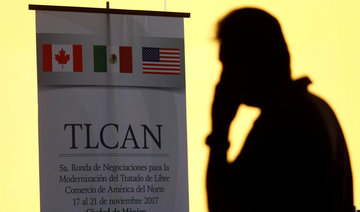
NEW YORK/MEXICO: Canadian Prime Minister Justin Trudeau on Thursday said he felt “positive” about talks to rework the NAFTA trade pact, while a top Mexican official held out hope a deal could be hammered out by the end of May.
US officials say the negotiations need to wrap up very soon to give the current Congress time to vote on a final text for a revamped North American Free Trade Agreement.
“To be honest, we are down to a point where there is a good deal on the table,” Trudeau told the Economic Club of New York, saying top Canadian officials were in Washington for talks on how to advance the negotiations.
“It’s right down to the last conversations ... I’m feeling positive about this, but it won’t be done until it’s done.”
Canadian Foreign Minister Chrystia Freeland was due to travel to the US capital later on Thursday for internal meetings and talks with key stakeholders, said a spokesman.
A Mexican technical negotiating team is in Washington but there is no date set for the next NAFTA ministerial meeting with the United States and Canada.
Mexico’s Economy Minister Ildefonso Guajardo said a deal could be reached by the end of May, but added that if no agreement is reached the talks could extend beyond the July 1 Mexican presidential election.
For that to happen, though, the United States and Mexico would have to end what officials say is deadlock over US demands to raise wages in the auto sector and boost the North American content of cars made in the three NAFTA nations.
Critics complain the move is a clear swipe at Mexico, which US President Donald Trump says added low-wage manufacturing jobs at American expense after NAFTA was signed in 1994.
“Any renegotiated NAFTA that implies losses of existing Mexican jobs is unacceptable,” Guajardo said in a tweet.
Under the Trade Promotion Authority statute that would allow a simple yes or no vote on NAFTA, Trump must notify Congress 90 days before he can sign the agreement. The US International Trade Commission then has up to 105 days after the signing to produce a study on the effects of the agreement.
US House Speaker Paul Ryan had said that the Republican-controlled Congress would need to be notified of a new deal by Thursday to give lawmakers a chance to approve it before a newly elected Congress takes over in January.
Ryan, asked on Thursday whether there was any wiggle room in the NAFTA approval timeline for Congress, said “the wiggle room would be at the ITC.”
He added: “My guess is there is probably some wiggle room at the ITC for what it takes for their part of the process but not an indefinite amount and that means time is really of the essence.”


Multilateralism strained, but global cooperation adapting: WEF report

Updated 10 January 2026
Follow

Multilateralism strained, but global cooperation adapting: WEF report

DUBAI: Overall levels of international cooperation have held steady in recent years, with smaller and more innovative partnerships emerging, often at regional and cross-regional levels, according to a World Economic Forum report.

The third edition of the Global Cooperation Barometer was launched on Thursday, ahead of the WEF’s annual meeting in Davos from Jan. 19 to 23.

“The takeaway of the Global Cooperation Barometer is that while multilateralism is under real strain, cooperation is not ending, it is adapting,” Ariel Kastner, head of geopolitical agenda and communications at WEF, told Arab News.

Developed alongside McKinsey & Company, the report uses 41 metrics to track global cooperation in five areas: Trade and capital; innovation and technology; climate and natural capital; health and wellness; and peace and security.

The pace of cooperation differs across sectors, with peace and security seeing the largest decline. Cooperation weakened across every tracked metric as conflicts intensified, military spending rose and multilateral mechanisms struggled to contain crises.

By contrast, climate and nature, alongside innovation and technology, recorded the strongest increases.

Rising finance flows and global supply chains supported record deployment of clean technologies, even as progress remained insufficient to meet global targets.

Despite tighter controls, cross-border data flows, IT services and digital connectivity continued to expand, underscoring the resilience of technology cooperation amid increasing restrictions.

The report found that collaboration in critical technologies is increasingly being channeled through smaller, aligned groupings rather than broad multilateral frameworks.  

This reflects a broader shift, Kastner said, highlighting the trend toward “pragmatic forms of collaboration — at the regional level or among smaller groups of countries — that advance both shared priorities and national interests.”

“In the Gulf, for example, partnerships and investments with Asia, Europe and Africa in areas such as energy, technology and infrastructure, illustrate how focused collaboration can deliver results despite broader, global headwinds,” he said.

Meanwhile, health and wellness and trade and capital remained flat.

Health outcomes have so far held up following the pandemic, but sharp declines in development assistance are placing growing strain on lower- and middle-income countries.

In trade, cooperation remained above pre-pandemic levels, with goods volumes continuing to grow, albeit at a slower pace than the global economy, while services and selected capital flows showed stronger momentum.

The report also highlights the growing role of smaller, trade-dependent economies in sustaining global cooperation through initiatives such as the Future of Investment and Trade Partnership, launched in September 2025 by the UAE, New Zealand, Singapore and Switzerland.

Looking ahead, maintaining open channels of communication will be critical, Kastner said.

“Crucially, the building block of cooperation in today’s more uncertain era is dialogue — parties can only identify areas of common ground by speaking with one another.”