“No fireworks” at NAFTA talks, but few signs of progress

Time is running short to seal a new deal to update the North American Free Trade Agreement by the deadline of end-March 2018. (Reuters)
Updated 19 November 2017
Follow

“No fireworks” at NAFTA talks, but few signs of progress

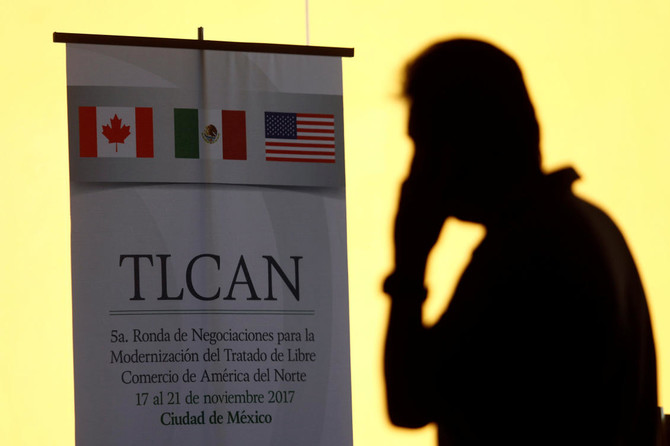
MEXICO CITY: Negotiations in Mexico to update NAFTA have not made much progress on tough US demands that could sink the 1994 trade pact, but the current round of talks are progressing with civility, some participants said on Saturday.
Officials from the US, Canada and Mexico are meeting in Mexico City for the fifth of seven planned rounds to update the North American Free Trade Agreement, from which US President Donald Trump has threatened to withdraw.
Time is running short to seal a deal by the deadline of end-March 2018. Officials say next year’s Mexican presidential election means talks after that date will not be possible.
The US administration has made demands that the other members say are unacceptable, such as a five-year “sunset” clause and tightening so-called rules of origin to boost the North American content of autos.
“It is very slow moving but there are no fireworks,” said a Canadian source with knowledge of the talks, adding there had “not been much conversation at all” on the more contentious US proposals.
Within hours of the latest round of talks formally starting on Friday, Canada was complaining about inflexibility by the US.
Officials have so far discussed other issues such as labor, gender, intellectual property, energy and telecommunications but it is too soon to say whether there will be any breakthroughs this round, added a source familiar with the talks.
“The work is moving forward,” Mexican deputy economy minister Juan Carlos Baker told reporters, adding that the three countries had prioritized technical work in Mexico City.
But he said negotiators were aware that much work lay ahead and “we have to double our efforts.”
“The atmosphere is good, the atmosphere is one of work,” Baker added.
The mood was calmer than the tense scenes during last month’s round in Arlington, Virginia, where tough US demands were revealed. Still, the negotiations have passed the halfway point of an initial schedule with few clear signs of process.
Mexican officials hope chapters on telecommunications and e-commerce will be concluded by the end of business on Tuesday, but there has been no indication of this yet.
Although negotiators are scheduled to discuss rules of origin every day, the source said detailed talks on boosting North American content would not be held before the end of the round on Tuesday.
Canada and Mexico say the new rules of origin are unworkable and would damage the highly-integrated auto industry.
“I hope the US understands there are things ... that Mexico won’t accept, and (I hope) the negotiating process becomes more rational,” Moises Kalach, head of the international negotiating arm of Mexico’s CCE business lobby, told Reuters.
On Friday, the US Trade Representative’s office revised its official objectives to conform to its current demands.
The move prompted US Senator Ron Wyden, the top Democrat on the Senate Finance Committee, to remove a “hold” he had put in place to block confirmation of two Trump administration nominees for deputy USTR positions, a Wyden aide said.
Wyden had complained the trade office was keeping members of Congress “in the dark.”


GCC growth set to accelerate to 4.4% in 2026 on non-oil strength: World Bank 

Updated 6 sec ago
Follow

GCC growth set to accelerate to 4.4% in 2026 on non-oil strength: World Bank 

RIYADH: Economies across the Gulf Cooperation Council are forecast to grow 4.4 percent in 2026, accelerating to 4.6 percent in 2027, driven by rising non-oil activity in countries including Saudi Arabia, according to an analysis. 

In its Global Economic Prospects report, the World Bank said the Kingdom’s real gross domestic product is projected to grow 4.3 percent in 2026 and 4.4 percent in 2027, up from an expected 3.8 percent in 2025. 

Earlier this month, a separate analysis by Standard Chartered echoed similar expectations, forecasting the Kingdom’s GDP to expand by 4.5 percent in 2026, outperforming the projected global growth average of 3.4 percent, supported by momentum in both hydrocarbon and non-oil sectors. 

The World Bank’s latest forecast broadly aligns with the International Monetary Fund’s October outlook, which projects Saudi Arabia’s GDP to grow by about 4 percent in both 2025 and 2026. 

In its latest report, the World Bank said: “Growth in GCC countries is forecast to increase to 4.4 percent in 2026 and 4.6 percent in 2027, mainly reflecting a steady expansion of non-hydrocarbon activity, in addition to a further rise in hydrocarbon production.” 

It added: “The strengthening of non-hydrocarbon activity — accounting for more than 60 percent of GCC countries’ total GDP — is projected to be supported by expected large-scale investments, including in Kuwait and Saudi Arabia.” 

Expanding the non-oil sector remains a core objective of Saudi Arabia’s Vision 2030 agenda, as the Kingdom continues efforts to reduce its long-standing reliance on crude revenues. 

Highlighting the strength of Saudi Arabia’s non-oil momentum, S&P Global said the Kingdom recorded the highest purchasing managers’ index reading in the region in December, at 57.4, supported by rising new orders, continued growth in non-energy business activity, and expanding employment.

At the country level, the UAE’s economy is projected to grow by 5 percent in 2026, before accelerating to 5.1 percent in 2027. 

Oman’s GDP is forecast to expand by 3.6 percent in 2026 and 4 percent in 2027, while Qatar is expected to record growth of 5.3 percent next year, rising sharply to 6.8 percent in 2027. 

In Kuwait and Bahrain, GDP growth is projected at 2.6 percent and 3.5 percent, respectively, in 2026. 

Across the broader Middle East, North Africa, Afghanistan and Pakistan region, growth is estimated to have reached 3.1 percent in 2025 and is projected to strengthen further to 3.6 percent in 2026 and 3.9 percent in 2027, largely driven by improving performance among oil-exporting economies. 

Potential growth challenges 

The World Bank also outlined several downside risks that could weigh on economic growth across the region. 

These include a re-escalation of armed conflicts, heightened violence or social unrest, which could disrupt economic activity and weaken confidence. 

Other risks include tighter global financial conditions, further increases in trade restrictions and tensions, greater uncertainty over global trade policies, and more frequent or severe natural disasters. 

For oil exporters, lower-than-expected oil prices or heightened price volatility could also dampen growth. 

“A re-escalation of armed conflicts in the region could cause a significant deterioration in consumer and business sentiment, not only in the economies directly affected but also in neighboring economies,” the World Bank said.  

It added: “It could spill over into a broader increase in policy uncertainty and a tightening of financial conditions, dampening investment and economic activity.” 

Global outlook 

The World Bank said the global economy has proved more resilient than expected despite last year’s escalation in trade tensions and policy uncertainty. 

Global economic growth is projected at 2.6 percent in 2026, easing from an estimated 2.7 percent in 2025. 

“The modest slowdown comes on the heels of a post-pandemic rebound over 2021–25 that represented the strongest recovery from a global recession in more than six decades,” the World Bank said, adding that the rebound was uneven and came at the cost of higher inflation and rising debt. 

Among advanced economies, US GDP is projected to grow by 1.6 percent in both 2026 and 2027. 

China’s economy is expected to expand by 4.4 percent in 2026 before slowing to 4.2 percent in 2027, while India’s GDP is forecast to grow by 6.5 percent and 6.6 percent over the same period.